Showing posts with label swinging flies. Show all posts

May 13, 2026

SteelheadBum.com Is Back

A redesigned SteelheadBum.com from Gorge Fly Shop, rebuilt with curated gear, practical resources, and a stronger, easier ecommerce experience for steelhead anglers.


We’ve been working on something behind the scenes for a while, and we’re excited to finally share it.

Steelhead fishing has always been a big part of who we are at Gorge Fly Shop. The rods, reels, lines, flies, river seasons, and small details that come with chasing these fish have always deserved their own space.

That’s why we rebuilt SteelheadBum.com with a sharper focus on the swing and the gear systems behind it.

The updated site is geared around how steelhead anglers actually fish—from fly rods and reels to lines, flies, sink tips, and setup resources.

Whether you’re new to two-hand casting, working through a winter sink-tip setup, or looking for proven flies for summer water, the goal is simple: make the process easier and help you spend more time fishing.


Why We Built It

Steelhead setups can get complex fast. Every part of the system needs to work together, from the way a rod loads to how the line, tip, leader, and fly move through the run. When one piece is off, the whole setup can feel harder than it should.

SteelheadBum.com was rebuilt to simplify that.

Built Around the Swing

At the center of the site is swung-fly steelhead fishing built around Spey casting and gear.

That means thinking about presentation, speed, depth, angle, fly choice, and line control. It means choosing a setup that helps you fish the run in front of you—not just selecting gear from a spec sheet.

You’ll find sections for Skagit systems, Scandi lines, running lines, tips, dry line flies, sink-tip flies, intruders, leeches, traditional patterns, and more. As the site grows, we’ll continue adding guides and articles that connect gear choices to real days on the river—not just from us, but from the guides, friends, and industry partners we work with who are spending time on the water too.


More Than a Place to Shop

Think of SteelheadBum.com as another tool in your kit: a place to check before your next trip, your next setup, or your next fly box refill.

Along with gear collections, you’ll find staff picks, featured flies, sale and closeout items, seasonal notes, fly selection help, and practical setup information. Some of it is product-focused, and some of it is simply there to help make sense of a fishery that rewards patience, timing, and the right setup.


Powered by Gorge Fly Shop

SteelheadBum.com is owned and operated by Gorge Fly Shop, Inc.. The site has been around for over a decade, but it has now been rebuilt with a new ecommerce experience and the same knowledgeable team behind it.

You can expect the same service, product knowledge, and care that Gorge Fly Shop has provided anglers since 1992. This rebuilt site simply gives steelhead fishing its own dedicated space.


Take a Look

We’ll keep building from here with more gear, articles, seasonal recommendations, and shop insight for steelhead anglers.

Visit SteelheadBum.com, take a look around, and check back often as we continue building it out.


541.386.6977

— For the Steelhead Pursuit —

"Fly Fish the World with Us"

Nov 21, 2024

Columbia Gorge Fishing Report - 11/21/24

Deschutes Steelhead

Well, it's been a good one!  The weather has sure been a bonus this time around.  The Deschutes did not experience the dramatic and rapid drop in water temps that we'd seen in the last few years.  The lower river has been hovering somewhere around 48 degrees as of late.  That's a pretty good number in late November, but it's bound to change in the relatively near future.  If you're looking to get a last trip in, go sooner than later.

The bite has been pretty consistent when the conditions have been stable.  It's pretty much a sink tip program at this time of year.  Whether you get a hairwing down with a sinking leader or go to the Skagit and tip, you'll want to get the fly down a bit.  This doesn't have to mean full-on dredging....just get it down a little.  Could you still catch one on a floating line? Sure!  This is especially true on warmer afternoons.  Your best shot with this approach will be in shallower runs where fish don't have to move up quite so far to grab your bug.  Either way, there is something really special about catching your last Deschutes fish of the season....or at least trying to.  Best of luck to those who give it one more try!


Deschutes Trout

Trout anglers have been pretty happy out there lately.  Similar to the steelhead, the trout don't love when the water is on the rise, but the fish has been solid with stable conditions.  The current weather patterns just scream B.W.O.'s!  They should be around mid-day most of the time for the foreseeable future.  A two fly nymph rig with an olive nymph dropper will be a great way to prospect.  Be ready to see emerging bugs sometime between noon and 2:00.  

Beyond the bugs, this is a great time to grab your trout spey or single hand streamer rig.  This window between fall and winter can provide some of the best streamer fishing of the year.  When it's on, it's a silly amount of fun and often produces some sizable fish. Standard leeches and sculpins will work well.  Don't be afraid to go big, either.  Larger streamers definitely have their days.....especially with the biggest fish in the run. 


https://www.gorgeflyshop.com/store/pc/Sale-Closeouts-c38.htm

"The Gorge"

Gorge Fly Shop Team - 541.386.6977


"Fly Fish the World with Us"

Oct 18, 2024

Columbia Gorge Fishing Reports - October 18, 2024

Deschutes Steelhead

It's been a great season on the Deschutes.  Consistent fishing started early and remains strong.  The later portion of the season should prove to be good for those willing to deal with colder weather.  It looks like fall has officially made its showing in the Gorge, so be prepared for some crisp mornings.

The bite as of late has been all over the map, particularly on the lowest portion of the river.  Fish are certainly being caught but you definitely need to put some time in...or just get really lucky!  The return of Fall Chinook notably messes with the steelhead fishing for a bit in late September and the first couple weeks of October.  Fortunately, the salmon should be nearing the end of their life cycle soon and the steelhead fishing will improve.

One thing to keep your eye on is the water temps.  With much colder nights in the forecast, the water temperature is starting to slide.  The fish don't love when the temp is dropping on a daily basis, but they get happy again when it stabilizes for a few days.  Getting your fly down a little bit in colder water can dramatically increase your odds.  That doesn't mean that you have to dredge, but switching from a floating polyleader to a slow sink can be a game changer.  

Deschutes Trout

Fall is such a wonderful time to trout fish the Deschutes.  The cooler water just makes the fishing a lot better.  The trout know that winter is just around the corner and they try to pack on some weight before the water temps start to slow them down.  Expect to see a smattering of caddis and BWOs in the afternoons.  Nymph and streamer fishing will be great.  Though it may be blasphemous to some, have a handful of egg patterns in your arsenal, too.  Indicator fishing with an egg trailing a heavy nymph is a homerun with all the salmon present.  Like it or not, trout love eggs!

Local Lakes


We are nearing the end of stillwater season here on Mount Hood.  Please check the regulations as many of the lakes in the Central Region close at the end of the month.  If you have the opportunity to give it a try, focus your efforts on the later half of the day and expect the bite to fade as soon as the sun is off the water.  It's been getting pretty cold up at elevation and the snow level is getting lower and lower.  The warmest part of the day will present the most opportunities.

Hatches are noticeably on the decline, but there will still be some chironomids buzzing around in the afternoon.  Indicator fishing with a balanced leech and chironomid dropper will be a great bet.  Be prepared to slim down your tippet at this time of year.  As the water cools, much of the suspended algae dies.  The water can be gin clear and switching from 4x fluoro to 5x and 6x tippet will make a huge difference.

For those looking to extend their stillwater season, we've just received some glowing reports from the Justesen Ranch!  It gets rather hot out in Grass Valley, but that time has come and gone.  Water temps are ideal and the fishing has been fast and furious.  These private lakes will stay open until the weather gets really bad.  If you haven't been to this ranch, put it on the menu.  The scenery is spectacular and your party will have a private lake all to yourself for the day.  It is well worth the drive and the rod fee!


https://www.gorgeflyshop.com/store/pc/Sale-Closeouts-c38.htm

"The Gorge"

Gorge Fly Shop Team - 541.386.6977


"Fly Fish the World with Us"

Mar 7, 2024

WHEN ALL LINES UP...AND YOU COME TIGHT!

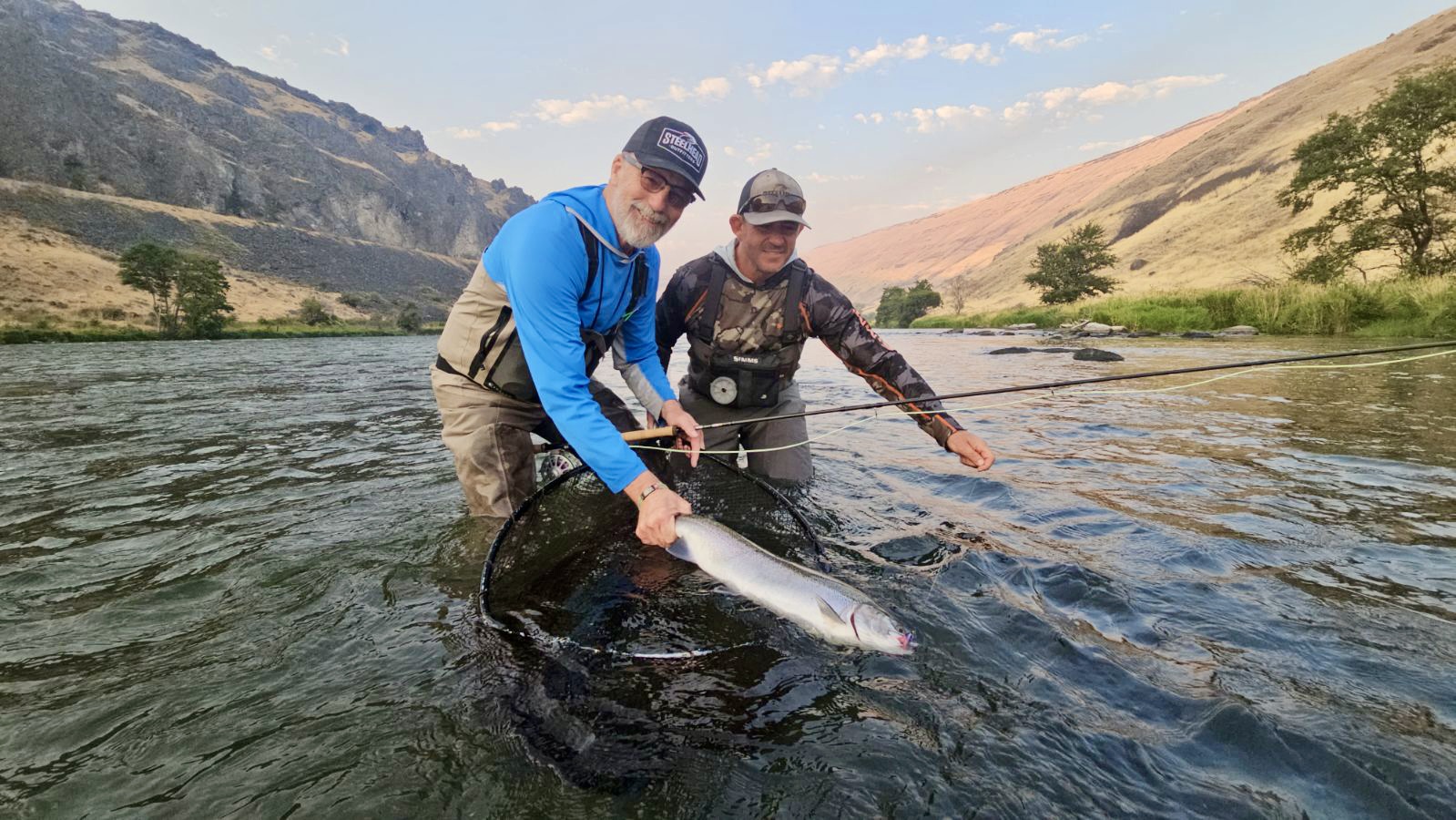
Admiring a beautiful summer run steelhead before watching her swim away.

Recently, I was lucky enough to fish with my good friend and guide buddy, Sam Sickles chasing our favorite fish, utilizing our favorite method...swinging for somewhat aggressive winter steelhead that are willing to chase a swung fly.  We've caught our fair share of steelhead using other methods, but swinging flies is definitly our favorite way.

We met early morning for the considerable drive to our launch destination.  We wanted to be on the water just before daylight to take full advantage of the day.  Drive time chats consisted of almost everything steelhead and how the river was in near perfect condition.  He had already had some success in prior days and needless to say, I was pretty stoked for the day.  I've ALWAY'S had a great time fishing with Sam, regardless of whether or not fish are caught.  Never any pressure to perform on his end or mine.  Just two buds out for a day of fishing.

I get a kick out of Sam because in every run I've ever fished with him, before we even step in the water he's bringing the confidence level up by saying..."this is my favorite run on the whole river. we oughtta get one here."  I like that.  I mean, might as well be confident in what you're doing and where your fishing.  Confidence is part of the game, a big part.  What I think is funny about it is that he literally says it in every run, no joke.  When he says that, In my mind I think..."what's my favorite run?" and the responce to myself is the one I am currently fishing in.

My intention for this post is to talk about the "Come Tight" part of it all.  Undoubtably you've heard the saying..."the TUG is the Drug" and even though this saying has been around for a long time, It's still the pinnacle of the process. It's that moment we dream of and can't wait for.  We endure hours, sometimes days waiting for the eat and sometimes we question our own sanity, especially in the winter.  At times, it can take extreme patience between grabs.  Getting caught up in the rhythm of it all, we make a sweet cast, set the fly up for the swing and then start talking to ourselves..."man I should just get crushed right now!"

I've tried to explain it to my wife, my kids, anyone who will listen many times, that catching a steelhead is always nice, but when I step into a juicy run, my adrenalin is already in full swing.  The anticipation.  My heart is pounding, the excitement of the possiblity of hooking and landing a steelhead is so strong in me, that I've told friends that I need to catch a fish to calm down.  In comparison to some fisheries where the adrenaline rush comes after the hook set...with swinging flies for steelhead, the rush starts the second I look at a run and step in.  

I'm sure we can agree, when it comes to hunting steelhead, it can consume you if not careful.  Everything becomes all about steelhead, your thoughts, your conversations and you life style reflect a die hard steelheader.  This applies to fly fisherman and gear fisherman alike.  At this point in my life there are only two fish that I've pursued so far that have kept me awake at night in anticpation, and those are Steelhead and Tarpon.  If you're like me, you go over your equipment like a surgeon, you make list to make sure you don't forget anything and the days leading up to your trip are filled with prepartion for the day.  You are checking the weather forcast, the river level forcast on and on...

This!...this is the reason you endure the elements of time, weather and patience!
Look at that thing!  I mean, stunning! Sam did everything right after the eat!

Let's talk about the "come tight" for a bit.  When I guided, most folks would ask what do I do after they eat the fly?  That was one of the major questions often asked and rightfully so.  It's an important issue, and inquiring minds wanted to know.  Especially those first time customers or those that just didn't do it very often and hadn't become seasoned by experience.  Funny thing about answering the question is that no matter how articulated and consice I was in explaining the answer, almost everyone would absolutely forget everything we talked about when the eat actually happend.  I've seen folks freeze on the eat, dazed and confused to what just happened, to folks that set the hook so hard that if they did stick the fish it most likely would have broken it's neck or died of shock.

There's a fair amount of debate out there on whether or not to carry a loop, to set the hook or not to set the hook.  I personally don't carry a loop and I personally set the hook.  I personally LOVE to set the hook!  When I say "set the hook" it's really not what you think.  My setting the hook is more like a steady long sweep with my rod tip low and towards the bank.  It's not a break neck type of hook set, but again it's a firm side sweep with steady pressure once the fish has turned and taking out line.  I think of it as something like tug of war.  When the fish has turned and taking line, I simply sweep to the bank side and pull on the tight line to help "seat the hook" in the corner of the jaw (see photo below).  This has proven to be very, very effective for me over the years.  That doesn't mean its 100% foolproof and I never miss or lose a fish, because I do.  But I'll tell you that, for me, it's pretty rare that I miss or lose very many fish in a season.

Others swear by carrying a loop, that it improves their odds drastically, and it may.  I just haven't personally experienced that it does.  Folks that carry loops, lose or miss fish too.  If you haven't made a choice try both and see which you prefer.  I truly love using a click & pawl type reel, such as the Hardy Marquis Salmon series reels or the Hardy Widespool Perfects.  This allows the fish to easily turn and take line from the reel before I set the hook. 
Which is why some carry a loop, in that when the fish turns and takes the loop out, you can then come tight on the fish and the odds of successfully landing the fish are increased.  Even when I'm using a non-click & pawl type reel, such as a Tibor Signature Series, Galvan Torque or Sage Spey reel, I'll set the drag loose enough, that when a fish eats and turns with the fly, it can take line without causing a backlash. When he takes enough line out that I can't stand it any longer, I'll set the brakes on him by putting my hand on the reel before coming tight on em.  Hope that all makes sence.

Summer Steelhead with a 'come back" fly, the Kalamath Intruder!

Side Note: In the photo above, this steelhead had originally tried to eat a Jerry French Black and Blue "Dirty Hoh" (photo below on the left) during the swing, he grabbed it 3 times but just wouldn't commit.  Thought I'd try another cast and he wouldn't touch it. So, I tied on the much smaller "Kalamath Intruder" in the same Black and Blue color (because that's what it originally went after) and the very first swing, nearly got the rod ripped from my hands with an explosive, amazing eat!  Look closely and you'll notice that the hook on the Kalamath Intruder is ever so slightly bent out.  Not always will they comeback to a fly, but boy I sure love it when they do!

Going smaller with similar color is never a bad idea for a come back fly!


Parting Shot:

Next time, you're lucky and come tight and bring that fish to hand, take a moment to look at it, really look at it, admire it, look at the beauty of her markings and the journey you both took to have this moment together bankside.  Then let her go, and look forward to the next.

So, where am I going with all this?  I don't really know. Maybe it's self encouragement to help endure the elements until I come tight again.  Maybe it's in hopes of encouraging others to do the same.  Maybe it's me reminising all the hours and sometimes days between fish that I slow down a bit more and discover something new on the river that I hadn't seen before.  Maybe I'm realizing that it's not all about the numbers of fish I catch but the expeirence of each one that I do.  There's something about a fish that makes you loose sleep over it, that brings your heart rate up like a work out, when you finally get that eat, something about them that makes you spend major time, money and effort in pursuing them.

I guess my point might be..."that it ALL matters."  Everything done from start, to the point of releasing the prize matters.  It keeps you connected to the sport and what you love doing.  So, the next time you're lucky enough to come tight, try your best to be calm, cool and collected.  Understand that it's a game.  You win some, you lose some, but it's fun to play.  You'll find what works best for you and you'll become efficient at it and when you do, the "odds will forever be in your favor."

Book a Trip w/Sam:
Sam Sickles | Steelhead Outfitters
Ph:  541-400-0855


Thank you for spending your time reading this, I hope you enjoyed it.

GFS Team
John G.

https://www.gorgeflyshop.com/store/pc/Sale-Closeouts-c38.htm

"The Gorge"

Gorge Fly Shop Team - 541.386.6977


"Fly Fish the World with Us"

Mar 9, 2017

Sage ONE Trout Spey 2109-4 Review

Winter Bow
The highly anticipated player in my multi year trout spey obsession is now in hand! The acclaimed Sage ONE Trout Spey 2109-4. I've been dreaming of the tug on a tight line swing with this pint size trout spey for longer than this rod has even existed. The anticipation is maddening!


Sage One 2109-4

Light, balanced, smooth, without hesitation the power exhibited from the 2109 would go unnoticed if it weren't for your fly landing on the other side of the river. Effortless is an understatement!

It's closing in on 4 years since I've landed my first two hand trout. In that time I have fished some amazing water with some great rods. Those rods have helped me learn and refine my casts and tactics in the pursuit of trout on the swing, especially winter trout.

I've always felt a yearning to downsize my gear. The fives, fours and three weights in progression have always led me to seeking smaller, lighter sticks. I have even spent a considerable amount of time throwing one hand spey on single hand rods and that experience has further increased my desire for less.
A peek at my one hand spey game
I've noticed in many two hand trout conversations that it's generally assumed the smaller trout speys cannot do as much as their big brethren. Proceed with caution in these conversations. Many factors play a part in this discussion including fly size, river size, line weights and wind. In thinking about a trout spey rod consider them to be just longer than average fly rods but with a ton of serious power hiding down deep in the butt section. To be a spey rod and trouty at the same time the rod must have reasonably limber deep loading tip sections for light tippet fish-ability but still harness power to move skagit, sink tip and fly. Trout spey rods, just like fly rods, as conditions increase in difficulty be it such as wind or fly size so does the nature of casting difficulty increase.

My point to all this chatter is to express the idea not to assume the little 2109 is incapable of skagit head, sink tip and weighted flies. This stick possesses a serious amount of trout soul while still having a strong backbone. While not the rod I reach for in the most demanding conditions it has become the rod I grab in all but the toughest conditions.

My experience with trout spey is we are just now realizing the full potential of abilities with the smaller rod offerings. New lines today from RIO, OPST and Airflo have been key in helping us to extract the deeper potential in these small rods. I have witnessed a combined effort of trout speys and short skagits that has taken us to where we have arrived today. Without these ultra short skagits I believe we'd still be unclear in the validity of such small spey rod offerings.

2109 - Not a wimpy noodle!

I gave 2109 a RIO Skagit Trout Max in 225gr and looped on 10' of T-8 and one of my cone head tube flies and went to work! Snap T, swing into the D-loop and gave a pull on the lower hand and away it went as if it was in autopilot. It felt right from the first cast!

Shown with the New RIO Powerflex Max .024"
What's that hiding in the background!

For this rig I chose a Sage 4650 fly reel. I loaded it with 100yds of gel spun backing, spooled on a RIO Gripshooter line in 25# and looped that to the Skagit Max Trout 225gr head. The 4650 five weight reel had plenty of room for the trout size spey lines and with it's lightweight feel, precision sealed disc drag and a audible clicker is a great compliment to the overall trout spey outfit.

RIO Skagit Max Trout Head measuring at eleven foot is the shortest of any skagits I know. When I first tested these heads I had some trouble holding anchor points. I found them more useful on single hand rods for one handed spey cast. Figuring the short length of 2109 I felt that I should give the little skagit a try. I am a bit surprised at how well a 225gr matched up. I really like the shortness of these heads because they allow you to strip in closer. Yes, I swing flies but I also do a lot of swing/strip and many days that's the method the fish want.

Line It Up

I tested OPST Commando Heads in 225gr and the new Airflo Skagit Scout in 210gr. Both heads performed very well. I feel the 2109 just has a great progressive load that allows it to work well over a wide range of skagits. I see on the internet some guys really like this rod all the way down to OPST Commando 175gr. I haven't tried that yet but no reason why I won't in the future. Point is this rod is not picky so choose your preference but a great starting point would be the OPST 225gr.

Soon I will be testing some scandi's on 2109 as well as 3110. As of writing this I am in winter mode and that means staying active, swinging streamers and hunting for aggressive trout. The anticipation is what keeps me warm on cold winter days.

Some will question my sanity claiming I have found the ultimate Trout Spey and it happens to be this little guy 2109. Truth is the entire Sage ONE Trout Series is incredible and if your water calls for bigger, more powerful and longer sticks then by all means step up. The 3110 sibling is super sweet a very capable player of all things trout. The 4116 feels a tad faster and while it handles a skagit with authority it is also "and" still my personal favorite scandi stick for bug sipping season.

If trout are in your perimeter reach and you haven't pick up a two hand trout spey yet then all I got to ask is "Why Not?" The gear is so good, we have all the lines we need, and the TUG CAN"T BE BEAT!


BassProGreg
Leave a Message


Gorge Fly Shop Internet Sales Manager | Product Specialist


"Fly Fish the World with Us"


Jun 27, 2016

There goes Tokyo - Go Go Sculpzilla

Hard to find a leach pattern fly better than Sculpzilla. The #8 Size is a staple for stripping or swinging flies to trout with two hand rods. I like the Olive color but all of them can be producers. Fish it on a floating line and leader for slow water and shallow water or swing it on a sink tip to get it down in fast currents and tail-outs. Also great for streamer stripping from a boat. 


I believe what makes this little leach so effective is it really gets down. It's not too over-weighted but the slim size seems to help it sink and it will get heavier as the rabbit zonker gets wet. I tie most of my own flies I use today but I still have a selection of Sculpzilla's with me at all times and sometimes he's just the ticket to get a strike when nothing else seems to work. If you're a streamer junkie like I am then put a selection of these in your fly box. When the day comes you will be rewarded!


BassProGreg


Gorge Fly Shop Internet Sales Manager | Product Specialist


"Fly Fish the World with Us"

Aug 20, 2015

Trout Spey Lines: DEFINED by George Cook

Blazing New Trails On A Stream Near You

Trout Spey Lines : DEFINED….Conundrum SOLVED

Trout Spey….Micro Spey…”Small Ball” has indeed arrived! The Spey Angling enthusiast of today has limitless opportunity, be it Trout, Sea Run Cutthroat, Smallmouth Bass, even the various Shad species of both coast. Trout Spey tackle which spans from the 4 and 5 weight Switch Rod Theater down thru the 2 and 3 weight true Trout Spey rods set the stage for some mighty interesting angling adventures. In these pursuits like its bigger cousin Spey Rods, lines are aplenty and with it, a given (expected) level of confusion as to just what is “best”. The line “Conundrum” is our subject today , so take 5 and unspool the mystery as we DEFINE today’s Trout Spey Lines, their selection and use. 

Skagit Max Short

Skagit Lines: several choices here and completely dependent on just what the angler’s methodology “Objective” is. On one hand, the “Swinging Streamer” enthusiast will find himself at home with RIO’s Skagit Max Short Head. Here, the 200/225 and 250 Grain Heads sit at a very manageable 17’, while the 275 Grain Head comes in at 20’. Matched up with RIO’s “Light” MOW Family Tips makes for a great SWINGING set up. An Example here would be the 225 Grain 17’ Skagit Max Short teamed up on SAGE’s NEW 2109-4 ONE Trout Spey. The NEW 3110-4 SAGE ONE Trout
Spey is killer with the 275 Skagit Max Short , a combo I recently worked Ol’ Bow Bow out with on Alaska’s Middle Kenai River. Again, it is vital to note that the Skagit Max Short will BEST SERVE the Angler looking to ply his game via the SWUNG FLY with small to moderate sized streamers .
MOW Light and even MOW Medium tips can and will apply in this “Swinging” theater. I might also note that with the Skagit Max Short the “Transition” from normal Spey rod sizes (12 ½ to 14’) to Trout Spey lengths (10’6 to 12’) is less radical in terms of casting stroke format.

Trout Max Short
Skagit Trout Max: A NEW and very Specialized Skagit style head sets the stage for the Trout and Smallmouth Angler throughout the country who has set his sights on a STRIPPED STREAMER Approach. Most Lower 48 along with Chilean and Argentine Trout (Both Bow Bow and Brown Town) are largely caught by way of a STRIPPED Streamer Method (VS Say Alaska Rainbows, Dollies and Northwest Sea Run Cuts taken on the Swing). The Skagit Trout Max head employs a very fishy 11’ Head that maximizes one’s ability to really format a Stripping Streamer methodology. Here it can be expected that one shall cast either ¼ Upstream to 90 degrees (straight out) in order to gain a quick drop followed by the classic stripping motion made famous by the legendary Joe Brooks in the 1950’s. By formatting a short 11’ head the Skagit Trout Max ensures maximum “Strip Time-Length” before your attached head to running line gently “Clicks” into your guides queuing one to fire off another one to continue the hunt ! Again, the MOW Light Series as well as the Medium MOW members will employ nicely here. I would be remiss not to mention here that while the whole of Trout/Micro Spey involves a very conscious effort on the part of the caster to “Scale Down” both his overall stroke size and speed of operation (Get SMALL as I call it) the mere 11’ of the Skagit Trout Max dictates a further reduction here, get small, stay compact and ever so smoothly execute the Spey stroke, no big moves, no hurky, no jerky !
Scandi Short Heads

Scandi Short Heads: The elegant casting choice has Trout Spey in mind with Short Scandi heads from 180 (28’), 210 (28’) and 240 (29’) grains that play super well. Working with short RIO Versi- Leaders, all types Floating thru 7.0 ips (ips=Inches per second related sink rates ) in 6’ & 10’ styles or even a 9’-12’ RIO Trout Leader straight off the looped head these classic Scandi style
heads work beautifully with Soft Hackle and other related patterns. Un-weighted streamers , classics like the Light and Dark Spruce, Muddler Minnow, Black Dace along with a host of Northwest Sea Run Cutthroat Flies will fly fast and with ease utilizing these Scandi Short style heads. As with their bigger Spey Rod cousins the Scandi game always plays at a lower Grain Weight then the Skagit Weight for the given (Same) rod. An example here would be the New SAGE Trout Spey 2109-4 ONE, while the Skagit Max SHORT (Or Skagit Trout Max) choice sets up at 225 Grains the Scandi Short selection will roll in at 180 Grains.
RIO Switch Chucker

RIO Switch Chucker Lines: The vaunted Switch Chucker has a definite home in the Trout/Micro
Spey Theater ! Now available in a NEW size #2 and #3 Chucker’s these 25’ heads make Spey Casting Transition relatively easy coming down into Trout Spey/Micro Spey Rod sizes and overall expected angling methods. Versatile enough to cover the whole gamut of Trout Spey be it Soft Hackle Swinging (get crafty and use a 10’ Floating Versi leader here!), stripping streamers or swinging meatier choices for bigger grabs the Switch Chucker will prove a most versatile choice. Indicator game will have its day in court here as well. Can be utilized with MOW Light and even
Medium MOW selections as well as a host of Versi leaders in 6’ and 10’ feet. The Chucker should be dead on line size targeted, meaning put a 2 Weight on a 2 Rod, 3 on the 3 so on and so forth. To be sure, the RIO Switch Chucker is a great all around choice here.
InTouch Single Handed Spey

NEW RIO InTouch Single Handed Spey Line: Awe…this one falls into the “Didn’t know such could work but turns out to be a fabulous choice” category. While mega good on the single hand intended usage (Both Spey and shockingly good overhead) the NEW RIO Single Handed Spey Line is a “Sleeper Choice” on Trout/Micro Spey Rods. Based on a 34’ Taper the Single Hand Spey Line on a “3 Bump Rule” works simply wonderful on these small ball Spey rods. 3 Bump Rule will show that in order to hit an “Applicable” grain window one shall select this line 3 line sizes HIGHER than the given rod line size. EXAMPLES: again the NEW SAGE 2109-4 ONE Trout Spey is a 2 weight rod, simply bump 3 sizes up (hence the WF-5-F Single Handed Spey Line) and batta bing, batta boom you have a simply KILLER match up. Just so happens that WF-5-F weighs out at around 227 grains hitting the 2 Weight Spey Grain window perfectly giving it both max propulsion along with an fully integrated fly line to boot. 9’-12’ RIO Trout Leaders will fine tune this choice into a Trout Spey machine !

So as you can see RIO has you covered on your Trout Spey Game no matter what your needs are!


George Cook
Anglers Rendezvous
Northwest Representative
Sage, Rio, Redington


"Fly Fish the World with Us"


Feb 18, 2015

Friends and Fishing

Josh Jablow guides at The Lodge of the Palisades Creek in Irwin Idaho

This is about friends more than it is about fishing. Every fisherman needs a good friend that is there to fish with during good and bad times. Fishermen grow and mature as anglers, and having someone to share that growth with allows them to become better anglers. This is just about the one fishing buddy that has had the most impact on me as an angler.

Josh and I have been fishing together for eight or nine years now. We were once roommates after my first year guiding for trout out in Idaho. I was just getting deep into steelheading before I moved out there, but I can say that Josh had more influence in my maturation as a steelheader than anyone else. Chasing steelhead started as more of a hobby that a lifestyle for me. I didn't think that I would miss it until it was unavailable.

I spent two entire guide seasons attempting to convince Josh to go steelheading “out west” with me. There are a lot of travel/fun options for a guide freshly finished with season, but for me, there was only one. In October of 2008, we made the trek across the great state of Idaho from one border to the other. Driving from one side of Idaho to the other doesn't seem like it should be that difficult or long, but it’s a solid 12+ hours from Driggs, ID (on the Wyoming border) to the Grande Ronde River (on the Washington border). It wouldn't be that bad if it wasn't for the giant wilderness that takes up most of central Idaho and requires a long detour around. Ironically, most of that drive across Idaho is done in Montana.

Josh first ventured out with me more out of curiosity than anything. He had heard of these mythical steelhead (unicorns), but didn’t know much else about them besides the usual; sea-run rainbows, hard to catch, etc… After spending nearly two years in the Rockies, my steelhead fever was overwhelming, like a junkie three days too long since his last fix. Trout are plenty of fun, and there are massive trout in the South Fork of the Snake, but nothing compares to the tug of a steelhead on a spey rod. Unfortunately, two years of trout fishing had really dulled my steelhead skills.

Grande Ronde Hook Up!

That first trip we took to the Ronde involved way too much driving and lots of second-guessing everything from which water to fish to what flies to use. We ended up figuring out a few things and actually catching a few fish. I was ecstatic with our results. I mean, we caught steelhead, even if it was just a handful. Success in steelheading cannot be measured in the quantity of fish caught, but the quality of the time spent on the water with good friends, and the improvement of skills. This is a hard concept for a Colorado trout fisherman to wrap his head around. In trout fishing, the more fish the better; as if you catch 60 trout in a day, you had a good day of fishing.

We did have to resort to nymphing for steelhead on that first trip; as we doubted and second-guessed our abilities to catch them on the swing. It just seemed so unnatural for guys who had just spent 150 days staring at bobbers and hopper/dropper rigs to think a fish would come up and eat a fly that in our minds, was presented so poorly that it was swinging in the current. We did swing a couple of runs unsuccessfully for most of the first day, but caught a couple of fish nearly immediately after setting up a nymph rod (2x trout tippet and a #12 prince nymph on a 6wt, right out of the guide box).

During the next two years, we took several trips out to the Upper Salmon River near Challis, ID during the springtime had satisfied our “fix” of steelhead, although that can hardly be considered true steelheading; its more like shooting fish in a barrel with a fly rod. We had one session where we hooked something like 19 steelhead in an hour and a half, none of which took any line or went airborne. After swimming somewhere around 800 miles and spending up to nine months in the river, there isn’t a whole lot of spunk left in them. They tend to pod up and bite a lot more than their fresher kin. It’s a little sad to compare them to anything we have in Washington and Oregon. They can’t help it; they have to eat a little bit to give them the last bit of energy they need to spawn.


We made another trip out the Grande Ronde two years after our first Ronde excursion. This time, we took my new raft three days from Boggan’s to Heller’s Bar. We nymphed from the boat in between swinging runs, but along the way, we ran into Ed Ward and his crew. They gave us tons of advice and set us up with some good water to work, and casually suggested that we break those nymph rods and never use them again. That was precisely the moment that we gave up the nymph rod as a primary tool; and our mutual addiction to steelhead grew to that point where it became unstoppable. Like when an alcoholic admits that they are powerless to stop it, we harness that feeling and use it to make ourselves better.
Camp Fire Tying

Later that day, we got into a run on the lower river that was stacked with fish. Josh and I each caught a couple of fish on a spey rod and dry lines. Neither of us had ever caught a fish on a scandi line and small, traditional flies. Josh had never caught one on a two-handed rod at all. We ended up camping on an uncomfortable gravel bar, sleeping on large rocks and mud, just because we did not want to leave that run. I knew at that moment that I would have to move closer to these fish.

A few years later and one more trip to the Ronde, I gave in to the power of the steelhead and moved out to Oregon. Josh stayed in Idaho, guiding trout in the summertime. He continues to come out every fall, working his way out from Idaho to California, fishing his way up the coast and then landing in the Gorge to hit the Deschutes, Klickitat and some other little spots around here before heading home (via the Clearwater and Grande Ronde of course).

Our adventure this year was probably the worst as far as fishing goes. Josh showed up right as the nasty weather hit in early November (really, the only nasty weather we’ve had this winter). He was there for the only skunking of the year on the Deschutes. We had east wind, dropping temps, dropping barometer and not a single grab with the river all to ourselves, even with the use of a jet boat to get to all the prime water.

Late Season Klickitat
Then the snow came and we had a couple of the coldest days I have ever had on the Klickitat. Icy guides, frozen lines, deep snow and overall miserable conditions made life difficult for a few days there. We had planned on doing a four day float on the Deschutes while he was here, but deep snow and arctic cold put a stop to that. He ended up leaving a week earlier than planned and went back to the Tetons to catch some powder turns and get a jump on tying flies for the upcoming season.

Even if Josh and I don’t even get to fish together all that much any more, even if we don’t catch any fish when we do see each other, it’s always a great time. Steelheading is just as much about experiencing a day on the river with good friends as it is catching a fish. I would definitely not be where I am if it wasn't for him, and he might have never known the joys and frustrations of this lifestyle we call steelheading if I hadn't dragged him out to the Ronde all those years ago.


Josh Jablow
** Winter 2015 update – Josh has just informed me that he will be coming out here in March for a couple of weeks of spring steelheading (can’t get enough). Expect a follow-up article on our adventures in early April.

Josh Jablow guides at The Lodge at Palisades Creek in Irwin, Idaho (www.tlapc.com) and can be found most of the year either at Grand Targhee Resort or fishing somewhere on the South Fork of the Snake River. If you want to have a great experience fishing for trout on one of the premier rivers of the west, book a trip with Josh.


Andrew Perrault
Gorge Fly Shop | Product Specialist
541.386.6977


"Fly Fish the World with Us"


Visit our Relaunched Steelhead Only Site

Shop Gorge Fly Shop & SteelheadBum.com

  © 'and' Steelhead.com Mike Prine 2009-2014

Back to TOP