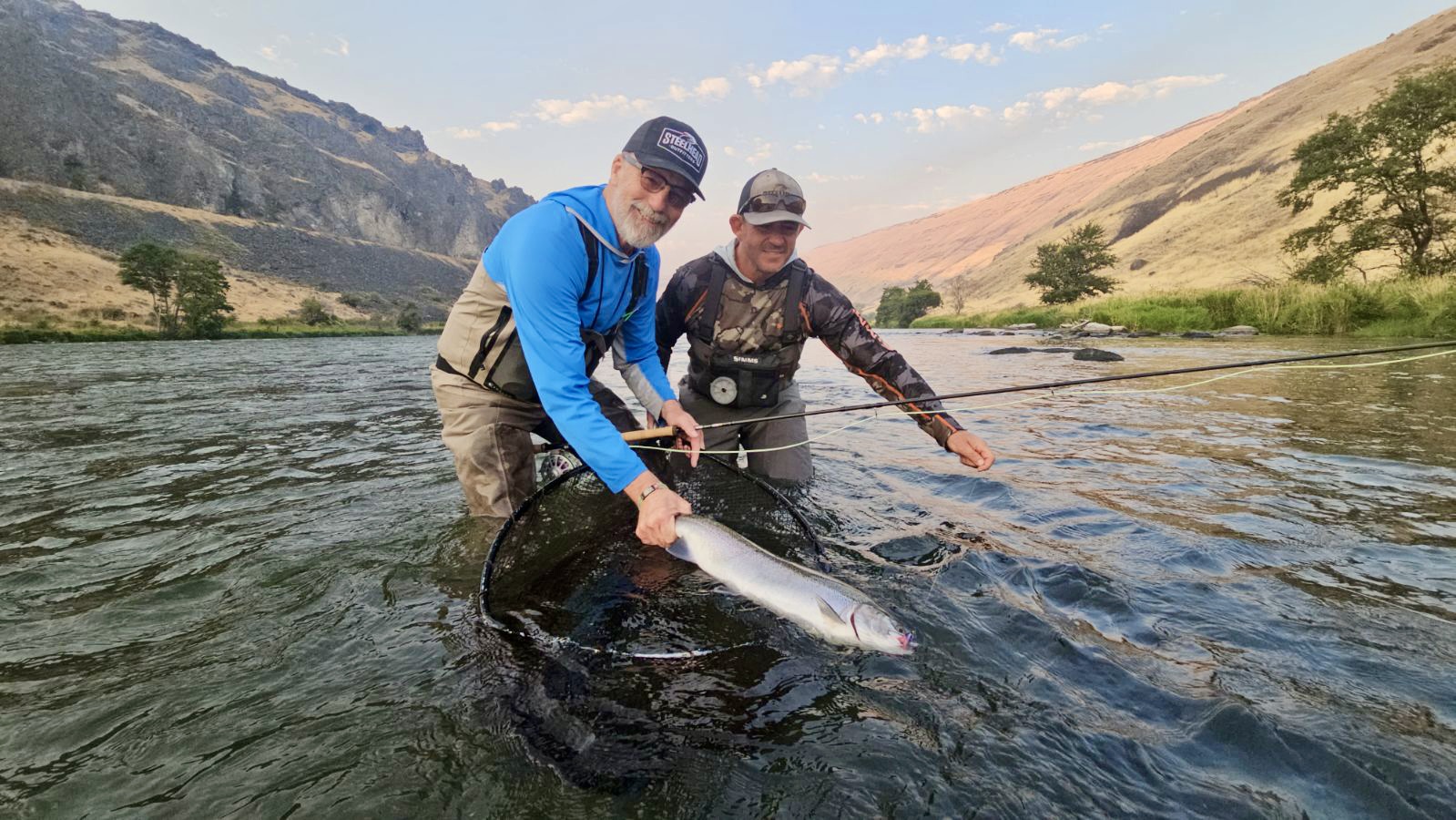
Seems like every steelhead season we're in at the time is my favorite, however, the Fall is definitely my favorite. Each season offers something different. Fall brings spectacular colors that line our favorite runs, low lying fog just touches the tops of those colorful trees, salmon have endured the journey and made it back home to spawn, not to forget the cooler mornings just bring a crispiness to the air. There's a bald Eagle perched in the fir tree above looking for a meal, I mean seriously what a beautiful time of year and what's not to love? It makes you feel alive!
Disclaimer: Below are tips which have worked well for me over the years. There are a lot of experienced, amazing steelhead anglers who could easily add to this list. Sometimes just thinking outside the box will produce results, but listed below are some tried and true tips that I hope will help you on your next trip out to your favorite river.
Fly Choices: Generally, fall fly selections would be dominated by the use of sink tips and or sinking polyleaders or versileaders. This is mostly due to the temperature of the water, depth and speed. I really love and would rather fish an appropriate sized unweighted fly for the conditions of the run rather than fishing heavy weighted flies or heavy sink tips any day. It's no secret that it's easier to cast unweighted flies and use the sink tip to get it down. However there are times you just have to go heavy. Heavier sink tips and heavier flies.
That being said, my fly choice really comes down to the color, speed and depth of the water I'm fishing. The more off colored the water is the bigger and darker my fly choice would be. As the river drops and becomes more clearer the smaller my fly choices become. For instance, if water is dropping and the river is green and cold but not clear I will use more colorful fly such as the famous Fish Taco in Pink! I feel that the extra bling bling helps in the cold water temps.
If the water gets really, really low and clear from a long spell of no rain, I will even fish my Scandi set up with a sinking polyleader or versileader and use a smaller summer style wet fly, like the Purple Muddler Minnow or a Mack's Canyon for example. If fish become spooky because of pressure and or a lack of water, this tactic has proven successful in the past for me.
Historical Flies of Choice:
Fishing Tip: If you're swinging a larger fly and you get a grab or a pluck during the swing, change your fly to a smaller one in similar colors and often enough you will get smoked!
- Hartwick's Marabou Tube - variety of colors.
- Hoh Bo Spey - variety of colors.
- Fish Taco's - variety of colors.
- Bantam's - on the smaller side - various colors.
- Brett's Klamath Intruder - on the smaller side - Black/Blue a favorite, but other colors work.
- Stu's Intruders (Ostrich and Barred Ostrich) - various colors.
- Muddler Minnow (Yes, on a sink tip) - Purple is a favorite.
Sink Tips: Undoubtedly one of the most confusing parts of fishing with spey rods, especially if you're new to the game. There are way too many options, right? I assure you that it's nice to have an assortment of tips, but I find that I use the basics most often.
For nearly most conditions I will use 4 or 5 different sink tips to cover the water I am fishing. Rather than changing sink tips 2 or 3 times in a run, I will adjust my cast to accomplish what I need to do to cover the water effectively. My go to sink tips would be, the:
- RIO MOW Tip Light 10' T-8
- MOW Tip Medium 10' T-11
- RIO MOW Tip Light 5'Float/5' T8
- RIO MOW Tip Medium 5' Float/5' T-11
- Occasionally RIO MOW Tip Heavy 10' T-14.
Fishing Tip: You may or may not know that sink tips have a dual purpose. #1. Not only does it get your fly down faster, but #2, it also helps turn over the weighted fly better. A good example is that 10' of T-14 is better at turning over a heavily weighted intruder, than a much lighter T-8 or even T-11. Mass moves mass. If you're using that T-14 sink tip to help turn over a heavy intruder better but it gets down too deep too fast, simply direct your cast more downstream and bring the fly into tension quicker to keep it from sinking too deep. Hope that makes sense.
Sinking Leaders (Airflo Polyleaders or RIO Versileaders): Polyleaders and Versileaders designed for and work well when using a Scandi style head or a single hand rod. They don't really work very well when combined with a Skagit type head. The easiest way to explain and describe the difference between a "Sink Tip" and a Polyleader or Versileader is that the latter replaces your leader, whereas a sink tip, has more mass and sinks much better and stays down better. Polyleaders and Versileaders have a monofilament core and Sink tips will have a braided core that is much thinner in diameter and will stay deeper in the water column.
Fishing Tip: In continued low and clear conditions during late fall and even through winter, don't be afraid to use your summer "Scandi" set up with an intermediate or slow sinking polyleader or versileader and a smaller non-weighted fly. You may be surprised of your success in tough conditions.
Swing Speed: Some may not even think about this, but your swing speed is crucial for success. General rule is that the colder the water, the more you should slow down your swing. When I first started fly fishing for steelhead, I'll admit that I just cast out there and let what happen, happen. I even caught a few steelhead. Dare I say even enough to think I was doing it right.
But, I'll say that again, BUT, when I discovered and learned how to control my swing speed and mend correctly my hook up ratio skyrocketed and I realized the importance of this. I started to visualize my presentation of the fly and how it looked during the swing. I also realized how much I was over mending, way over mending. Now, when I mend it's rarely, and most often it's just a slight lift of the rod tip either upstream or downstream of my fly line to make the adjustment that's needed and that is it.
Fishing Tip: The more you angle your cast downstream, the slower the swing will be. Once you cast, then set the fly up for the swing there is less resistance against the line when compared to casting at a greater upstream 45 degree angle. If you need to get deeper, then a greater angled cast upstream with an extra mend or two will give your sink tip and fly more time to sink deeper.
Fishing Through a Run: Cover the water well. That doesn't mean fish it forever. Having a system enables you to know that you fished it well. I would rather cover more water in the time I have to fish than fish one spot the entire time. Even if I am only going to fish one run, I would rather fish it twice than just once real slow. I can tell you without hesitation that I have caught more fish going through the same run two or three times than I ever have fishing it super slow.
Visualize a grid, and when you step into the run, if deep enough, start with about half of your Skagit head out of the tip of your rod. You'll be surprised how many fish you will catch before you ever get the full Skagit head out of your rod. It's exciting to catch a short line steelhead! After each cast, pull off another strip of line and make another cast, repeat this process until you have cast as far as you can or as far as needed. Then after that cast, take a step or two downstream and make that same long cast again. By the time you reach the end of the run you will have completely covered the entire run in a grid like fashion and any fish would have been able to see your fly.
In addition, say you're fishing a deeper run and need to get the fly down deeper. Using the same Grid like pattern and rather than taking a step or two down before your next cast, make the cast first, pull your fly into position, throw a slight down stream mend in the line and then take your step or two downstream. This will allow your fly time to sink deeper before coming into tension and start your swing.
Fishing Tip: When fishing a run with lots of boulders and conflicting currents, using a line such as the Airflo F.I.S.T. or RIO GameChanger , or the RIO PickPocket will help you get most of the head under the surface current and it really, really helps to slow down your swing. Which is perfect for late fall and through the winter months when water temps are getting colder. This is a go to set up to use when your typical Skagit looks like a snake swimming on the surface of the water during the swing. This scenario typically calls for way more mending with you typical Skagit head to achieve a nice swing but using the above listed types of heads will give you a more uniformed juicy swing we all have come to love, with very little mending at all!
A side note to swinging flies during the fall, especially later, is those beautifully colored leaves we all love and admire start to fall to the river and can become a nuisance to say the least. On a windy day the river can become completely inundated with the leaves and make it very difficulty if not almost impossible to swing a fly with out hooking leaves. Leaves will be in every column of the water depth. My experience with this situation is that I rarely catch steelhead utilizing any technique while this is happening. I have caught a few fish during the leaf hatch, but when it's at it's worst it's difficult! I would say that most of the steelhead that I have caught during the leaf hatch have come while indicator fishing.
How I Deal With the Leaves:
- I will Indicator Fish: This is a more effective way to fish for the Steelhead when the leaves are bad enough that it is difficult to swing flies. The presentation is more up and down rather than swinging through the run. This doesn't mean fishing with an indicator set up is a fool proof way to avoid the leaves because it isn't, you'll still have to deal with them but it's less frequent.
- I will give the river a rest and organize your gear or work on my "honey do" list.
Hope this helps as you fish this fall and winter. Have a great fall & winter season, if you have any questions we love to talk fishing here at the shop.
John

"The Gorge"
Gorge Fly Shop Team - 541.386.6977