Showing posts with label george cook. Show all posts

Apr 23, 2020

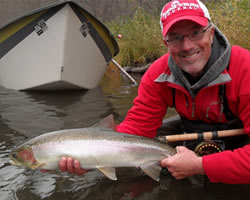
George Cook giving Austin casting instructions


John caught Austin on camera one day while casting some new sticks from Sage

Shop Sage Fly Rods

https://www.gorgeflyshop.com/store/pc/Sale-Closeouts-c38.htm

"The Gorge"

Gorge Fly Shop Team - 541.386.6977


"Fly Fish the World with Us"

Oct 31, 2015

Redington Chromer Two-Hand Spey and Switch Rods

"And On the Seventh Day We Hucked"

Fall colors in full bloom. The Redington Chromer 7136-4 got the job done and done very well!

First off, let me just state for the record that the title of this article is not just a catchy sales slogan, but something George Cook has said several times when referring to the Redington Chromer and in fact what I can confirm to be truly - A FACT! More on that later. When Georgie (our Redington Rep) first revealed the Redington Chromer to us at the Gorge Fly Shop I became super interested in it. What caught my eye was its unique design with the Polymer pinch grip sections on the handles. The main reason for this is that I’ve been a longtime fan of monofilament running/shooting lines for the extra distance and line speed that is generated by a “slicker” shooting line.

After using mono shooting lines for years, it’s almost impossible for me to use a “fly line type” of shooting line for any length of time. This is not to say that they are not a quality product and can’t get the job done, they can and do get “r” done, but for me and what I am used to, and what I like most, mono suits me well. I have used lots of different running/shooting lines that are available on the market and believe me each one has its issues or drawbacks. Maybe in the future I could do a breakdown of pros and cons of each running line that I have used, but not today. Today I want to focus on the design of the addition of the Polymer pinch sections on the handle and the benefit that it has for the mono lovers or the folks who are on the verge of trying a mono type shooting line.

A few years ago RIO created the “GripShooter” shooting line which incorporates a thick “fly line type” handling section to help prevent the slipping of the mono through cold, wet fingers and yet still have the benefit of a mono shooting line. The very fact that Rio would create such a line is proof of the benefits of a mono shooting line and the need to help anglers transition from the fly line type of lines to a mono type shooting line. Essentially giving the angler the best of both worlds. Although Rio’s mission was accomplished with the creation of the “GripShooter” and many made the switch, I felt that the shooting line was slightly slowed down by the fly line handling section until it transitioned into the mono shooting line and then, shot out like a rocket. But remember I am so used to mono that any fly line type of shooting line seems slow to me, and that if you’re transitioning from a fly line type shooting line to a mono type, you may not notice the difference, and I would highly recommend the GripShooter if you need a line to help you transition. The bottom line is the need to help alleviate line slipping from your fingers in wet and cold conditions because this is the major issue anglers have with mono shooting lines.

Jamey slips on the big rock at the tail out of “Magic”, a sweet run on the Deschutes River. I was told by Sam to huck it out there as far as I could so I launched a cast that left only a few wraps of my running line still on the reel and hooked that fish right on the lip of the tail out about 20 feet away from him. The Chromer had no problem helping me get the distance I needed for success.
Going back even before the creation of the GripShooter, anglers who wanted to help stop line slipping from their fingers would use non-adhesive tape (like that used on golf clubs) to help them solve the mono dilemma. I say all this to lead up to this point…In steps the Redington Chromer. Seriously a sight for sore eyes. I don’t know, maybe it was Georgie, who thought of the idea for the Polymer Grips, but its genius. They should give the man a raise! It’s one of those ideas that you wonder how come we hadn’t done this sooner. Brilliant but simple. The Polymer grip doesn’t hurt the effectiveness of the rod at all. It certainly, in my opinion, doesn’t hurt the aesthetics of the rod, in fact I think the rod looks pretty sweet. I love the matte black finish and even how the word “Chromer” on the rod shines like a freshly washed chrome bumper on a classic car (see photo below). On a clear sunny day you better make sure you have your shades on while fishing with the Chromer!

Better wear your shades
I am also a big fan of the price tag on this rod. I’ve said this before but I believe it’s a better rod than the price tag indicates. Travis, the shop owner has a saying and it certainly is true with most rods and that saying is… “If you don’t want to spend more money on a better rod then don’t cast one.” I will tell you this, if you were to put the Redington Chromer on the counter with the rest of the rods that I have tested and used in the same price range, even up to a few hundred dollars more, I would, without hesitation, fight you over the Chromer.

On the first full day of fishing this rod, I only had one time that the line slipped from my grip and that was no fault of the rods. I was purposely trying to see how loose I could pinch my mono shooting line against the Polymer Grip before it would slip. No joke, the Chromer does exactly what it was designed to do, and it’s just innovative enough that I think the idea will be around awhile. There are numerous other things I like about the Chromer besides the Polymer Grip, like the cork handle, it fits nicely in my hands and feels super comfortable, this is a big deal for me. I don’t like a thick handle, it doesn’t feel right to me. Its light in hand at only 6.8 ounces (I didn’t weigh it, I am actually taking their word for it and honestly don’t feel like I have to weigh it because it feels light in my hand). I fished with my Hardy Bougle #4 on it and it felt a little rear heavy due to the weight of the reel but when I fished it with my Lamson Litespeed #4 on it the Litespeed balanced the Chromer absolutely perfectly. It is important to place your fore grip at the position where the rod balances while casting, for comfort and power, and the Chromer and Litespeed balanced at the point my fore grip was exactly in the middle of the Polymer Grip. It does have a smooth fast action as Redington claims and It cast effortlessly at normal casting distances but when you need that extra umph to huck it out of bounds it has no problem accommodating you. Put a little more power into your bottom hand and watch it launch. By the way I put a RIO Skagit Max 525 grain head on it when I need to use a sink tip and a RIO Scandi 450 grain head for surface work.

Bottom Line:

The Chromer is legit, a dandy, worth every penny, and I would highly recommend it to anyone shopping around for a rod in this price range and as I said earlier, even a few hundred dollars more. The only drawback that I can come up with on the Chromer when compared to rods in its class is that - I DIDN’T COME UP WITH THE IDEA!

The Details:

  • Super-smooth fast action
  • Down locking reel seat for improved in-hand balance
  • Polymer Pinch Grip sections on top and bottom handles
  • Polymer grips maintain body temperature for comfortable winter fishing
  • Matte finish blank for flash reduction
  • Section tips epoxy coated to prevent sticking
  • Full Anodized aluminum reel seat
  • Premium grade cork handles
  • Fully protective Cordura rod tube with dividers
  • Lifetime warranty


The Specs for the 7136-4 Chromer:

  • Handle - “C” (pictured above)
  • Length - 13’6”
  • Line weight - 7
  • Rod weight - 6.8 ounces
  • Skagit Grain Weight - 500 +/- 550 (the Rio Skagit Max 525 grain was MONEY!)
  • Scandi Grain Weight - 425 +/- 475 (the Rio Scandi 450 was dead on!)
  • Price Tag - $399.95

A well-deserved break after hundreds of cast…I think I like this rod. I like it a lot!

Remember, if you can’t find it at the Gorge Fly Shop, you don’t need it!


Gorge Fly Shop
John Garrett | Product Specialist

541.386.6977

"Fly Fish the World with Us"

Aug 20, 2015

Trout Spey Lines: DEFINED by George Cook

Blazing New Trails On A Stream Near You

Trout Spey Lines : DEFINED….Conundrum SOLVED

Trout Spey….Micro Spey…”Small Ball” has indeed arrived! The Spey Angling enthusiast of today has limitless opportunity, be it Trout, Sea Run Cutthroat, Smallmouth Bass, even the various Shad species of both coast. Trout Spey tackle which spans from the 4 and 5 weight Switch Rod Theater down thru the 2 and 3 weight true Trout Spey rods set the stage for some mighty interesting angling adventures. In these pursuits like its bigger cousin Spey Rods, lines are aplenty and with it, a given (expected) level of confusion as to just what is “best”. The line “Conundrum” is our subject today , so take 5 and unspool the mystery as we DEFINE today’s Trout Spey Lines, their selection and use. 

Skagit Max Short

Skagit Lines: several choices here and completely dependent on just what the angler’s methodology “Objective” is. On one hand, the “Swinging Streamer” enthusiast will find himself at home with RIO’s Skagit Max Short Head. Here, the 200/225 and 250 Grain Heads sit at a very manageable 17’, while the 275 Grain Head comes in at 20’. Matched up with RIO’s “Light” MOW Family Tips makes for a great SWINGING set up. An Example here would be the 225 Grain 17’ Skagit Max Short teamed up on SAGE’s NEW 2109-4 ONE Trout Spey. The NEW 3110-4 SAGE ONE Trout
Spey is killer with the 275 Skagit Max Short , a combo I recently worked Ol’ Bow Bow out with on Alaska’s Middle Kenai River. Again, it is vital to note that the Skagit Max Short will BEST SERVE the Angler looking to ply his game via the SWUNG FLY with small to moderate sized streamers .
MOW Light and even MOW Medium tips can and will apply in this “Swinging” theater. I might also note that with the Skagit Max Short the “Transition” from normal Spey rod sizes (12 ½ to 14’) to Trout Spey lengths (10’6 to 12’) is less radical in terms of casting stroke format.

Trout Max Short
Skagit Trout Max: A NEW and very Specialized Skagit style head sets the stage for the Trout and Smallmouth Angler throughout the country who has set his sights on a STRIPPED STREAMER Approach. Most Lower 48 along with Chilean and Argentine Trout (Both Bow Bow and Brown Town) are largely caught by way of a STRIPPED Streamer Method (VS Say Alaska Rainbows, Dollies and Northwest Sea Run Cuts taken on the Swing). The Skagit Trout Max head employs a very fishy 11’ Head that maximizes one’s ability to really format a Stripping Streamer methodology. Here it can be expected that one shall cast either ¼ Upstream to 90 degrees (straight out) in order to gain a quick drop followed by the classic stripping motion made famous by the legendary Joe Brooks in the 1950’s. By formatting a short 11’ head the Skagit Trout Max ensures maximum “Strip Time-Length” before your attached head to running line gently “Clicks” into your guides queuing one to fire off another one to continue the hunt ! Again, the MOW Light Series as well as the Medium MOW members will employ nicely here. I would be remiss not to mention here that while the whole of Trout/Micro Spey involves a very conscious effort on the part of the caster to “Scale Down” both his overall stroke size and speed of operation (Get SMALL as I call it) the mere 11’ of the Skagit Trout Max dictates a further reduction here, get small, stay compact and ever so smoothly execute the Spey stroke, no big moves, no hurky, no jerky !
Scandi Short Heads

Scandi Short Heads: The elegant casting choice has Trout Spey in mind with Short Scandi heads from 180 (28’), 210 (28’) and 240 (29’) grains that play super well. Working with short RIO Versi- Leaders, all types Floating thru 7.0 ips (ips=Inches per second related sink rates ) in 6’ & 10’ styles or even a 9’-12’ RIO Trout Leader straight off the looped head these classic Scandi style
heads work beautifully with Soft Hackle and other related patterns. Un-weighted streamers , classics like the Light and Dark Spruce, Muddler Minnow, Black Dace along with a host of Northwest Sea Run Cutthroat Flies will fly fast and with ease utilizing these Scandi Short style heads. As with their bigger Spey Rod cousins the Scandi game always plays at a lower Grain Weight then the Skagit Weight for the given (Same) rod. An example here would be the New SAGE Trout Spey 2109-4 ONE, while the Skagit Max SHORT (Or Skagit Trout Max) choice sets up at 225 Grains the Scandi Short selection will roll in at 180 Grains.
RIO Switch Chucker

RIO Switch Chucker Lines: The vaunted Switch Chucker has a definite home in the Trout/Micro
Spey Theater ! Now available in a NEW size #2 and #3 Chucker’s these 25’ heads make Spey Casting Transition relatively easy coming down into Trout Spey/Micro Spey Rod sizes and overall expected angling methods. Versatile enough to cover the whole gamut of Trout Spey be it Soft Hackle Swinging (get crafty and use a 10’ Floating Versi leader here!), stripping streamers or swinging meatier choices for bigger grabs the Switch Chucker will prove a most versatile choice. Indicator game will have its day in court here as well. Can be utilized with MOW Light and even
Medium MOW selections as well as a host of Versi leaders in 6’ and 10’ feet. The Chucker should be dead on line size targeted, meaning put a 2 Weight on a 2 Rod, 3 on the 3 so on and so forth. To be sure, the RIO Switch Chucker is a great all around choice here.
InTouch Single Handed Spey

NEW RIO InTouch Single Handed Spey Line: Awe…this one falls into the “Didn’t know such could work but turns out to be a fabulous choice” category. While mega good on the single hand intended usage (Both Spey and shockingly good overhead) the NEW RIO Single Handed Spey Line is a “Sleeper Choice” on Trout/Micro Spey Rods. Based on a 34’ Taper the Single Hand Spey Line on a “3 Bump Rule” works simply wonderful on these small ball Spey rods. 3 Bump Rule will show that in order to hit an “Applicable” grain window one shall select this line 3 line sizes HIGHER than the given rod line size. EXAMPLES: again the NEW SAGE 2109-4 ONE Trout Spey is a 2 weight rod, simply bump 3 sizes up (hence the WF-5-F Single Handed Spey Line) and batta bing, batta boom you have a simply KILLER match up. Just so happens that WF-5-F weighs out at around 227 grains hitting the 2 Weight Spey Grain window perfectly giving it both max propulsion along with an fully integrated fly line to boot. 9’-12’ RIO Trout Leaders will fine tune this choice into a Trout Spey machine !

So as you can see RIO has you covered on your Trout Spey Game no matter what your needs are!


George Cook
Anglers Rendezvous
Northwest Representative
Sage, Rio, Redington


"Fly Fish the World with Us"


Jun 3, 2015

The Genius of RIO’s Skagit MOW and iMOW Tips

Originally brought forth by the “3 Speyketeers” as I call them, Mike McCune/Scott O’Donnell and Ed Ward (Hence the name MOW…McCune-O’Donnell-Ward). The MOW System is nothing short of brilliant!


Available in Light (T-8 format 7.0 ips), Medium (T-11, 8.0 ips), Heavy (T-14 format @9.0 ips) and Extra Heavy (T-17, 10.0 ips) .

Each MOW Family (Series) has 6 “Family Members” consisting of the following:
                10’ Floating Tip
10’ Sinking Tip
12.5” Sinking Tip
THEN….the 3 MOW’s…..7.5 x 2.5 (7.5 Floating integrated into 2.5 of given make up say medium as an example in T-11). 2nd MOW is a 5 x 5 (5’ of Floating integrated into 5’ on sinking).MOW #3 is a 2.5 x 7.5 (2.5 of Floating Integrated into 7.5 of sinking).

MOW Tip Kits
There are two ways to get these 6 family members, either individually or in a MOW Kit (Say, a MOW Medium Kit as an example).


Practical Usages as prescribed below….

10’ Floating Tip : The MOW system is built for use with Skagit Style Spey Lines . Regardless of Skagit “Type” (RIO formula’s include Skagit Max Short, Skagit Max & Skagit Max Long) the MOW’s are formulated to play in the Skagit line theater. The 10’ Floating Tip is a quick way to “Ala Carte” your Skagit Line into a Full Floating use line.

10’ and 12.5’ Sink Tips: Available throughout the MOW Range (Light/Medium/Heavy/EX Heavy), these practical length sink tips play incredibly well with a wide range of Spey and switch rods making them a wonderful addition to the standard “Traditional” 15’ sink tips (Intermediate/Type 3, 6 and Type 8). These 2 sink tips will provide the Angler with sink rates from 7.0 ips (Light T-8) all the way to 10.0 ips (EX Heavy T-17)that will cover a wide range of use from Alaskan Kings to Tierra Del Fuego Sea Run Browns as well as the full gamut of Steelhead application.

The 3 True MOW’s

Here is where the absolute Genius of the MOW boys shines brightest !  Given that any “Cut” sink tip under 9’ is likely going to basically become a boomerang/tumbler within the cast that will prove to be ugly at best and ultra frustrating at worst. The “Integration Format” that McCune/Scotty O and Ed brought to the table from their “Chop Shop” artistry days providing the stability/cast-ability of a 10’ common denominator in overall length coupled with the desirable “Baby Tips” making for one of the all time great innovations.

7.5 x 2.5 (2.5 being the Sinking Portion): True “Rock Garden/Tail Out Probe Tool”. One could think of a 15’ Type 3 in this instance but the beauty of the MOW idea/format is that the mere 2.5 sinking portion is simply unrivaled when it comes to sliding around and thru such haunts. The traditional 15’ sink tip or even the 10’ and 12.5” MOW Sink Tip family members are all prone to “Swing Drag Thru” often catching/hanging up and killing any real chance at a follow and/or GRAB.

5 x5 (5’ Floating with 5’ Sinking):  Again, another Rock Garden probe but long enough to provide quick drop for given slots particularly in ledge rock environments found in many Steelhead streams. The 5 x 5  MOW Heavy (T-14 Format) is a great one for such a task where the angler needs a quick drop into a slot where he’ll need to engage quickly in order to be in that zone/slot target area. Lots of Pacific Northwest watersheds feature just such places making the 5 x 5 MOW a handy tool.

2.5 x 7.5 (7.5 being the sinking portion): My personal favorite in both the standard MOW as well as IMOW (See Below). This “Baby Tip” if you will has tons of application for a host of fisheries most certainly including the trout game. Given water depth and speed considerations often play perfectly into the hands of the 2.5 x 7.5 MOW quite often in the MOW Medium (T-11) format. Incredibly versatile sliding thru the boulders and swinging “All The way In” giving both “The Long Followers and The Down Below You” Critters time and opportunity to run down or run into your swung offering.

iMOW Family

The innovation of the Intermediate style Skagit Heads necessitated the invention of the iMOW in order to accommodate MOW usage with such an Intermediate format head (Substituting Integrated Intermediate VS Floating as found in the original MOW format), this is the obvious use of an iMOW but certainly not limited to an iFlight/IMAX format line. I personally love the iMOW’s, as a general MOW use tool as they can, and do have their place covering a host of angling waters particularly where you know going in, that the bottom format is relatively clean but needing “Less” of a given sink tip. iMOW’s come in LIGHT/Medium and Heavy. Kits have 6 family members with the previously mentioned 10’ floating Tip subbed out for a 10’ Intermediate tip.

iMOW Family:
                10’ Intermediate Tip
10’ Sink Tip
12.5” Sinking Tip
       The 3 iMOW’s
7.5 x 2.5 (7.5 is intermediate integrated to 2.5 of given sink tip say iMOW Heavy T-14 as an example)
5 x 5 IMOW
2.5 x 7.5 IMOW

Al in all, the MOW Families have a lot to offer the Spey and Switch Rod enthusiast. I can tell you with absolute confidence that every angler out there has/knows places that are “Made To Order” for MOW use, in particular the 3 True MOW tips. The Spey community owes a lot to the genius of the “3 Speyketeers “ Mike Mc Cune, Scott O’Donnell and Ed Ward.


George Cook
Anglers Rendezvous
Northwest Representative
Sage, RIO, Redington


"Fly Fish the World with Us"

Jun 2, 2015

Spey TV with George Cook

George Cook

Watching a tutorial videos can greatly accelerate the learning curve of today's high tech sporting industry. It is my belief that in the perfection of fly fishing about 50% of our effort needs to be aimed at quality casting. It takes much practice to become efficient at casting but it also takes little tweaks along the way to overcome hurdles that are holding us back from casting perfection. I never know where those little tweaks are going to come from and I can tell you from many years of experience that they have come from everywhere and often times some very unlikely sources. 

Hiring the best instructors will certainly get you on the right path but don't overlook other resources. One never knows what will trigger our own internal light switch that makes our light bulb glow.

George Cook could be one of the most experience anglers I know. Besides being an industry rep for more than 25 years George draws much of his experience on just doing it! Just getting out and immersing into the angling sport and passionately doing what George loves to do. In the many years I I've got to know George he has pass to me many nuggets of information/instruction that have helped improve my casting skills greatly.

Welcome Spey TV!  I'm pretty excited to watch Spey TV videos. Like I said earlier my I've learned many things from George that has helped to become a better caster and I'm sure with watching George's videos that I am certain to learn more. I'll post them out here as they come available.

Episode 1


Episode 2


BassProGreg


Gorge Fly Shop Internet Sales Manager | Product Specialist


"Fly Fish the World with Us"


Mar 25, 2015

Spey Day 2015 | My Experience, Your Benefit | Bend, Oregon

Got the email from Erik of Angler's Rendezvous (our Sage, Redington and Rio reps) that our annual Farbank Mini Spey day was going down on March 22nd, 2015 in Bend, Oregon, a short three hours drive from my hometown of Hood River. I thought, what a great excuse to get away and spend six hours casting Spey and Switch rods until my hands had to be pried from the cork handles...Like a warrior who's held a sword for hours during battle and his hands won't let go.

Spey Day - Bend Oregon

Sage and Redington Spey & Switch rods
patiently wait their turn to perform.
If this years Spey day is anything like last years, I am going to thoroughly enjoy it. It's not too often that a guy has the chance to cast multiple Spey and switch rods side by side, for an instantaneous direct comparison. To really get a feel for the difference, casting different models, lengths and tapers side by side is by far the best method of telling the differences. Honestly, not only is it fun for me to spend the 6 hours casting all the rods but it translates into the confident conversations that I have on a daily basis with customers who call the shop or drop in looking for guidance in making their first spey rod purchase or their tenth.

From a customers standpoint, there is nothing like talking to someone on the phone that has actually cast or fished with the rod that they are interested in. From a shops standpoint there is nothing like having an employee who has actually cast or fished with the rod that the customer is interested in. First hand knowledge of equipment reeks through your conversation over the phone. I hate talking to someone that seems to be reading right out of the catalog trying to sell me something. It doesn't take too long to realize when this is happening.

Google or YouTube anything today and in a matter of milliseconds you have years of information and opinions at your fingertips. This is a good thing and it can be a bad thing. Good because you can do research without the pressure of a used car salesman breathing down your neck paid by commission. Bad because you can do your research...too much research...research overload, so much to the point you can't make a decision one way or another. You're now more confused than when you first started. If you're reading this and are thinking of making a Spey or Switch rod purchase, with all due respect, do some research, and pick just a couple of fly shops that actually fish with spey rods and you're confident with, give them a call and get dialed in. I have had numerous conversations with customers who have over researched and finally, out of desperation reach out to us. I once had a customer (if this is you, I didn't mention any names) straight up, within the first few seconds of our conversation confessed that he had been researching the equipment he was interested in for months and that he had literally called nearly every fly shop in the United States and now was so frustrated because he kept getting conflicting intel. I totally understood what he was saying and I respectfully said to him...that he had become so saturated with information he couldn't make a decision because most of the folks he talked to contradicted the previous guy he called. I politely said to him that he needed to take a breath and pick a couple of shops, who actually use spey rods, and start to trust somebody. He agreed with my statement and confessed that he was exhausted from all the research and he thanked me for being so honest with him. I could actually feel the tension in his voice subside as I told him this.


In short he'd become so overloaded with different personal preferences from so many shops that he couldn't choose. Shop employees where giving him advise on their casting preferences but neglecting to ask him about his. He was transitioning into the two handed world from single hand rod experience. So I was able to gather enough info from him and his background with a single hand rod that I could recommend a rod suitable to the casting style he was already used to, which made for a smoother transition for him. The equipment he was interested in was expensive and he wanted the confidence that he was making the right choice for his investment. He didn't have a local shop that he could test drive the equipment or talk to anyone who even used a spey rod.


Spey Rods and Reels stacked like chord wood!
OK, where do I start!
There are many reasons why you need to take a deep breath, sit back, relax a bit, and approach the spey/switch scene with a bit of trust. I say that assuming from this point on you will take my advice and use a shop that actually lives and breaths to spey fish and knows the equipment.

There are a number of variables that will help us get you dialed in. For instance, your casting style, are you on the aggressive side or are you a bit more laid back and patient, what size of a river you fish, what style or technique will you want to use and much more. I cannot give you a true diagnosis of the correct rod you should choose, by just considering my casting style. That would be like going to the doctor because you're ill and the Doctor diagnoses you with his symptoms. Doesn't make sense, does it? I need to gather as much information from you to help you make the right choice.


For example, I once set up a petite woman with a Sage One 7116-4 (11'6" 7 weight) Switch rod and a Rio Skagit Max Short head due to the fact that she was small, the shorter switch rod and head fit her perfectly. The standard, go to, introduction to Spey rods, Sage One 7136-4 (13'6" 7 weight) was too big for her. Once she took the Switch rod outfit to the river, it didn't take her long to fall in love with it. I try my best to get as much information from the customer and their casting style before recommending which rods would suit them. If they have no experience at all, either with a single hand rod or a two hander, my default recommendation is typically a fast action rod such as the Sage One. There's a reason for this. Typically a fast action rod is much more forgiving than an ultra-fast action rod, were your timing is somewhat critical, or a slow action rod because most people, honestly don't have the patience to wait for a deep flexing rod to load up before they start their forward stroke. When casting an ultra fast rod, such as the Sage Method, if your stroke is on its "A" game the rod will let you know how awesome you are by producing blistering line speed with little effort. BUT if you're having a "B" day, you're gonna struggle and you may not like the Method so much. The Sage One is the perfect go to rod for most folks. It's easy going for a somewhat laid back caster, super smooth and yet still has the power if you give it a little more umph on your bottom hand when you need to. Now there are other rods that have a fast action that would suit the needs of most folks, I'm just using the Sage One as an example, because in the Sage lineup of rods, it is my go to "comfort food" rod. It's an amazing tool. I wouldn't know these intimate details of the Sage One if I didn't have a personal relationship with the rod. The Method is an awesome rod, no joke, it's awesome...for the guy who loves an ultra fast rod...not so awesome for the guy who likes a more traditional full flex rod.


In the six hours I spent casting, I cast 4 weight switch rods to 15' 10 weight spey rods and everything in between. Spending considerable amounts of time on each. If you want to test your casting skills grab a 4 wt switch rod and immediately after casting that for 20 minutes grab the 15' 10 weight Sage Method, then go straight for the Sage Accel 7126-4 aka "Mr. Wiggles" and just see if it doesn't take some adjusting before you get your stroke back. This is why I go to these "Spey Days". To be able to grab rods and cast them side by side for an accurate instant comparison is priceless for the customer who doesn't have that opportunity or have a local shop that they can do so themselves. My experience equals your benefit. You, the consumer benefits from my personal time spent with each of these rods. Now, if you call the shop and ask me about a rod that I have never cast, I will tell you that I have never cast that one...yet. I will be honest with you and tell you that I haven't lined that rod up yet. I can still describe the action of the rod, maybe even talk to you about the taper, give you a great line recommendation but this conversation won't have the passion in it compared to the rod I have actually went out and spent time on the water with or even personally owned. You can tell when someone has a bit of passion about something.


I'll end with this. The "Spey Day" was on one of my days off...just sayin...

Low and Clear

This beautiful Steelhead was caught on a Sage One 6126-4 in low clear water conditions. When water is low and clear, lighter rods, lighter sink tips or no sink tips, and natural colored flies are a good choice to improve your odds in landing the prize...

Remember, if you can’t find it at the Gorge Fly Shop, you don’t need it!


Gorge Fly Shop
John Garrett | Product Specialist

541.386.6977

"Fly Fish the World with Us"

Feb 9, 2015

RIO Outbound Fly Lines

We recently posted a very informative piece on Skagit lines from our ever faithful rep George Cook, titled “Skagit/ology 3.0 – The Trilogy Comes to Light” where he went deep into the end zone and scored big time points with some confused customers who were trying to make sense of it all. Well, we thought we would have him do it again, but this time we are focusing on RIO’s Outbound Family of Fly Lines

RIO Outbound Series of Fly Lines

Contribution by Northwest RIO Representative George Cook

The Conundrum of WHO/WHAT/WHY & WHERE SOLVED

New Year’s Greetings…

As a longtime RIO Sales Rep dating back to 1993 there’s little doubt that the subject of Spey and Switch lines indeed dominate the landscape of questions, be it from dealers, consumer’s, guide’s and outdoor writer’s, the 2nd highest level of Fly Line questions surrounds the vaunted RIO Outbound family of lines. In this, there are a number of lines and with that number comes confusion and often times a straight up “Selection Conundrum”. The crew at GFS and I have spent many an early morning plowing thru the various families of the Outbound Clan and without further ado please find the below read as the CONUNDRUM SOLVED end all, be all explanation on Who-What, Why & Where as to the proper selection and use of these outstanding, innovative fly lines.


Throw Back!
The original Outbound line (now known-listed as the Coldwater Series Outbound) brought about by the innovative mind of RIO’s founder Jim Vincent was largely formulated for the East Coast Striper/Bluefish crowd where just a little more distance was ALWAYS being sought to reach yet another far off bait ball with busting critters just waiting for their next mouthful. This 37.5’ Integrated (=Fully Built)Shooting head was truly a gift to the angler in that it sprang forth three super important aspects that had previously really only been available thru “The Chop Shop Custom Shop” in other words someone in the local “Secret Society” who likely wasn’t sharing! The 1st aspect was that of the Ultra Custom Shooting Head that was largely found in California among-st the foremost inner sanctum crowd plying the fabled California coast for Steelhead, Chinook as well as Stripers. These west coast legends the likes of Bill Shadt, Bob Nauheim, Walt Bennett, Les Eichorn and others (Buy or Rent “Rivers Of The Lost Coast” narrated by Tom Skerritt and see these cats in action!) had brought forth the next generation of super shooting heads by taking existing Weight Forward (WF) Floating or Intermediate lines applying a “One Bump Up” theorem and then custom cutting them around the 38’ mark. So for a 9’ eight weight rod these boys would get their mitts on a full WF-9-F Fly Line, come back into it 38’, cut it, then play some level of splice or possibly loop system with a given shooting line (Amnesia being a good one). The outcome of this custom chop shop masterpiece was nothing short of next level performance in that one of these babies would simply FLY, Fly Away in the hands of the ardent double haul practitioner. The theory was ultra sound here in that by extending the classic shooting head from the standard 30’ out to 38’ one could reasonably expect a number of factors to come together that would produce greater max distance potential, boy did it folks! I got to play with one of these secret society lines in January of 1988 at the ISE Sacramento Sportsmen’s show when longtime Sage Pro Staffer Walt Bennett strung one up and put it on the then brand new SAGE 890 RPL Rod. I watched Ol’ Walt belt out some mighty rip roaring cast anxiously waiting my turn to cast this west coast magic line for myself. To be sure, I’d never seen anything like it, it was truly bad ass and I could instantly see the max distance potential that such an extended length taper (Shooting Head) would provide the caster, particularly with the recent advent of the Graphite 3 class rods like the RPL of the late 1980’s. It was plain to see that at 38’ the aerial stabilization factor was greatly pronounced in such a way to gain unprecedented distance.

Fast forward to Y2K when Jim Vincent cranked out the ultra-innovative OG (Original Gangster) Outbound Fly Line. 

Jim rolled with the longer Shooting Head length at 37.5 but improved upon a couple needed aspects A) “Double Bump” weight distribution ( hence an 8 weight line kissing a 10 weight range) and B) the integration, smooth transition of head to running-shooting line as a full built, complete fly line. The double bump idea was brilliant in that the Graphite rods of today were then and are now formula one race cars compared to the Classic Fenwick Glass Rods of the 60’s and 70’s that transcended to the first low modulus graphite weapons in the 1970’s. Graphite II brought about by SAGE would not hit till the 1984 period. These were all recurve bows compared to today’s laser like tools and the “One Bump Up” idea that was so valid then had given way to Jim’s modern day, modern graphite double bump. The integrated line format was simply lovely in that it insured clean, long cast in repeatable fashion, again Jim was hitting on all cylinders!

Today, we have the luxury of many available OUTBOUND format lines, no doubt a fantastic offering but can be somewhat confusing at first glance. Here you’ll find the lowdown on just which lines right for you, your fishing, your expectations and ultimately your success.


Coldwater Series Outbound
Coldwater Series RIO Outbound: Again the OG of the group. 37.5’ Max Distance Taper. This folks is your go to line for the following task… Puget Sound Beach Bombing with flies in the ½” to 3” inch range. Throw spinning rod like distances (70’-110’) from beach or boat in pursuit of Sea Run Cutthroat, resident and migratory Silvers, Chums and Pink salmon. While often overlooked this line is a sleeper Lake Line in that the same size flies and distance expectations that are common in the beach game transcend to Western Lake fishing as well and believe me the “Bank Rats” have their day in court armed with such lines in both Intermediate and floating versions. The KEY identifier here is that this is the 37.5’ taper NOT A SHORT Version. Do note that the likely only true drawback of this line is that once the fly size gets north of 3” in length folks can and will have trouble getting this longer line up, loaded and launched.


Outbound Short 

Specialty Series RIO Outbound SHORT: Short here does indeed imply SHORTER as in a 30’ taper VS the OG 37.5’ taper found in the Coldwater series. This is a freshwater/Coldwater line as well but at a shorter 30’ length still featuring the double bump weight format. This line is ideal for a number of angling scenario’s like Western Boat Streamer Bank Banging where repetitive cast to the banks edge with nasty streamers often produce the best Trout of the day, maybe the season! Think Yellowstone, Yakima, Madison and Missouri type environments where short range 25’-45’, rapid succession cast and strip techniques are the rule of the day. Quick loading with power to turnover and deliver the big nasty’s straight to Bow Bow and Brown Town’s favorite haunts. The 30’ SHORT taper is simply ideal for this classic western streamer fishing format.


Outbound Short Coldwater

Coldwater Series RIO Outbound SHORT: Essentially the SAME Animal as the Specialty Series Outbound Short (Above). The difference being simply put is how the line is marketed by RIO and presented by dealers. Confused…don’t be, just know this is another 30’ Double Bumped Outbound Short Line that is largely promoted as a Coldwater Fresh or Coldwater Salt use line. On one hand this baby will play that Western Streamer ballgame as discussed above in the Specialty Series Outbound Short. It is also a Larger Fly (3”+, think 4” to 8”) “GO TO” line for both East and West Coast striper chasers. It will also be prescribed for the Rank Beginner who ventures onto the same Puget Sound beaches where the veteran angler is busy launching mega cast with the 37.5 Outbound line. This prescription is set to have that new beach angler in a position to make good, acceptable fishing cast as he literally gets his feet wet in the salty brine of the Pacific Northwest. I will tell that same newbie that he will ultimately WANT the 37.5 Coldwater version as he develops his game to the next level as it will outcast the 30’ Short by leaps and bounds, no getting away from that aspect. The larger fly Striper seekers will find that this is a great choice to get up, load and launch those larger baitfish patterns particularly when crashing critters offer flash opportunities.
Outbound Short Tropical

RIO Tropical Outbound SHORT: Warm-tropical water use Outbound SHORT line that once again utilizes a double bumped weight formula that is a fantastic line for the Tropical salt water angler be it beach or boat. Examples abound here….Baja Roosters, Christmas Island/Seychelles’ Trevally. Anytime big flies and quick cast meet on the curve this is the clear cut winner.
Here’s what our very own Gorge Fly Shop owner and avid tropical fisherman, Travis Duddles had to say about Rio’s Tropical Outbound Short… “I have found the Tropical Outbound Short to be my favorite line for stalking Tarpon and Snook along the mangroves. This situation requires quick 40 to 60 foot cast. The Tropical Outbound loads the rod with one quick back cast allowing for a very quick powerful cast to the mangroves. Although this would not be my choice for a distance line, this is the only line I would use in the mangrove lagoons of Mexico, Belize and Florida.

RIO Outbound Short Shooting Head: The classical 30’ freshwater shooting head now available in the vaunted double bump Outbound SHORT format as a head only. For those anglers seeking an old school shooting head experience the advent of the killer Outbound SHORT taper brings load and line speed to the forefront of today’s available shooting heads.


Whatever your angling pursuits are there is a RIO Outbound line at the ready to maximize control, distance and ultimately SUCCESS for that all important time on the water.

George Cook - January 2015

Honestly there isn’t any need for me to say anything else that Georgie hasn’t already said. Thank you Georgie for the intel! We hope that this helps make some sense of the Rio Outbound Family of Lines. Rest assured that there is an outbound line that will fill your need. We hope you enjoyed the read and look forward to seeing you out on the water… if you have any questions feel free to give us a call @ 541.386.6977 or visit us on the web at: gorgeflyshop.com

Remember, if you can’t find it at the Gorge Fly Shop, you don’t need it!


Gorge Fly Shop
John Garrett | Product Specialist

541.386.6977

"Fly Fish the World with Us"


Jan 14, 2015

Skagit/ology 3.0 - The Trilogy Comes to Light


“The Trilogy Comes to Light”

John Garrett

Every once in a while in the course of fly fishing evolution, something happens or is created, that changes the game. Techniques are tweaked and fine-tuned, rod technology introduces lighter and stronger materials which in turn make it possible to cast, especially with a two handed rod, all day long with little or no fatigue, reel materials and drag systems just keep getting better and better as well. In this post I want to focus on the Skagit style spey lines. This “Skagit” style of spey casting has opened up a whole new world for many fly anglers and generated what I would call a revolution.

I can remember some years ago when I first started seeing two handed spey rods on the rivers I was guiding. Curious, I asked the first fellow I saw with one…”what kind of rod are you fishing with?” and he quickly replied…”Spey rod”. This thing was huge, I mean (I’m not certain but vaguely remember) it had to have been fifteen feet and he said it was a 9/10wt. I asked him if I could hold it and check it out and he was gracious enough and let me interrupt his routine. When he put that rod in my hand, I kid you negative, it seriously felt like I was holding on to a telephone pole. At that moment, right then and there, I convinced myself that I would NEVER be a spey fisherman. I refused to fish with a telephone pole and such heavy equipment for the six to fifteen pound steelhead that I would typically catch. It seemed like a lot of work and major overkill to me.

So, I put that technique in the back of my mind and filed it under: “I’ll never do that again” and I moved on. Years past by and right under my nose the spey industry was evolving and I was missing out on it. Next thing I see…another guy with a smaller, lighter rod…so on and so on…to the point now that I am becoming very interested in this spey thing. This was before the spey explosion, we are experiencing today. Now, I know that Skagit style casting has been around for a while now, but even in the realm of just Skagit style casting, there has been considerable changes since it first came about. The beautiful thing about Skagit style casting is its versatility but with that versatility comes what some would consider mass confusion.

Here in a reprinted copy of George Cook and Erik Johnson’s Skagit/ology 3.0, George and Erik help simplify and bring to light the very Heads (lines) that are part of the confusion. Let me say that in giving credit where credit is due, I would personally like to state that George “Georgie” Cook deserves to be on the name dropping list that he himself includes in this piece. A master caster/angler, and a rep worth his weight in gold, who’s been in the game for a long time, he knows his stuff and is passionate about it. Thank you Georgie and Erik for sharing these golden nuggets…

Skagit/ology 3.0 (2014 | 2015)

By George Cook | Erik Johnson

Over a decade has passed since the introduction of the vaunted, original Yellow Skagit Line. However, despite its effectiveness and popularity, misconception, confusion, and lack of overall clarity of the use of Skagit Lines remains. The following is a short but specific conversation regarding the history and usage of the various Skagit lines in the worldwide spey fishing theater.

History – Beginning in the 1990’s many of today’s most recognizable spey authorities independently where developing Skagit type lines. Noted casters and anglers such as Ed Ward, Mike Kinney, Scott O’Donnell, Scott Howell, Mike McCune, Jerry French and the legendary Harry Lemire among others were at the forefront of the Skagit revolution. Along the banks of Northwest rivers coupled with late nights in the depths of fly tying rooms of the Pacific Northwest the chop-shop artist and line theologists were hard at work developing what would become today’s Skagit Lines. Some would cut and splice their way, others would utilize bumped up WindCutter bodies to perfect the craft. The shorter belly approach was underway. The day had come to maximize the spey rod for winter Steelhead conditions as well as Alaskan and B.C. Kings with large outsized flies. The use of Northwest hybrid and Skagit Casts such as the Snap Tee, Perry Poke, Snap Z and Wombat lent themselves to a shorter more powerful approach. Today the Skagit line is THE approach to sinking line endeavors worldwide. Be it Kings in Alaska to Sea Run Browns of the Rio Grande from the Umpqua to the Babine and all points in between. The Skagit Line has become the omnipresent tool. Originally developed purely as a sink tip asset, the Skagit line also can be an effective full floating line particularly on 12’ to 13’9” rods. To be sure, the spey caster will endure a greater level of stripping of line to recast (applies to all Skagit lines versus mid to long belly lines) but the reward is a undeniable highly energized, long and straight cast.

Types – The original RIO Skagit Line worked from a 27’ body that today in the era of the new Skagit Max is found in a 23’ to 25’ length. In 2009, the Skagit Short came onboard providing and ideal line for switch rods as well as shorter spey rods in the 12-12’9” range. These lines are specialized shorter 17’ to 20’ Skagit lines now know today as the Skagit Max Short. Often times the Max Short serves the ardent spey caster well in strategic tight corridor situations often found in such Steelhead haunts as the Oregon Coast, Olympic Peninsula and Vancouver Island.

Usage – Specific Skagit Line size (grain weight) math-ups come with a degree of variability coupled with angler opinion. Line speed versus load, moderate versus fast action all add up to a witch’s brew of variables that must be fleshed out on any given rod regardless of manufacturer. The great casters often find themselves 25 to 100 grains apart on any given rod. In the end the angler must boil it down and get the details. All in all, most spey rods 12’ to 15’ in length will have as many as three different Skagit Lines that will work. For example, the TCX 7126-4 aka “The Deathstar” can work with a Skagit Max Long in 525, Skagit Max 550 and even 575. The 525 offers the line speed choice while the 575 offers the mas load choice. Generally, one will be ideal. To discover this, the angler must seek out opinion within the spey community, be it a guide, angling buddies, factory rep or retail representative, as we as GET OUT AND CAST!


Skagit Max Short – Ideal for switch rods in the 10’6” to 11’9” range along with application for shorter spey rods in the 12’ to 12’9” range, 8 weight and under. These are specialized shorter 17’ to 20’ Skagit lines. These lines are also perfectly at home on 9 to 10 foot single handed rods in a single hand spey approach. The new Max Short is available in 25 grain increments from 200 grains to 650 grains.

Skagit Max – The Max is a true game changer featuring RIO’s exclusive connect-core technology, along with a new taper that produces outrageous line speed with wind slicing tight loops. Available from 425 grains up to 750 grains, these revolutionary 23’ to 25’ heads are destined to become a Northwest favorite.

New Skagit Max LONG – While the last decade has witnessed an ever increasing angler preference for shorter spey rods with 12’6” – 13’6” becoming the “GO TO” Length in 6,7, even 9 & 10 weights, the reality in the worlds waterways is that there are still plenty of spey enthusiasts upon the water plying their trade with 13’4” to 15’ rods. In this, there is now an identifiable trilogy of applications to the Skagit Max family. Skagit Max Short is dead on for today’s switch rods. Rio’s Skagit Max hits the mark in fine fashion for the 12’ to 13’3” Spey rod entries. Time has repeatedly shown that once an angler’s spey rod reaches 13’4” – 13’6”+ in length the reality of Skagit use dictates a Skagit Head North of 27’!! New Fall of 2014 please welcome the New Skagit Max Long Series! Featuring 500 through 750 grain offerings in the critical 27’ -30’ length that sets the stage for Skagit use success with rods 13’4” to 15’. These new Skagit Max Long lines feature the vaunted Skagit Max taper along with RIO’s Connect Core Technology in a slightly elongated taper. To be sure, in today’s use of the various MOW family tips as well as conventional 15’ tips, along with the brand NEW introduction of the In Touch T-Series (T-8 through T-20) that is typically custom cut in 9’ through 15’ lengths. The Max Long Taper ensures consistent, repeatable, “D” loop formation in its purest form transcending to forward stroke success with optimal line speed, directional acuity, and MAX potential DISTANCE.

Also found in the Skagit family of lines are the Skagit IFlight and IShort lines. These strategic use heads feature a largely intermediate body that serves to sustain an acquired swing depth. Coupled with various sink tips, and iM.O.W. systems, these lines can serve the angler well for deep lies for winter Steelhead, spring and summer Chinook, and South American Sea-Run Browns.

Building a la carte Skagit Floating Lines – The Skagit line as a floating line is both an effective and practical match up particularly on 12’ to 13’9” spey rods. The a la carte construction for a full floating line works as follows; Skagit Max 550 as an example (23’) with a #9, 15’ floating tip or a 10’ Floating Medium M.O.W. tip. This format gives you a complete Versi-Tip approach with your Skagit line in the a la carte floating line approach.

No doubt spey casting has more opinion out there than any other sport other than maybe Archery. In this, one thing remains true to form. Sink tip lines, in conjunction with intruder type flies get free flight lessons, long and straight with the Skagit Max Family of tapers. Floating line enthusiasts upon acceptance of extra line strip will enjoy the benefit of highly energized long straight cast with dries and summer patterns as well.

George Cook/Erik Johnson: July 2014


Closing Thoughts – since working at the Gorge Fly Shop nearly 4 years ago I take calls on a daily basis where customers are confused or need clarification on how to set up their system. I hope that this post will help in some way clarify any questions you may have. Glean what you need to and enjoy the sport of spey casting/fishing. Remember you can always, always call us at the Gorge Fly Shop with any questions you may still have, we love spey casting/fishing and when we can’t actually be on the water we like to do the next best thing and that’s “talking about it”.

Over my fishing career I can honestly say that I’ve never seen a single technique overtake a fishery as dominantly as Skagit style casting, and fishing for steelhead with a spey/switch rod. I’ve seen tons of techniques come and go over the years (both fly and gear), and I’ve been a part of a couple, but again never have I seen such a dominating takeover. I seriously rarely even see a single handed rod on any steelhead river I fish nowadays. Don’t let confusion keep you out of the game. We are here to help you. Have fun out there, and if you recognize me on the water say hello and remember…”If you can’t find it at the Gorge Fly Shop, you don’t need it”…


John Garrett
Gorge Fly Shop


Fly Fish the World with the Gorge Fly Shop


Visit our Relaunched Steelhead Only Site

Shop Gorge Fly Shop & SteelheadBum.com

  © 'and' Steelhead.com Mike Prine 2009-2014

Back to TOP