Showing posts with label Trout Spey Chronicles. Show all posts

Feb 8, 2018

Single Hand Skagit - How to Get Started


This Winter season of Trout Spey I've chose to reach into the really cool topic of single hand skagit. I've two hand trout spey fished a good variety of trout water across the US and while the Trout Spey or Micro Spey, whichever you prefer, hits home in many waters throughout America, I've also come to realize that there is a multitude of great trout streams in which this long rod just becomes too cumbersome and unnecessarily long. What I have found is small streams are ideal places for single hand skagit casting. It allows you to make casts in places where traditional overhead casting is not possible and trout spey rods are just over-kill.

At this time of writing, no USA companies are building a technique-specific single hand skagit stick for trout. I'm aware of two offerings for steelhead, first from Echo, OHS or One Hand Spey and one from Burkheimer simply called the Single Hand Spey. A Canadian Company, Pieroway along with the influence of Jerry French has both trout and steelhead offerings in a new line of single handed skagit rods called Renegade.

I see the skagit line sales and y'all ain't buying 200gr heads for spey rods! As of this writing, you have two options for single hand trout skagit: Dust off your old 5 weights or build your own custom single handed skagit rod. In the recent I've done both and have enjoyed some fun casting and great fishing.
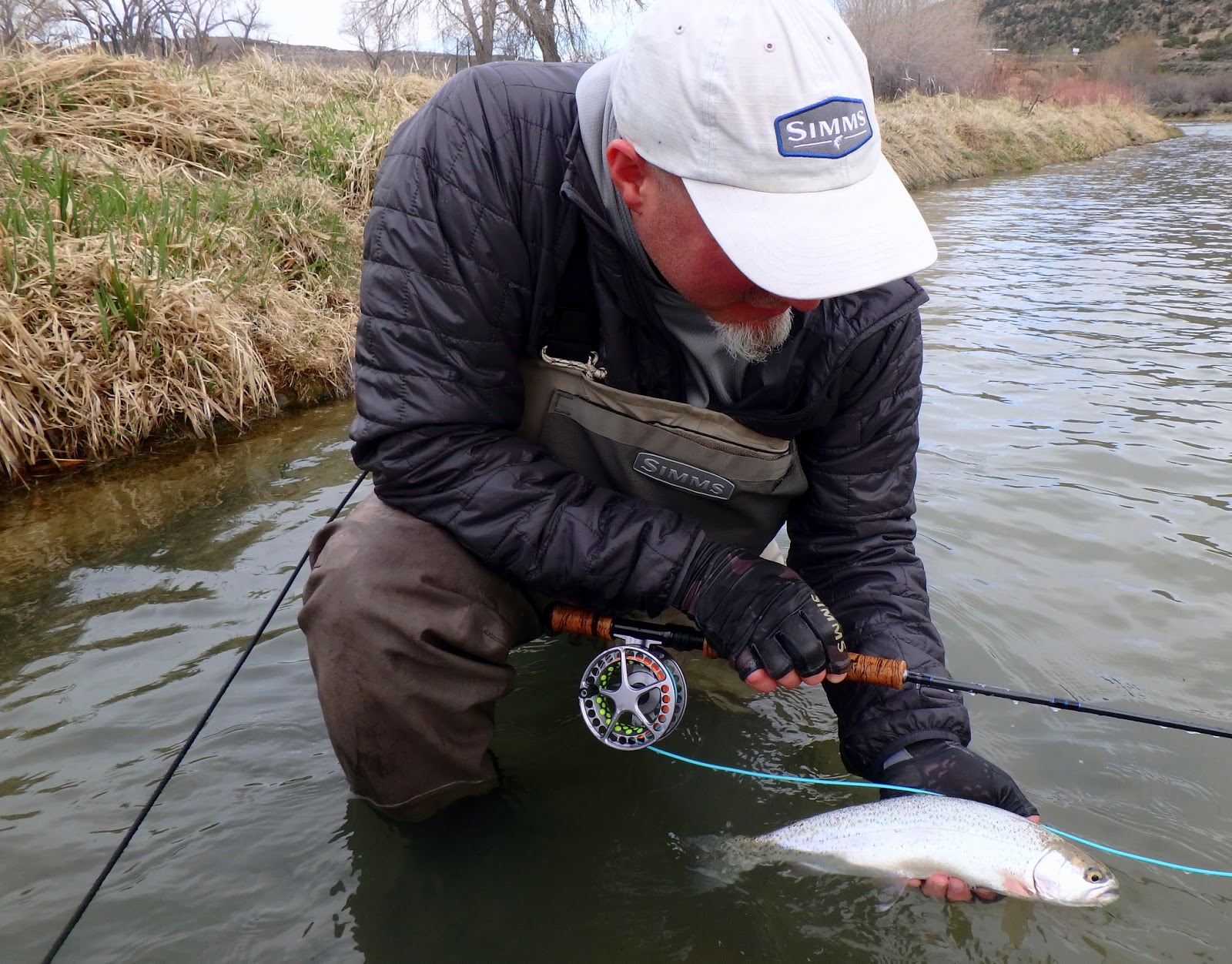
Custom 9'3" Single Hand Skagit Rod
I'm certain the interest is growing in both steelhead and trout markets. I see your youtube videos and as I already mentioned, the line sales. Admittedly I'm going to be a little trout bias in this article that I believe is for good reasons. First reason is, for steelhead two hand anglers, single hand skagit will come absolutely natural, so I feel no real need to push this on you. Reason two is, I know many trout anglers despite the movement of trout spey still write off two hand skagit fishing as a tool they don't have any use for and has no place in their streams. Trout guys...with today's single hand skagit tactics you're about to run out of excuses. Drop "bob" already and feel the grab.

Michael McGovney swinging a 490-4 Peiroway Renegade

Single handed Skagit

Here's the beauty of this, we already have the lines. The modern short skagit such as OPST Commando, Scientific Anglers Spey Lite Integrated Skagit, RIO's InTouch Skagit Trout Spey and Airflo's Skagit Scout have not only changed spey but I would argue that the even bigger revolution happening now is they have created a gateway into single handed skagit.

Here's what I want you to do...

Go to your rod arsenal and pick out a 9' 5 weight, or something close. It could be a 586, 490, 376, 690, whatever you got that is trouty. Preferably on the moderate to mod-fast side of action is best; not only for groovy feeling but also for tippet protection. Follow the OPST provided chart below and choose a grain weight to match. Most 5 weight rods hit the 200-225gr skagit mark.
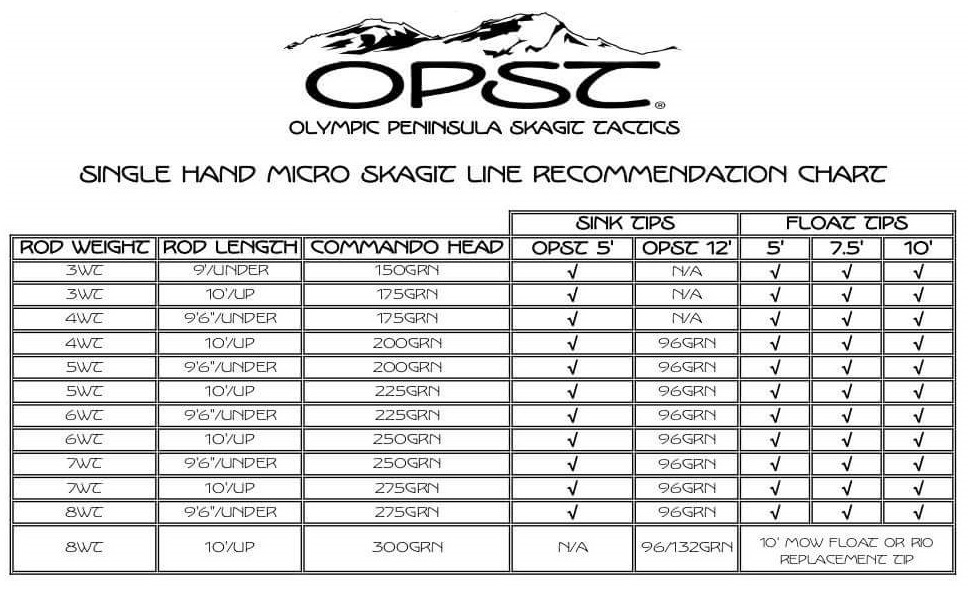
Courtesy of Olympic Peninsula Skagit Tactics

Choose your head or line system...

Here you have some choices, personally I choose the Scientific Anglers Spey Lite Integrated Skagit. The seamless, attached running line is very liberating with a single hand rod. The benefits include stripping flies all the way without loop interference in the rod guides and it also allows you to perform forward hauls on your cast without loop interference. Just for reference the S/A Spey Lite Skagit integrated shooting line section micrometers out at approximately 0.028 inch.

1/22/2019 - Update

The OPST Commando Smooth is now available! Now you have the famous Commando head seamlessly integrated to a thin shooting line. Just add OPST Micro Sink Tips and you've got a perfect simple system.

I know steelheaders are not going to deviate from separate head / running line setups. The benefits for this is you have many head choices and running line options to choose from. Admittedly I favor mono shooting line for the ease of distance but I feel in my trout fishing the versatility of integrated shooting line is a greater advantage then the additional distanced achieved with mono shooting line.

Choose a Running/Shooting line (Unless you chose the S/A Spey Lite Skagit Integrated)
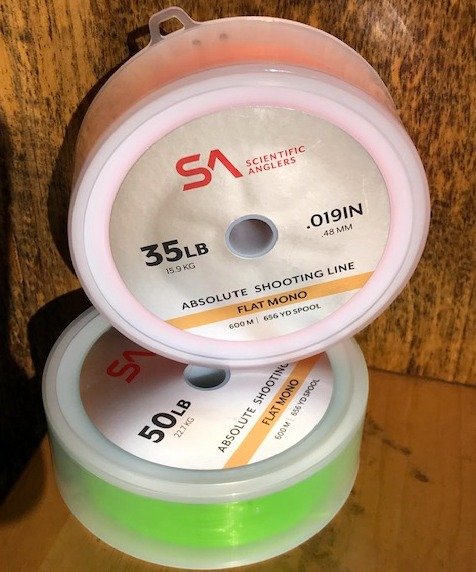
Many steelhead veterans will reach for a mono type of shooting line such as OPST Lazar or RIO Slick Shooter. When I do use head systems I like to use RIO Gripshooter in the 0.024" for its easy handling section and great shooting distance. If you want to retain the fly line feel in your shooting line reach for RIO Powerflex Max in 0.024" or RIO ConnectCore in 0.026".

Get some tips...

So many choices in this area that it's hard to even make a recommendation. If you've got steelhead poly's, (polyleaders or versileaders) go ahead and start with them and adjust from there. If you're buying tips just for trout I would consider OPST Micro Tips, Airflo Trout Polyleaders, RIO InTouch 10ft Sink tips and good old T-8 cut to fit sink material.


Choose a reel...

As long as you don't feel the need to have 500 yards of backing (exaggeration), and 100 feet of running line (more exaggeration). Stop! Put this in prospective. You're building a trout skagit setup. One hundred yards of backing should be more than enough. If your using a shooting line setup chop that line back to a reasonable amount like 60-70 feet. The S/A Spey Lite Integrated Skagits are 100 foot head and running line total, Perfect! Most of the time I get away with matching reel to the rod on my single hand trout skagit setups providing the reel is a large arbor of at least 5/6 size and I keep my backing to minimal. I could certainly see in some rivers such as Alaska big rainbow fisheries one would need a larger size reel for more backing, but I would also imagine one would be into a full on trout spey outfit as apposed to a small single hand skagit stick. You know your fishery, you be the judge.

Pick an assortment of flies...

I fish with anything from small intruders to soft hackles and many things in between. Swinging flies is more about getting your fly in front of fish then the fly itself. It's a game of forcing the fish to make a decision or miss out on a meal. Of course they can be selective but don't let yourself get to caught up on matching the hatch. More often than not I choose my fly according to the speed and/or depth of the water. Fast and shallow I want streamer flies that will swim. Slow and shallow I'll use a very sparse and lightly weighted leach pattern. Slow with silty bottom, get out you hackles and nymphs. Yes...I said it "nymphs", despite popular belief nymphs can in fact be fished on a tight line without a bobber!
597-4 Sage X Single Hand Skagit casts very well

The cast...

If you already two hand fish then skip this section. All the same rules apply from two hand to the single hand rod. Snap T, swing into the D-loop and away you go.

In this next statement is were I'm going to get a lot of sighs from the industry experts. If you are just getting started in spey, in my opinion, (IMO guys), with today's micro skagit lines learning spey with a single handed rod set up with micro skagits is FAR easier then learning full-on spey casting with two hand long rods. There, I said it! Now let me break it down to the basics.

Can you roll cast? Start there. Get to your water and pull out the skagit head all the way till it all hangs out the rod tip. This would be at the black marker section of the S/A Spey Lite. Start roll casting, feel it load. Get comfortable with it and work it until you can get line to lay out straight. You just performed the basis of all spey cast and this is a good time to inform you that all spey cast involve water loading just like a roll cast does. Spey casting is often described as modified versions of a roll cast.


Next you will need to learn some moves such as Snap-T and Reverse Spey that allow you to set your anchor point in various different locations. This is the point an instructor can really help but if you don't have a local instructor available you can find all kinds of YouTube videos demonstrating these casts.

Single Handed Spey Cast 

But it's too hard to learn!

John in the photo is not fluent in fly fishing period, let alone spey casting. This fish he is holding was taken on the swing with a single handed skagit setup in a about 15 minutes time from never having spey cast ever to fish in hand. I don't want to ever hear another word about it being too hard. Matter of fact with the proper prepared gear I believe a single handed spey cast is way easier to master basic technique as compared to learning effective traditional fly casting or two hand spey casting. John did have the benefit of not having old baggage to get in his way while dissecting each step of a snap T cast. He was a clean slate to work with and naturally possesses good motor muscle skills. I don't wish to downplay the event but don't want anglers to expect 15 minute success either. Combined circumstances of a good student, competent teacher, working gear and cooperative fish created a successful situation.

I'm writing this article to the trout guys who seek out smaller water...the guy that wants to swing some buggers while he watches for a hatch to come off..the guy who wants to ditch the "bob" and find the magic of tight line fishing nymphs or soft hackles...the guy who wants to learn some basic spey without throwing down a couple ounces of gold to do it.

It's not too late for me to learn a new trick and the best personal reward is it's not too late to teach this method to those that will be the future of this awesome sport of tricking fish with a fly.

I'm willing to show you how...Are you willing to discover!?


Gorge Fly Shop Internet Sales Manager | Product Specialist


"The passion of fishing is a lifelong pursuit of discovery"


May 4, 2017

Scientific Anglers Spey Lite Micro Skagit Review

Swinging Micro Skagits 

Are you into mini micro skagits? Read on...

Not into the micro skagits? Could be time to reconsider. Do you swing flies or want to swing flies? Are you interested in spey but hold back due to the many facets of gear acquisition and/or line confusion? Read on!!!

Brief History - What is Micro Skagit

We can accredit OPST with the short (micro) skagit revolution and while it was born on the heels of the steelhead angler those guys had enough insight to realize an open door into the emerging trout spey world. They built their micro skagits heads all the way down to 150 grain and short enough to open up the whole scene of micro skagit single handed rod spey casting. It is a revolution in the fly world that whether you've experienced it or not has created a dramatic change in the way we will view spey casting and fly fishing forever.

When I first entered trout spey nearly five years ago, an area of difficulty that exposed itself very early on was the lack of ability to fish close. Pre-Commando, light grain skagit heads at that time were just downsized from steelhead gear and still way too long. Connecting loops constantly got in the way when trying to fish short. While attempting to boycott head loop systems I tried every integrated switch/streamer version of line on the market from then to now and they all just, in my opinion, failed on the trout stream.

Short micro skagit heads such as commando and trout max solved the situation for most anglers but still the ability to strip and fish very short was interrupted by a loop connection. Every time I attempted to strip in close the head loop snags the guides, every time I attempt to cast close the head loop snags the guides and now that I do so much single handed micro spey the loop to loop connection interferes with my ability to haul my single handed spey cast.

I've been asking for a micro skagit seamlessly attached to a thin diameter running line. You'd think this would be a simple request yet don't ask me to run down the list of past failures because some would not like what I have to say about their current offerings.

Scientific Anglers Listened and Responded!

S/A Spey Lite Skagit

Two versions of this skagit line, Spey Lite Skagit Head and Spey Lite Integrated Skagit. I'm going to kick off this review with the fully integrated running line version

Impressions from actual testing
Starting with a subtle color called horizon they extruded a slick, durable, short, micro skagit head while ending it into an easy to see, in any light, black marker section and finally seamlessly integrates into a thin diameter subtle horizon color running line.

S/A added one additional feature with texturing on the black head marker section to create an audible reference which indicates the head has reached the tip top. At first I didn't give this much thought but after using it I started to realize I was locating the head with my ears and no longer needed to watch for the head marker. The small subtle section of textured line created no interference and the added reference proved to be a cool benefit. The textured section starts immediately at the end of the head and runs about 3 feet of line. Note that this is the only textured part of this full integrated skagit line and the head only version does not have this feature.

Casting Performance

Very Impressive! This is a real deal micro skagit! I put the integrated version skagit through a variety of test subjects including actual two hand trout spey rods as well as four and five weight single hand rods. I easily adapted to all my test rods with many styles of cast including Snap T's, Reverse Snap T's, Snap C's, Reverse Double Speys, T&G's and Single Hand forward hauls. All cast where easy to execute with appropriate tips applied. The Spey rods of course handled T-8 with ease while the single hand rods are best to be equipped with polyleaders. I was able to cast 8' of T-8 with a 9' 5 weight rod with relative ease. I not going to elaborate more into this area because it is a grey area. Limitations of sink tip choice have more to do with the power in the rod being used and ones casting ability. With my equipment and ability I could easily push the limits beyond the printed S/A recommendations found in the product specs.

I'll save you the squalls of smooth, tight and precise analogies and tell you the way it is. It's a skagit! By design they are created to chuck spey cast with relative ease while utilizing sink tips and weighted flies. Spey Lite Skagit performs these duties precisely and effectively.

Test Subjects
Aside the qualities we already talked about this line also benefits from a very slick integrated shooting line. I measured the running/shooting line diameter on both a 210 and 240 grain lines and it micrometers at about .028".  I found the handling and shooting ability of the integrated running line to exceed my expectations on both trout spey two hand rods as well as single hand spey rod setups.

Specs -
Item #Head WeightHead LengthColorSink RateLength
128568
150gr
11ft
Horizon/Black/Horizon
Float
100ft
128575
180gr
11ft
Horizon/Black/Horizon
Float
100ft
128582
210gr
12ft
Horizon/Black/Horizon
Float
100ft
128599
240gr
13ft
Horizon/Black/Horizon
Float
100ft
128605
270gr
14ft
Horizon/Black/Horizon
Float
100ft
128612
300gr
15.5ft
Horizon/Black/Horizon
Float
100ft
128629
330gr
17ft
Horizon/Black/Horizon
Float
100ft
128636
360gr
18ft
Horizon/Black/Horizon
Float
100ft


I feel the integrated version of this line really benefits single handed spey rod setups. With the Spey Lite Integrated Skagit on a (for example), 9 foot 5 weight fly rod I can swing flies with mild sink tips or polyleaders and strip them in all the way to the leader. I can also add a "haul" to my forward cast for ease of distance without a loop connection interference. Whether fishing single hand rods, switch rods or trout spey rods the Spey Lite Integrated Skagit gives the angler more versatility "in tighter", on smaller water.

Brownie Likes the swing

Spey Lite Skagit Heads

For many anglers, separate heads and running/shooting/mono lines are better for their purpose. S/A Spey Lite Skagit also comes in a head only configuration. Same great subtle horizon color with black marker rear section. The head version does not have the textured audible section. The head lengths are identical to the integrated version and I found in testing, performance matched exactly.

Specs -
Item #Head WeightHead LengthColorSink Rate
128643150gr11ftBlack/HorizonFloat
128650180gr11ftBlack/HorizonFloat
128667210gr12ftBlack/HorizonFloat
128674240gr13ftBlack/HorizonFloat
128681270gr14ftBlack/HorizonFloat
128698300gr15.5ftBlack/HorizonFloat
128704330gr17ftBlack/HorizonFloat
128711360gr18ftBlack/HorizonFloat

Line Identification

One simple feature I really like about S/A lines is their vertical printed line identification. I find vertical is much easier to read then the horizontal printing others use. Also with the black rear section there is no guessing which end is what on the head only versions. 

Line identification easy to read

I think the integrated version is a slam dunk for those interested in single hand rod spey techniques and also a great choice for those wanting to get into trout spey and not be hassled with loops or too many running line and head choices. The head only version is perfect for those are already accustomed to these systems and/or want that versatility of head and running line choices. Either way they are both excellent performing and high quality that we've come to expect from Scientific Anglers.


Gorge Fly Shop 
Internet Sales Manager
Product Specialist

"Fly Fish the World with Us"

Mar 9, 2017

Sage ONE Trout Spey 2109-4 Review

Winter Bow
The highly anticipated player in my multi year trout spey obsession is now in hand! The acclaimed Sage ONE Trout Spey 2109-4. I've been dreaming of the tug on a tight line swing with this pint size trout spey for longer than this rod has even existed. The anticipation is maddening!


Sage One 2109-4

Light, balanced, smooth, without hesitation the power exhibited from the 2109 would go unnoticed if it weren't for your fly landing on the other side of the river. Effortless is an understatement!

It's closing in on 4 years since I've landed my first two hand trout. In that time I have fished some amazing water with some great rods. Those rods have helped me learn and refine my casts and tactics in the pursuit of trout on the swing, especially winter trout.

I've always felt a yearning to downsize my gear. The fives, fours and three weights in progression have always led me to seeking smaller, lighter sticks. I have even spent a considerable amount of time throwing one hand spey on single hand rods and that experience has further increased my desire for less.
A peek at my one hand spey game
I've noticed in many two hand trout conversations that it's generally assumed the smaller trout speys cannot do as much as their big brethren. Proceed with caution in these conversations. Many factors play a part in this discussion including fly size, river size, line weights and wind. In thinking about a trout spey rod consider them to be just longer than average fly rods but with a ton of serious power hiding down deep in the butt section. To be a spey rod and trouty at the same time the rod must have reasonably limber deep loading tip sections for light tippet fish-ability but still harness power to move skagit, sink tip and fly. Trout spey rods, just like fly rods, as conditions increase in difficulty be it such as wind or fly size so does the nature of casting difficulty increase.

My point to all this chatter is to express the idea not to assume the little 2109 is incapable of skagit head, sink tip and weighted flies. This stick possesses a serious amount of trout soul while still having a strong backbone. While not the rod I reach for in the most demanding conditions it has become the rod I grab in all but the toughest conditions.

My experience with trout spey is we are just now realizing the full potential of abilities with the smaller rod offerings. New lines today from RIO, OPST and Airflo have been key in helping us to extract the deeper potential in these small rods. I have witnessed a combined effort of trout speys and short skagits that has taken us to where we have arrived today. Without these ultra short skagits I believe we'd still be unclear in the validity of such small spey rod offerings.

2109 - Not a wimpy noodle!

I gave 2109 a RIO Skagit Trout Max in 225gr and looped on 10' of T-8 and one of my cone head tube flies and went to work! Snap T, swing into the D-loop and gave a pull on the lower hand and away it went as if it was in autopilot. It felt right from the first cast!

Shown with the New RIO Powerflex Max .024"
What's that hiding in the background!

For this rig I chose a Sage 4650 fly reel. I loaded it with 100yds of gel spun backing, spooled on a RIO Gripshooter line in 25# and looped that to the Skagit Max Trout 225gr head. The 4650 five weight reel had plenty of room for the trout size spey lines and with it's lightweight feel, precision sealed disc drag and a audible clicker is a great compliment to the overall trout spey outfit.

RIO Skagit Max Trout Head measuring at eleven foot is the shortest of any skagits I know. When I first tested these heads I had some trouble holding anchor points. I found them more useful on single hand rods for one handed spey cast. Figuring the short length of 2109 I felt that I should give the little skagit a try. I am a bit surprised at how well a 225gr matched up. I really like the shortness of these heads because they allow you to strip in closer. Yes, I swing flies but I also do a lot of swing/strip and many days that's the method the fish want.

Line It Up

I tested OPST Commando Heads in 225gr and the new Airflo Skagit Scout in 210gr. Both heads performed very well. I feel the 2109 just has a great progressive load that allows it to work well over a wide range of skagits. I see on the internet some guys really like this rod all the way down to OPST Commando 175gr. I haven't tried that yet but no reason why I won't in the future. Point is this rod is not picky so choose your preference but a great starting point would be the OPST 225gr.

Soon I will be testing some scandi's on 2109 as well as 3110. As of writing this I am in winter mode and that means staying active, swinging streamers and hunting for aggressive trout. The anticipation is what keeps me warm on cold winter days.

Some will question my sanity claiming I have found the ultimate Trout Spey and it happens to be this little guy 2109. Truth is the entire Sage ONE Trout Series is incredible and if your water calls for bigger, more powerful and longer sticks then by all means step up. The 3110 sibling is super sweet a very capable player of all things trout. The 4116 feels a tad faster and while it handles a skagit with authority it is also "and" still my personal favorite scandi stick for bug sipping season.

If trout are in your perimeter reach and you haven't pick up a two hand trout spey yet then all I got to ask is "Why Not?" The gear is so good, we have all the lines we need, and the TUG CAN"T BE BEAT!


BassProGreg
Leave a Message


Gorge Fly Shop Internet Sales Manager | Product Specialist


"Fly Fish the World with Us"


Feb 11, 2016

Winter Troutin' 2016

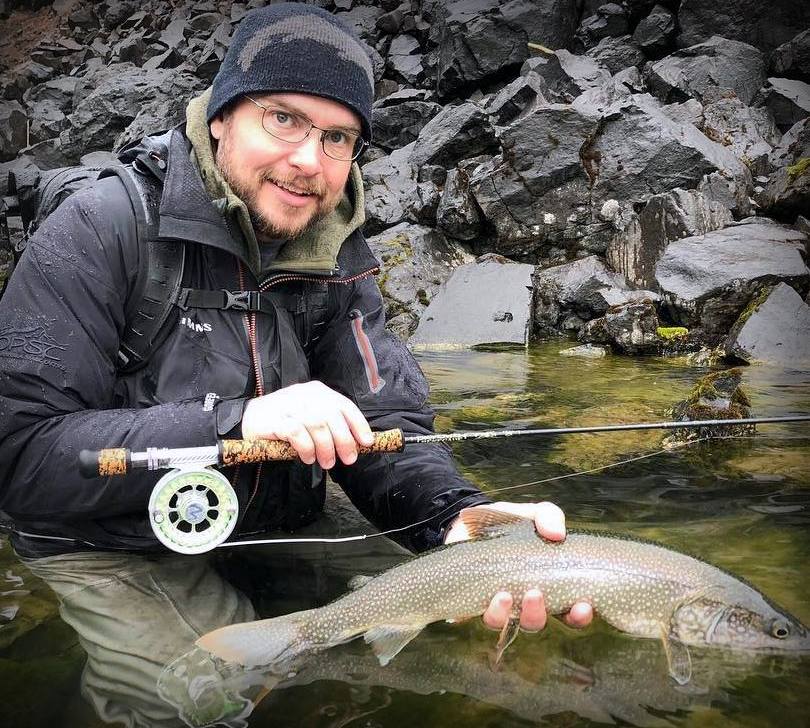
Ice on my rod guides and Trout in my hand, Priceless!
Why do I do it? I can give a dozen reasons not to do it like frozen guides, icy cold water, lethargic fish, frozen reels, numb hands, frozen snot and the list goes on. Now clear your mind for a minute and focus on the fishing. You're in a stream with no one else around. The air is crisp and clean. The sounds you hear other than your own can only be of nature. The fish that eat are the strongest in their environment. Just like you, they're not lying around being lazy. Just like you, winter trout have learn to embraced the cold and strive to live a life of solitude and peace even when it would just be easier to rest back in deep holes and sip on midge larvae all winter.

Those words are as much to encourage myself as they are to encourage others. You see I don't need another excuse to not go winter troutin' but when I put it all aside and finally get to release a strong beautiful fish like the one in the picture all of the excuses to not do it are erased.

How to do it
coffee break
I set out on this cold winters day to float about 5 miles of river in my Outcast Stealth Pro. I especially like to float this time of year. It's so much easier to cover water this way instead of trying to access everything on foot. Snow, mud and ice on foot makes trekking very treacherous. It's much easier to float plus I get to cover a lot of water. I'm only looking for the most active eager fish and I find them in current on seams where the water is alive and oxygenated.

On this day I had three rods with me. That's another advantage of floating, you can carry multiple rods.  My tried and true Winston BIIIX 4110-4 Microspey with a Bauer CFX #4 Trout spey reel. I loaded it with the Airflo Switch Streamer line of 330gr and 10 foot of T-7 Sink Tip. I must confess I modified the Airflo line. Everything is perfect about this line except the abnormally large running line part of it. I couldn't take no more so I chopped it at the back side of the head and applied a RIO Braided loop so I could connect it to RIO SlickShooter mono shooting line. I'm not suggesting everyone should do this. Try it first and you might be fine with it. I made it through last year fishing it but winter freezing temps finally made me give up on it. Too thick to work in icy guides and shooting lines such as mono are much better for this cold weather fishing.

Peregrine Falcon

My next outfit is the new Sage ONE 3110-4 Trout Spey coupled with a Lamson Litespeed #3 reel and the RIO Intouch Switch Chucker #3. The Sage rod feels great! I'll be doing a full review on it in the near future once I've had a chance to fish it some more with some different lines and heads. Right away this grip on the Sage feels so great...It just fits me and the rod balances perfect. What I didn't like on this day was the Switch Chucker. I just don't get this line. It just doesn't turn over for me easy. Maybe it's me or maybe I expect too much from it. I started out with 8 foot of T-7 sink tip but backed off to a 10 foot fast sinking polyleader. It still seamed difficult to turn over.  Maybe it needs a 5 foot polyleader or just a regular leader. I will fish the Sage rod again soon with the RIO Skagit Trout Max heads and also try my favorite scandi the RIO Scandi Short VersiTip. I wished I had the VersiTip with me this day. It would have been ideal for some of the slower riffles that were holding fish. The sink tips I was fishing were too much for them.

Mr Brown hammered a streamer in icy cold water
My third outfit was a 9' 7wt unnamed rod let's consider it a prototype coupled with a Bauer CFX #4 Trout Spey reel. For lines I had a RIO 0.024" Powerflex shooting line looped to a OPST 225gr. Commando head and 8 foot of T-7 Sink tip. I can't begin to describe how fun this setup is. Just think about what you want to achieve and do it. Roll cast like a dream, overheads easy and spey is just too fun. Set you anchor and let it rip or perform a touch and go cast. These super short commando heads bring life to single hand rods in ways that one should not overlook. I found myself fishing small micro seams that I used to pass over because my two hand rods were just to much for these little pockets. With OPST Commando heads or the RIO Skagit Trout Max heads I am now seeing new water to fish and it's paying off. The trout on the top of the page came on this outfit on a micro seam.

Towards the end of my float is a long great swing run. Another advantage of floating is I was able to set up on the opposite side of the river of were it could be foot accessed. A nymph angler was across the way so I stayed clear of him. I was backed up tight to the bank and needed to Snap T cast to set up my swing. A minute later the nymph guy yelled down and said "Nice Snap T!" I yelled back and said you are the first person on this river to know what that is. I went on and caught a couple and he also caught a couple. When I left I rowed my boat across river and up the back eddy to the guy. Got out and chatted. Yep he lived in the NW and had been spey fishing for 20 years on the peninsula and BC. He continued to fish as we chatted and I couldn't help noticing the double spey he was doing with his single hand nymph rod setup. The only reason I bring this up is that it doesn't matter what technique you're doing out there anyone can benefit from some two hand techniques. After watching him perform endless double speys I had no reason to doubt any word he spoke of his steelhead experiences. He wasn't thinking about what he was doing, he was just doing it.

So back to the question "Why do I do it?"
 I think the answer to that is somewhere in this article

More articles like this one in Trout Spey Chronicles

BassProGreg


Gorge Fly Shop Internet Sales Manager | Product Specialist


"Fly Fish the World with Us"


Jul 15, 2015

New from Sage - ONE Trout Spey

ONE Trout Spey = Ultra Light Two Hand Rods specifically for trout chasers

Sage ONE Trout Spey

The ONE Trout Spey rods are designed specifically for two-handed casting and swinging flies for trout. These ultra-light Spey rods are delicate enough to protect small flies on light tippets yet are powerful enough to cast modestly weighted streamers on light sink tips. The Super Plus cork mini-Spey fore and rear grip complete these two models. These ONE models will retail for $1050 and will be available August 2015. 

“Anglers looking for ultra-light rods and rods made specifically for chasing trout with a Spey rod, now have the just that in the world-class design of the ONE rod family,” says Sage chief rod designer, Jerry Siem.

Sage builds on its successful ONE family of fly rods with the addition of the LITTLE ONE and the ONE Trout Spey. Both new rod families utilize Konnetic Technology®, Sage’s exclusive rod technology that allows for slimmer blank profiles with maximized strength and energy transfer without sacrificing line speed, responsiveness, and accuracy.

Notes From George Cook
The new One Trout Spey features the One Rod Story-line bringing premium performance through the Konnetic platform to the Small Spey World (2109-4, 3110-4).  We recently had the good fortune to put the 3110-4 to the test on Alaska’s Kenai River taking rainbows to 22”.  These rods are perfectly matched with RIO’s Skagit MAX Short (Swing Game), small sized Switch Chucker’s, along with the brand new specialized Skagit Trout Max (Some Swing Mostly Streamer Strip), and Small Scandi Tapers.  Whether you find yourself swinging a soft hackle on the Deschutes or Madison, a fall quest for Sea run Cutthroat in the Pacific Northwest or swinging streamers for Trout both near and far you have your tool in the ONE Trout Spey.

Jun 27, 2015

Airflo Super-DRI Switch Float - Now in Stock!

Power Up your Switch Rod
In the two plus years I have been plying trout waters with switch / micro spey rods one thing came quite clear, we needed a specialized two hand trout line! After expressing my need to several industry professionals I finally not only found someone to listen but also learned that others had reached the same conclusion. Thanks to line wizards Tim Rajeff and Tom Larimer we now have a set of trout spey lines that will benefit us all for years to come. Dry line or sinking tip these fully integrated lines have established the new standard on trout rivers across the nation while enabling modern trout anglers to easily gain the benefits of two hand angling.

Finally...a taper formulated for switch and small spey rods with the same feeling and performance you'd expect from Airflo's family of spey products.


After years of splicing, welding, and testing "Franken-Lines", Tom Larimer and the Airflo Design Team have produced the best weight-forward, integrated switch line available today. The Super-DRI Switch is an ideal match for light switch and small spey rods, designed for anglers tossing surface patterns or swinging soft hackles and small streamers.

Based loosely on the popular Rage Shooting Head, the Super-DRI Switch has a compact weight-forward head designed specifically to compliment today's lighter two-handers, making loading the rod incredibly easy.

The innovative front taper is capable of turning over a variety of leader and fly combinations, and is also able to accommodate light sink tips. Perhaps the most important feature is the seamless joint between head and running line, making it easy to strip flies all the way to your feet. For easy rigging, each line is packaged with an Airflo 10' Floating PolyLeader.

Available in line weights 3-6, and grain weights ranging from 210-390.

Compliment your Airflo Switch Float with the ALL NEW Airflo Streamer Switch line designed especially for Sink Tip use. 

Switch Streamer - Designed for real sink tips!

An evolutionary step from our popular Skagit Switch design, the Super-DRI Streamer Switch features an aggressive front taper with a shorter, heavier head designed to make tip tossing a dream. Specifically designed to easily load modern switch and short spey rods, the Streamer Switch will help anglers of any level of skill or experience cast more efficiently and effectively.


The Airflo Switch Streamer is a complete head and line integrated together and includes a 10' Fast sinking replaceable Polyleader. Just add tippet and fly and your switch rod is ready. 


Specs - Short heavy head for turning over sink tips

Line Size Color Head Weight Head Length Sink Rate Total Length
WF4 Pale Mint/Orange 300 18ft Float 85ft
WF4.5 Pale Mint/Orange 330 18.5ft Float 85ft
WF5 Pale Mint/Orange 360 18.5ft Float 85ft
WF5.5 Pale Mint/Orange 390 20ft Float 85ft
WF6 Pale Mint/Orange 420 20ft Float 85ft


Get more information about Trout Spey Lines - No Perfect Answer!

Get more Trout Spey Buzz from Trout Spey Chronicles

May 13, 2015

Trout Spey Reels

Trout Spey Reels

Does one need a special reel for a trout spey rod? Absolutely! We must always be in pursuit of the perfect match of rod, REEL and line!

So what makes a perfect reel for a two hand trout spey rod outfit? While line capacity, drag performance and weight account for most of the answer ultimately we still get to make our own decision based on pure personal preference. It's hard not to like all fly reels. Machined aluminum, anodized colors and precision movement, what's not to like! If you're tired of standard issue offerings you can always spring for one of the many custom options including colors and engravings offered by many fly reel manufactures including Abel, Nautilus, Tibor and Bauer.

Just like in my previous line article (Trout Spey Lines - No Perfect Answer!), I'm not going to go into every little detail about fly reels but instead review the reels I have used, what I like and don't like about them.

Bauer CFX4 Spey

While CFX #5 and #6 spey reels are not new the Bauer CFX #4 size is new. Brand New! I bought the first two to ever ship from the Bauer factory. Summer 2014 over lunch with Jon Bauer on my travels through southern Oregon an idea came to me that I instantly shared with Jon. I told Jon that current spey and switch specific reels are too large for my trout spey rod needs and most of today's single hand fly reels are too light to properly balance my two hand rods. Not to mention they just don't have a soulful look. Now I'm not a retro reel enthusiast but I do love the look of a solid back reel and the extra metal adds the weight needed to balance a two hand rod. Jon Bauer understood my needs and agreed to do a run of CFX #4 with solid backs like the #5 and #6 CFX spey reels. He has some inventory of them and because the spool is the same as the standard CFX all color options are available including the inner drum and drag knob colors. At this time of writing we are currently the only Bauer dealer with this CFX #4 spey option on our website.

Solid!
Bauer reels are smooth operators with undetectable start up inertia.
It's one of the few reels that still uses hardwood handles, something that I like and find lacking on most modern reels. On the CFX model you will find the drag knob located on the crank side of the reel. This is an age old argument as popular as which hand should you retrieve with. I like the drag on the crank side, why would I want to reach around the reel to adjust drag and have to think about which way to turn the knob to adjust. Having the drag knob on the crank side makes it easy to adjust when needed and the design of the knob lets you reach in with two fingers to make an adjustment so as to avoid getting your knuckles whacked by the crank.

Specs - Bauer CFX #4
  • Diameter 3.75"
  • Weight 6.6 oz (scaled 6.6 oz) 
  • Capacity 330gr Airflo Switch Streamer + 100yds/20# backing
  • RIO Scandi Short VersiTip 320gr #5 + Rio Powerflex 0.024 running line + 100yds/20# (lots of room to spare)

The CFX #4 should handle any 3 and 4 weight spey/switch rods and lines and maybe have enough capacity for some 5 weight rods depending on your line choices.

Note about spey reel specs
There are so many variables in two hand reel specs that you really should take in consideration when choosing a reel size. How much backing do you want/need? What length and diameter of running line do you intend to use? What line or head system will you choose; (I.E. Skagit, Scandi, integrated or other)? I start out with 100yds of 20# backing. I consider that to be more than enough for the trout angler. Running/shooting lines are a pretty big variable. Are you going to use mono or a standard level line? How long do you need? 100' running lines are pretty much overkill and you could easily gain some reel capacity by trimming off the backing end to 70' or 80' and still have more than enough. Skagit heads need more space than Scandi heads...So you can see the many variables with reels. I generally find reels in the 6/7/8 weight category to be sufficient for 3/4/5 weight trout speys.

Tibor Light Back Country CL Wide

Not a "new to the scene" reel the Tibor Light Series of reels have been around for quite awhile. Modern in design but yet I feel they possess a look missing in so many of today's new reels.
I originally purchased my Back Country reel for my Sage Bass Series Smallmouth Rod but I had to try it out on my Winston 4110 Microspey. It is a perfect marriage! Balance, capacity and the soulful look is hard to beat. I'd like to get another in a different color and return the bass red to the rightful place on the Sage Bass II rod but until I need it for that purpose it's found a home on my Winston.
The drag is silky smooth and has done an excellent job of protecting lite tippet. I like the adjuster on it too. Do note that I retrieve right hand and that puts the adjuster on the forward end of the reel. This would be reversed to the rearward end for left hand retrievers. I've had various different 3 and 4 weight spey lines on it with no capacity issues. I have also run a mono shooting line on it and never once did it slip out of the frame.

Specs - Tibor Back Country CL
  • Diameter 3 5/8"
  • Weight 5.5 oz (scaled 6.5 oz) 
  • Capacity Rio #5-320gr Scandi Short VersiTip + Rio Powerflex 0.024 running line + 100yds/20#.

Sage Domain

Sage Domain - Full Caged Frame
I paired a Sage Domain reel to my Sage ONE 4116 with the idea that it would be lined with a mono running line and a scandi head. The full cage frame would keep the mono tamed and the weight would be a good balance. I did a risky gamble going with the 5/6 size but it worked out perfect! The stealth black look goes great with the Sage One. The drag has functioned flawlessly just like I have come to expect from all my Sage reels. If I had any complaints it would be that the spool is hard to remove but that's not really an issue considering I don't intend on having extra spools for it. The Domain is a nice mix of modern features such as large arbor and precision drag while including important two hand functionality such as full caged frame and enough weight for rod balancing. Capacity seems generous to the point that I was able to make the Size  #5 work for me with a mono running line and a scandi head but you would want to get the #8 if level running line and/or skagit head is in your plans.

Specs - Domain #5
  • Diameter 3.60"
  • Weight 6.2 oz (scaled 6.0 oz) 
  • Capacity Rio #5-320gr Scandi Short VersiTip + S/A 0.021" Mono Shooting line + 100yds/20# backing

Lamson Litespeed #3

If you're seeking lightweight it's hard to beat a Lamson Litespeed. While lighter than I prefer I have used a #3 Litespeed to do a lot of different line testings and it just works and looks great. Reliable effective smooth drag and large arbor for fast retrieves has given the Litespeed an incredible reputation as a highly effective fishing tool. I really have no complaints about any of the Lamson reels I own. Lamson actually has many great choices for the two hand enthusiast including the Speedster HD, ARX and Guru HD which are all full frame caged reels.


Specs - Litespeed #3
  • Diameter 3.75"
  • Weight 4.63 oz (scale 4.5 oz) 
  • Capacity - Rio #5 Scandi Short VersiTip + Rio ConnectCore 0.026 running line + 100 yds/20# backing
Lamson Speedster HD

Lamson Speedster HD #3

Modern, great looking, reliable and high performance are the words I will use to describe the Speedster HD Series of reels. Sure I love the soulful look of solid backs and hardwood handles of the more traditional style reels but you've got to respect the modern advancement of technology that comes with the Lamson Speedster. It's like comparing a 60's muscle car with a modern day Corvette. Both deserve our respect and what you choose is your choice and no choice is wrong! You certainly can't go wrong with the Speedster. I only wish they made it in black, (Hello Lamson: Hint! Hint!). While on the lite side of two hand reels I found my Speedster HD #3 to be in the ballpark of balance with the Winston 4110 Microspey.

Specs - Speedster #3 HD
  • Diameter 4.0" 
  • Weight 5.3 oz (scale 5.4) 
  • Capacity - Rio 325gr Skagit Max Short + S/A Textured Shooting line 0.032" + 100yds/20# backing...NOTE: This combo really packed the speedster but most of the line overkill comes from the S/A 120' of shooting line. You could chop that back to 90' and still have more than enough running line and get back lost capacity

Full Cage vs. No Cage

Caged (Lamson Speedster HD) vs. No Cage (Lamson Speedster)
Why use a full cage reel? The best reason to utilize a full cage is to help tame mono running lines. Mono running lines can be a love / hate relationship, you either learn to love what they can do for you or you end up hating how they can treat you. The advantages you get with mono such as longer casts have to be weighed out with the disadvantages such as tangling and coiling. One way to help tame mono is incorporating the use of a full caged reel. The cage part of the frame acts like a line guide and therefore removes some of the freedom a mono line has to coil around things or sneak out between frame and spool. In some cases a full cage reel can have an added benefit being that they usually weigh more than cage free designs thereby helping balance your two hand rod. So even if you never intend to use a mono running line you still might find a caged reel to be a weight benefit. An "easy to see the difference" example of this is the Lamson Speedster which is made in both caged and cage free models. The Lamson Speedster #3 (cage free) weighs in at 4.7 oz while the Lamson Speedster HD (caged) weights in at 5.3 oz. Although 0.6 oz is not a huge difference it is a noticeable difference in where your rod will balance.

To further this conversation about rod balance I'd like to point out a couple details of interest. First is,  I find reels that are too heavy to be more annoying than reels that are too light. When a reel is too heavy you are constantly forcing the tip of the rod down. Personally I find it easier to fish a rod that I have to pull the tip up. Second item is you can always add weight to a reel but you can't remove weight. Weight can be added to a reel simply by adding some tungsten sink tip or lead core line to the arbor of your spool. 200 grains of sink tip material is almost 0.50 oz. Keep in mind to feel the actual balance of a rod you will need to have a loaded reel attached with the line strung through the guides and the head part of the line outside the tip top just as if you are fishing to get an accurate idea of how the rod will balance on the stream. Balancing a rod is not an exact science. Too many variables exist that change the balance points such as where do you grip the handle or how much running line is out the tip as well as what type of line are you fishing with. You really are just trying to get in the ballpark with reel weight and as long as you're in it you will have a comfortable effective fishing tool. When an outfit balances well you won't even notice it but offset the balance and it will become quite clear on the stream. I have tried a couple popular 8 weight large arbor salt type reels on my trout spey rods and while the capacity is great the balance was way off particularly to the annoying side of heavy whereas reels that are on the "too light" side of balance seem to lean on the side of acceptable.

My guess is if you are getting into trout spey you are probably already a seasoned angler. You probably already have some reels in your collection that might work great or they might help you to determine what weight or capacity you need for your rod. Send me your pictures and tell me what you like. I really enjoy hearing about your experiences. Thanks for reading.

Lines I use on these reels - Trout Spey Lines - No Perfect Answer!

My two hand trout adventures - Trout Spey Chronicles


BassProGreg


Gorge Fly Shop Internet Sales Manager | Product Specialist


"Fly Fish the World with Us"


Visit our Relaunched Steelhead Only Site

Shop Gorge Fly Shop & SteelheadBum.com

  © 'and' Steelhead.com Mike Prine 2009-2014

Back to TOP