Showing posts with label Streamer fishing. Show all posts

May 2, 2018

Airflo Streamer Max Short Fly Lines


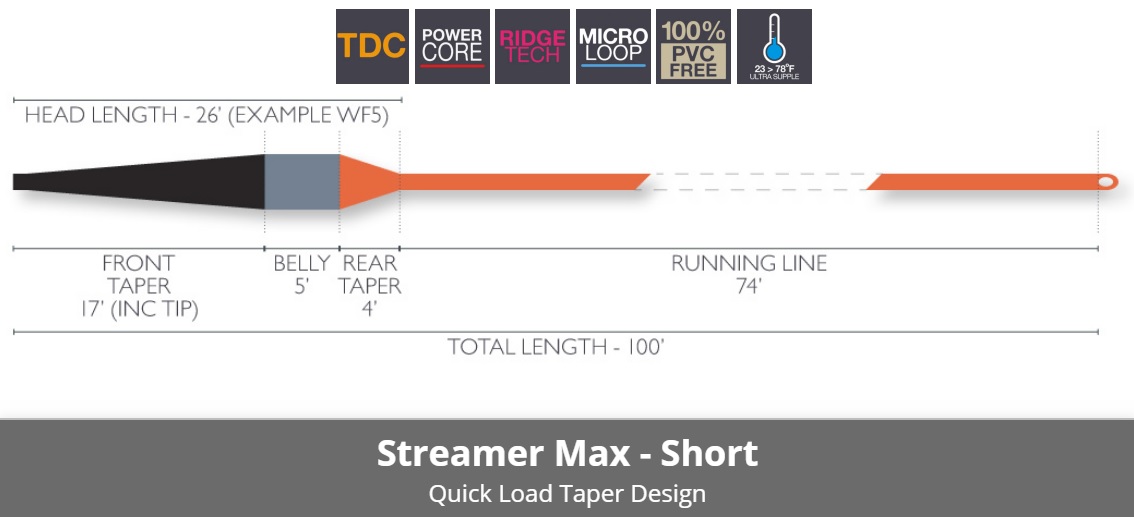
Airflo Streamer Max Short Fly Lines were developed specifically as a shooting head taper designed for throwing big streamers to bank hugging browns. It's quick load taper design and fast sinking head works for a variety of applications that involves predator species.

Rick Matney and the Airflo Design Team put their heads together to design the ultimate streamer line. Whether tossing streamers to bank hugging browns, baitfish patterns to mid-strata bass, or sliding nasty nymphs through deep shoots, this line does it all.

Features -
  • Taper: Quick Load Taper Design
  • Core: Power Core
  • Range: WF5 – WF10
  • Coating: Super-DRI Ridged running line
Specs -
Line SizeColorHead WeightHead LengthTotal LengthSink Rate
WF5Black/Grey/Orange160gr26ft100ft 7 ips 
WF6Black/Grey/Orange200gr26ft100ft 7.5 ips
WF7Black/Grey/Orange240gr26ft100ft 8 ips
WF8Black/Grey/Orange280gr26ft100ft8.5 ips 
WF9Black/Grey/Orange320gr26ft100ft10 ips 
WF10Black/Grey/Orange380gr26ft100ft10.5 ips

Find Streamer Max Short and all Airflo Fly Lines at...
"The Gorge"


The Gorge Fly Shop Team

541.386.6977


"Fly Fish the World with Us"

Feb 27, 2018

Airflo Super-Dri Streamer Float by Kelly Galloup


Streamer Taper fly lines are designed to make easy casting of larger then normal flies. They must have a stout enough head and front taper to facilitate fly turnover. Running line is generally thinner to aid in distance casting and because of that they don't mend well.
The taper of Airflo Super-Dri Streamer Float was designed by streamer legend Kelly Galloup. The 38.5' head length is ideal for launching long cast with heavy flies on 9 foot fly rods.

Find Airflo Fly Lines at...
"The Gorge"


The Gorge Fly Shop Team

541.386.6977


"Fly Fish the World with Us"

Dec 26, 2016

Scott Tidal Fly Rods - USA Built Under $500

Boogle Bug Bassin'

USA Built Under $500 - Article 12262016
This article series is intended to review Fly Fishing Rods and Reels under $500. The criteria for these reviews is that the actual product is tested in real world fishing conditions. They are not just wiggled in the showroom or cast in parking lot / show pond setting.

In doing some research I realized there are a few rods that demand our attention. They fit a budget, provide fish-able actions and are made in USA by top well known manufactures such as Sage, Scott and Winston. My goal is to fish a few of these rods and report what I find. In this article I will review the...

Scott Tidal 890-4

$495 (Scale Weight 4.2 oz) (Weight not published)
Handcrafted in Montrose, Colorado
While designated a saltwater stick I found these rods to have tons of soul. I call the action mod-fast. Yes I know it is listed as "Fast" on Scott's website. Now before you go and correct me let me just say I tend to rate rod actions lower then what the industry considers them. You see for me I didn't learn on rod actions that require a nap between strokes. So what the industry today calls moderate (yawn) I personally find to be painfully slow. I consider a mod-fast action rod to load rather deep and provide quite a bit of feel but still respond with quite a bit of power. I feel a mod-fast action as "wait for it" but no time for a nap!

This statement describes the Scott Tidal. I had to slow my stroke a little and "wait for it" but it recovers strong and delivers the goods with authority. I feel this rod action is ideal for situations such as winter redfishing, bass bugging and large streamers. It loads progressively deep while providing the angler with ample feedback to adjust one's stroke to match the required cast. The same action is super friendly with a short cast so often associated with winter redfishing. I would consider the Tidal to be a great rod for less experienced casters but not at all disappointing to a seasoned parking lot champion.

Deer Hair & Toothy Critters
I could cast this rod all day and never tire and I did just that on a couple of occasions this past summer while throwing bass bugs from the deck of my boat. Eight or nine hours straight of non-stop power casting and I never tired. I favored the S/A Wavelength Titan WF8F line for the Tidal. This double bump line does further slow the Tidal down but the key to the combo was the Tidal's power found down deep in the rod blank. This rod/line combo was really easy and effective for turning big wind resistant bass bugs like the frog in the picture.

Is the Tidal a 100 foot tight loop pro casting stick? No! If that's what you want/need then get the Scott Meridian. The Tidal is a rod that will let you relax, breathe and take in the scenery and don't fret over making "the cast". Just reach for it and let it happen. It probably is a stick that fits more anglers than most anglers are willing to admit.

Feather Game Changers
Finished in the natural look Scott Fly Rods has become known for the Tidal includes a cordura rod tube and Scott's lifetime warranty.

A bit about line choices


For the upcoming 2017 year you are going to see many new articles from us on this subject of line choices. No longer is it as easy as just buying the weight line that matches the rod. Most lines today are bumped in size, some as much as 2 line sizes and I even know of one line that is bumped 3 sizes. It's not all a bad thing. Modern high modulus graphite rods work over a wider grain range than ever and we as anglers further push the limits of fly size that places greater demands from rods and lines.

I'll write more about this subject in the near future but for now I challenge you to try something. If you have a few rods and line choices in similar sizes I want you to take a 7 weight line and try it on an eight weight and vice versa. Or a 5 on a 6 weight or a 6 on a 5 weight. Whatever you have to test this out with. You might be amazed at the results. You might find a new personality in your favorite rod or you may find a love with a rod you previously couldn't connect with.

Ditch the Yarn...

Aluminum Tube
When it is necessary to parking lot / yard test fly rods I use actual flies that I would be fishing with. I use old half worn out flies and cut the hooks off. Make it as true as possible to the conditions you will be using the rod for. Most times casting yarn does not provide accurate results unless you're buying a rod for dry fly work.

1.23.2017 - Correction

I had indicated that the Scott Tidal Comes in a Cordura Rod Tube. That is incorrect. It Comes in a Aluminum Tube and Cloth Rod Sock.

Wrap it up! I'll take one!

Seriously, I'm adding an 890-4 Tidal to my boat quiver as a big fly bass/pike rod this year. The Tidal is a super fun easy rod. It has a ton of soul and also exhibits a ton of crossover. It can easy be tuned with different fly lines to match anglers casting preferences and fishing conditions. It's got the great qualities all Scott Fly Rods are known for including the lifetime warranty and hand built in the USA.

BassProGreg


Gorge Fly Shop Internet Sales Manager | Product Specialist


"Fly Fish the World with Us"


Read more of Greg's Post

Feb 5, 2016

Gearing up for Meat Eating Trout

meat eater

Hi, my name is Ryan and I have a streamer problem.

Some would say I have an addiction. 

Some would say it’s not “real” fly fishing. 

Some would say you might as well fish with a spinning rod. 

I would say bite me!

 I have been a die-hard streamer guy for over a decade now and I will do my best to try to explain why and how I am setup for slinging big flies to monster trout.

There are 3 reasons I have become a streamer junkie:
  • Streamer fishing is active fishing or what they would call power fishing in the tournament bass world. You are casting and moving a lot, and really looking for fish that want to play ball. It isn’t a finesse game, but it will work when you can’t move fish other ways. 
  • Streamer strikes are often vicious and jarring. Once you have felt a few big trout crush a sculpin pattern it is hard to go back to watching a bobber… 
  • Streamers will move the biggest fish in the system. If you want to catch big fish regularly, then you better learn how to feed them some meat! 

Sculpin pattern
There are some important things to think about when considering the whys, whens and hows of streamer fishing. If you think about a simple energy used to energy gained equation, it is easy to understand why a trout would eat a sculpin, dace, leech, or another trout. How many midge larvae does it take to equal the calories in one sculpin? A bunch, I would say. Another crucial aspect of streamer fishing is understanding territorial behavior and reaction strikes. Trout, particularly large trout, will defend their area even if they don’t eat what they attack. Large trout will also strike invaders for no other reason than instinct. If a big “thing” is suddenly slapped in front of them or jigs right through their field of vision, they will often strike with malicious intent.

There are many ways to fish a streamer, and I can’t possibly cover it all here, but there are a few major categories: slapping the bank, swinging, and jigging/twitching. As you dive into the streamer chucking realm you will find out when and where to use each of these, and often I will use all of them in the same day. Now don’t get me wrong, if there is a good steady hatch I will put the streamer rod down, but when the insects aren’t prolific, you will most likely see me with a leech or sculpin on my rig. And I can tell you that I have caught as many sporadically rising trout on a well placed streamer as any dry fly I have tried to present.

Meat Locker

Rainbows on the Yakima River
So let’s get down to brass tax; gearing up for the streamer game… Let me start by saying that you can fish streamers on any trout rod and line you already own, but a dedicated streamer rod will make your life easier, and give you the ability to fish effectively, especially with bigger flies. For me, a single hand trout streamer rod should be a 6 or 7 wt that isn’t too fast. Some of my favorites are the Winston BIIIx, Sage ONE, and G Loomis NRX. I know these are top end rods, but trust me, you want a rod that performs well and is light enough to cast all day when you are throwing big flies. The fly line is equally as important as the rod. For most western rivers you will need a sink tip line. My favorites are the RIO InTouch Outbound Short full floater (WF6) and intermediate/type 6 sink tip (WF6I/S6), the RIO InTouch Streamer Tip intermediate and type 6 and the RIO InTouch 15ft Sink Tip type 6. Of these the 15ft sink tip is the most versatile and the outbound short is easiest to cast. I prefer the type 6 tips for all of these because I rarely if ever wish my flies would sink less, but often wish I could get deeper.

Winter Brownie

Now let me tell you that not all streamer fishing has to be aggressive and with big flies. Fishing a streamer in smaller water or quiet pools requires some finesse and working the fly in a seductive manner. For smaller water, i.e. spring creeks, small freestones and slower tailwaters, etc. you will like a shorter rod in a 5wt as it will really help your accuracy and will load quickly. There aren’t as many choices in short 5wt rods these days, but a few I can recommend are the Loomis Shorestalker 8ft 5wt, the Scott G2 8’4” 5wt and the Winston 8’6” 5wt BIIIx. If you are in really small water or fishing for smaller fish don’t hesitate to throw small streamers on your 7’6” - 8’ 3 or 4wt too! You will also not typically need a sink tip line for small water, but a good all purpose line should get the job done.


Trout Spey Chronicles
Microspey, trout spey, small ball, whatever you call it, trout sized spey/switch rods have changed the streamer chucker’s game for good. How I would have killed for one of these rods 10 years ago. The ability to make long casts with big flies and sink tips across a river and into that deep slot has always been the bane of a streamer nut, but we did it anyway. Now we have rods and lines that can do it with nary a thought. If you find yourself deep in the throes of streamer addiction, grab a trout spey rod from Winston, Sage, Loomis or Echo, put an Airflo Streamer Switch or OPST Commando head in the appropriate size and a T-8 through T-11 tip and huck meat!


Sculpins
Reels for the streamer game need not be too complicated, but having a good piece of equipment that won’t fail you when you hook a monster, is wise. Some of my favorites are the Tibor Back Country Wide, Lamson Litespeed, Ross Evolution and Galvan Torque in the appropriate sizes. I try to avoid very heavy reels as it is a bear to cast with those all day. Just make sure you have something that is dependable.

Leader and tippet should be fairly short and strong. I rarely use anything less than 8# or 3x for streamers and mostly 2x or 1x. I am a big fan of fluorocarbon tippet, but for the most part good mono is just fine. Leaders on your sink tip setup should only be 3-6ft long with a heavy butt section to help turn over your flies. I like to build my own with Maxima or heavy Rio shock or saltwater tippet in 30-50# and then double uni knot to my tippet off of that.

Streamers are as varied as the anglers that fish them, but my most successful flies have been heavily weighted rubber legged buggers, bunny leaches, and big articulated sculpins. My favorite fly, one I dubbed the Mohawk, is a bunny or squirrel strip/bugger mutant. It can be tied with a cone, bead, or dumbbell eyes, but it should be fairly heavy. Some other really good choices are the sculpzilla and skulpin bunny. Colors should range from natural olives, tans and browns to bright colors like yellow and chartreuse, but the go to when all else fails is black.

BB - Before Beard

The bottom line is this: if you want to try a new technique, or are sick of watching a bobber, or want to find out what the biggest fish in your local water is, grab a big meaty streamer, drop it in and find out!
If not...Then Bite Me!

The Bearded Pescador


Ryan Van Duzor
Gorge Fly Shop | Product Specialist
541.386.6977


"Fly Fish the World with Us"


Apr 2, 2014

Sage Bass II Series Rods - Not just for Bass

Sage Bass II Series

If there was ever a fly rod that I felt was under-rated that award would have to go to the Sage Bass II Series of fly rods. Maybe it's the name "Bass" that has labeled it a single species rod. I have fished this series of rods for years now and have pursued multi-species with them. Let me emphasize; this is much more than a bass rod. Maybe it should have been called Streamer Weapon or Streamer Stick...or Predator like its import cousin from Redington.

Fly Vault

History

So why does a prestigious fly rod company build a rod for Bass fly fishing. Doesn't any old 5 weight rod work for this purpose? Well maybe if your idea of pursuing this predator species involves small poppers or buggers to pond or creek bass with the hopes of landing something equivalent to what many call a "quality" size trout. Dedicated bass anglers have a very different perspective. Bigger flies and bigger buggers catch bigger fish and bigger fish are found in bigger water. So the common denominator of this equation really is "bigger is better". So while a trout stick will be just fine for your once a year trip to grandma's pond it's not attracting a crowd of hard core bass fanatics.

Travis and Austin...Now that's a lifetime memory!

7'11" length. Why?

Competition bass angling takes place all across America and B.A.S.S (Bass Anglers Sportsman Society) has a set rule that no rod used in competition can be over eight foot in length. A rule that was basically put into place to stop competitors from doing what was called dabbling with extreme long rods, basically forcing competitors to have to actually cast to their targets. Many years ago when the rule was put into place I don't think anyone would have ever thought that it would be limiting to any one's equipment. Most bass angler rods at that time were 4 - 5 foot and a long rod was 6 foot. Look at today's bass anglers and many have gear rods that max at 7'11". The other positive note about the 7'11" length is the bass boat. Today's bass fishing boats have storage built for this length of rod.
Attacked a Clouser Minnow Pattern

Serious bass anglers are predator anglers!

Bass anglers don't fish with bait and they don't settle for fishing morsel size flies for mediocre fish. I know!...I have been a big bass angler for most of my fishing life and today I am still as proficient at flipping a jig under a dock as I am casting a fly rod to an undercut. It's in my blood! I'm sure many of you know exactly what I'm talking about.
Today I spend much of my time doing the same for Trout...Streamers that is. This is predator fishing! It's the drive to present a meal with an aggressive retrieve in order to provoke an aggressive reaction. Doesn't matter what species we are in the hunt for...the same result is what we're trying to accomplish. It's the grab, the strike, the tug, the hit that makes your heart race!..........................I know I could nymph fish and probably catch more fish but numbers are not what I'm after. I need that tug on a tight line...that's my drug! It is the drive to fish as aggressively as possible for the most aggressive fish.

So what does a Sage Bass II rod have to do with streamer fishing?

Gabe caught this with a hand tied monster fly
Look at trout streamers and we can find imitations for minnows, crayfish and sculpins. Bass eat all the same foods. It's unbelievable how much similarity exist between these fisheries. I didn't grow up in trout country. I never even caught a trout until I was well in middle age years. Basically I was led to believe that these are insect sipping fish and a box of trout flies painted that impression well. Ironically my first of many trout all came on woolly buggers. I guess my streamer pursuit was destiny. But back to the "bigger is better" equation; bigger flies put more demands on fly rods, lines and one's patience. You've heard the expression chuck and duck well make a poor cast with a soft trout rod, sinking tip fly line and a big streamer aboard and you might want to duck! Quickly! Unless you're into body piercing.

My favorite single hand streamer rod

Bass, Trout, Bluegill, Pike and all other predators that we want to throw a streamer to can all be targeted with one of the 6 sizes of Sage's Bass II series rods. Most of these species can be pursued with just one or maybe two sizes of these rods. The rod taper itself is pretty fast but with somewhat of a forgiving nature.

The mojo comes from the length and type of line but before we get into the nuts and bolts first my disclaimer; these are my opinions and surely many will disagree. I have fished these rods since they were introduced so I really don't know anything nor do I claim to know anything and I'm quite certain you know more than I do. Now that we got that out of the way!........I should probably remove this statement...
Photo Credit - Dan Pierce
The shorter length of this rod actually helps you keep better control of it therefore keeping your line in better control. While technically a 9 foot rod is capable of a longer cast it also requires more precision to obtain a longer cast. Get a little loose on your stroke and that possible distance cannot be achieved and this happens quite easily with short headed fast loading lines. I believe the shorter length of these bass rods helps with rod control and is better suited for the shooting lines that are they are made to cast. I also feel that the shorter length makes them more accurate to cast. This length is also really nice in a boat for casting as well as storing.
John Garrett....Booyah!

Casting Technique

These rods and their lines are made for quick shooting cast. You just line it up and shoot it to your target. They are not made to carry line in the air and make repeated false cast. Just lengthen the cast out to around the head length and shoot the cast therefore eliminating a bunch of time and effort false casting equating to more time with your fly in the water fishing and less time wearing out your arm. I rarely backcast these rods more than once and if I do its just to line up with my target.

Let's talk lines

First up the Sage Bass II series rods come with a Sage Floating Fly line to match the rod. Now before we go any further I need to explain the weight system of these rods. They are lined by grain weight instead of line size. Kind of different for a single hand rod but hold onto that thought of confusion...it's really quite simple! I'm going to reference the Smallmouth size for this example which by the way I believe could be the most versatile size for many inland cold and warm water species. The Smallmouth size is rated at 290gr. This grain weight refers to the first 30' of the fly line. The floating line that comes with this rod is this grain weight. Here's the great news!, Rio offers many different Outbound Fly Lines with similar grain weight and they come in all types of densities for any fishing situation...

San Juan Bobo couldn't resist a streamer connected to a Sage Bass II Bluegill Rod

Outbound Fly Lines

Rio Outbound line examples

Look at the Rio Outbound Short Freshwater line. You will see the chart with all the grain weights listed. None match exactly but get it in the ballpark and your cast will fly. For the Smallmouth rod rated at 290 grain I usually go for the WF7 that weighs in at 265 grain. It loads the rod great. Now look at the densities available; floating, hover, intermediate tip, full intermediate, type 3 sink tip and type 6 sink tip. That should have you covered no matter what you plan to do. I really like to fish the intermediate tip and will go to the type 6 sink tip if conditions call for it. If your travels take you tropical then choose the Rio Tropical Outbound Short fly line. I have use this in the floating and intermediate version for mangrove tarpon on the Sage Bass II Largemouth rod where accuracy is far more important than distance. Other line tapers that work well with the rods are the Rio Pike/Musky, Rio Streamer tip, and Scientific Anglers Textured Titan.

This Predator fell victim to a Thin Mint Fly

The Sage Bass II Series

I mentioned the Largemouth and the Smallmouth, also in this series is a Bluegill and Peacock Rods. The bluegill could be the most fun of all and plenty powerful enough to handle any panfish species including crappie and small bass. I could see a lot of use with the Peacock for striper and pike as well. New for 2013 is a Pike and a Musky model in sizes 10 and 11 weight respectively. Based on the same fast action of the Bass II series these big predator rods come in the longer 9 foot length and have a larger fighting butt handle for figure eights. They include the Rio Pike/Musky fly line with the intermediate tip. These are your serious big predator rods. All of these rods have saltwater safe reel seats and components. They all also come with a ballistic rod/reel case.
Float and Fly caught Columbia River Smallmouth

My List of species subdued on a Sage Bass rod to date are largemouth, smallmouth, carp, rainbow Trout, brown trout and of course bluegill. Future targets include tiger muskie and pike.  Currently my arsenal includes the Bluegill, Smallmouth and Largemouth rods. When I'm gearing for predator streamer fishing these are the tools I always reach for! One Day I will own the complete series of the Sage Bass II Fly Rods!

Read "Spring Bassin" for a few Columbia River techniques
Gorge Fly Shop Internet Sales Manager | Product Specialist


"Fly Fish the World with Us"

Feb 22, 2013

Trout Streamer Tactics: Slow and Low


One of the nicest brown trout I ever hooked on the Madison River in Montana came while I was trying to untangle my line from around my feet. We were drifting down a stretch of water that I had fished numerous times over the years upstream from the town of Ennis. I was casting out the back of the boat when I realized my line was coiled around my legs and somehow hooked on damn near everything else. It was a real birds nest back there so it took a long time to pull myself back together and bring my attention back to the sculpin that had been lazily trolling along behind the stern. Feeling a snag, I thought, Dang that figures, I hooked a rock. Serves me right.

We were still drifting downstream but the line seemed to be leaving the reel faster than the rate that we were moving. In fact, a lot faster. I’ll never forget that fish, but perhaps the reason for that is not the fish, but because I learned a monumental lesson that day. The irony is strong here, for as I was struggling to get back to fishing how I thought I should be fishing, the fly was fishing exactly how it should have been fishing. Looking back, I don’t think I could have found a brighter silver lining tangled up in that web of frustration.

Jul 16, 2012

Streamer Fishing for Trout - Sink Tip and Full Sink Fly Lines


Trout and Streamer

If you like to streamer fish, it is best to have some sort of sink-tip line with you. Keep one strung up on another rod, or simply load one up on an extra fly spool.

The benefits are huge.

Why? Well, for one, casting is far easier. When fishing tips, we do not need long lengths of leader. Between 3-5 feet of stout mono is adequate. A short leader means that it is easier to turnover furry, sometimes large and weighted streamers. The transition from fly line to fly is much smoother, and less likely to break down on the cast. Heavy flies or flies that don’t cut through the air very well on the end of a long leader/floating line setup can be a pain to cast.

Furthermore, these lines are dense; so they add weight, and naturally help to flex or load your fly rod. You can really feel the rod come under load which makes for a lot of stored energy and adequate timing on the forward stroke. On the forward cast, as a result of the added density, the line holds its form and forward momentum extremely well. The result is a nice accurate cast to the target.

Mar 16, 2012

A Yellowstone Float

The day before, the valley had wind gusts up to 75 mph. We crossed our fingers that this day would be a little friendlier, especially since it would be our first trout float of the season. The start of the day felt nice enough – little bit of overcast, not quite chilly and just the slightest breeze could be felt meandering down the canyon. Got the boat in and started our float down the Yellowstone.

Felt good to have the 6 wt in hand again, but I soon found that my casting ability did not quite match my attitude. Yeah, I flailed a bit. I wasn’t quite hitting the spots I hoped for, but good times were had in spite of my fledging mediocrity. Was nice that it wasn’t yet blowing but I could have used it as an excuse. Needless to say, my buddy Jed on the oars made fine work of his pity…

Potty Break

After a hundred casts went by without any interest I offered:

“We might have to bust out a nymph at some point today.”

He looked at me, but all I saw was his profile.

“I left that box at home,” was Jed’s reply.

And so there it was… the commitment was spoken in a small, yet very potent chain of words. We were destined to spend the day chucking streamers to a seemingly non-existent community of trout. But that was Ok. That’s the process we chose.

Beneath the Absarokas
It’s just so damn fun. Yes, it’s true that Copper Johns or Pheasant tails may land more fish than Sculpins or your basic minnows, but evidently, that is beside the point. If you put your time in, chances are you will eventually be rewarded to some degree. Whether the reward has fins or not is up to the day at hand. But, if you commit yourself to the streamer there is always that chance that you just might hit the jackpot.

So we tried olive, we tried black, we tried tan and we offered yellow and we casted and drifted and stripped and dredged…

But it wasn’t until we tried one of Jed’s home grown patterns The…(I better not say for fear of offending folks) that we had our first take.  In hand it’s rather messy with a lot of white crystal dubbing, black and olive barred marabou, white marabou and a rainbow array of crystal flash.  In the water, this thing comes alive and looks real edible.  And edible it was...

"Dinner"
At least this brown assumed so... Floating early season out here is a bit of a gamble. The weather can be raw and biting. The wind can howl and the feeding windows are typically much shorter in duration. At this time of year, cooler water temps can leave fish a bit more lethargic so using sink-tip lines and weighted flies is a good way to go. Keeping your sights on the slower flows will be most effective. Often times the outer banks are moving too fast. You might find a few here and there tucked into some little eddy lines, but if it looks like the current is ripping, look to the inside of the bend – on the broad slow seam. In fact, you should always look inside as you drift into a riffle and manage a few casts up into that little cleft – where the slack water meets the fast water. I like to throw back upstream into these areas and kind of troll it down along the softening seam-line.

On this particular day, there was about an hour (between 3:00 pm and 4:00pm) when they seemed most interested. We managed a few to hand, but missed a handful more. I hooked one beautiful brown that was probably in the 18 inch range, but he threw the hook after a nice tail-walking display.

I’m glad we dug the drifty out of the snow bank… Spring and all of her fickle charm has arrived in Paradise Valley. It’s time to get on the water as I can think of no better place to be.

"Paradise"


"The Gorge"

Gorge Fly Shop Team - 541.386.6977
GorgeFlyShop.com Join our TeamContact Us


"Fly Fish the World with Us"


Visit our Relaunched Steelhead Only Site

Shop Gorge Fly Shop & SteelheadBum.com

  © 'and' Steelhead.com Mike Prine 2009-2014

Back to TOP