|
| Explore various types of running line options |
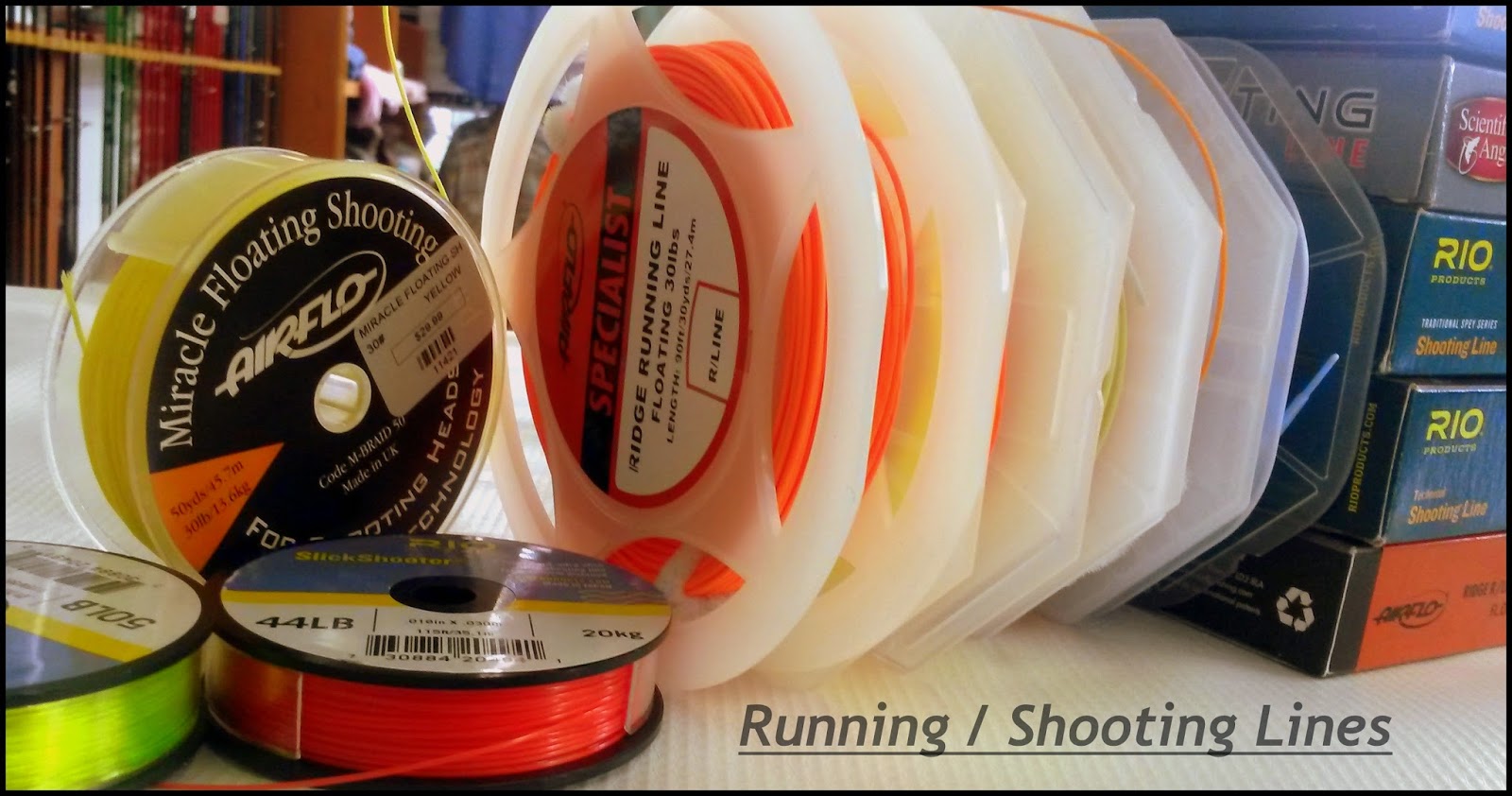
The biggest hurdle for many people that are just starting out with two handed rods is understanding all of the terminology and gear that is so specialized with in this sport. Today, we are going to discuss running/shooting lines.
A running/shooting line is a crucial part of your spey fishing set-up. There are many, many varieties of these lines and each has advantages and drawbacks. Let’s start by learning what a running and/or shooting line is:
A standard weight-forward floating line is pretty easy to understand. Tie it on to your backing, reel it up and tie a leader on to the front end. You’re ready to fish. If you look at a “line profile” for a
RIO Perception (just an example, choose any line), you will notice that there is a 36’ head and a 54’ running line. The running line is a thin diameter, level (has no “taper” and does not change diameter) floating line with minimal weight/resistance that is attached to the back end of the head.
A spey set-up is not much different, except for that the head and the running line are separated, then connected by a loop to loop system. This allows spey fishermen to change out the heads for different applications without having to carry spare spools.
Running lines for spey rods come in a wide range of options. There are different materials, diameters and textures to consider. I have chosen a few of my favorites to talk about. Remember that there is no perfect line for every application and person, but every angler will have personal preferences to what works best for them and what features are a priority in choosing a line.
PREMIUM LINES
RIO ConnectCore
This is in the running (pun intended) for my favorite all-around line. I would feel comfortable using this line year round in most conditions. It floats, and shoots well, which are definite advantages; but the big draw to this line is the “connect core”. The connect core does not stretch, and most important; every little rock, leaf and fish is felt through the whole line with maximum response. The minimal stretching also means that there is no energy lost in your cast. With a typical line (standard fishing lines stretch up to 22%), when a cast hits it’s anchor point, it has to stretch out quite a bit during the change in direction, which results in a loss of energy. There is no loss of energy with the Connect Core, which means longer, easier casts. I cannot stress how much of a difference it makes to be able to feel the energy in the line.
 |
| Feel More with ConnectCore |
It is available in four sizes (.026”, .032”, .037” and .042”). I prefer a .032” or .037” diameter for my 7wt spey rod, and definitely the .032” for my 6wt in the summer. The .026” is great for those little trout spey rods and the .042” is good for your 14’ and longer rods.
There is an increasing diameter (taper) on the front “handling section” which I really like as a larger diameter line is easier to handle, especially if you have numb hands or are generally clumsy. It’s not much of an increase, but every little bit helps, and the color change helps me know how far I have to go before I cast again. I can carry my loops more evenly when I see the color change coming.
Drawbacks: From my personal use I have noticed that it tends to get twisted up over time; a little more than other lines. This can be caused by a double spey cast which naturally puts a twist in the line, or a poorly tied fly that spins in the current. It can be solved with the
RIO Anti-Twist Spey Swivels, which are awesome if you tend to use a double spey on a regular basis.
The twisting is definitely not enough to stop me from using it, or even consider, but I have to be conscious of how it is looking after a day or two of fishing hard. I have occasionally had to take the head off and strip the running line down to the backing while it hangs in the current. This will naturally untwist the line; then you’re good to go for quite a while.
Overall though, this is a top shelf, year-round line, perfect for anglers that prefer a traditional feeling line and anglers that like the newest technology (ConnectCore).
Scientific Anglers Dragon Tail
So this is not a new concept, but I think that S/A has nailed it for this line. The big idea for this line is that there is a 15’ tapered section on the front which increases the diameter of the line from .038” to .075”. The diameter increases to the point where the transition between the head and running line has a minimal difference in diameter. The big taper results in a smoother transfer of energy from the running line to the head with tighter loops and straighter casts.
This running line has seen a lot of action this past winter on my steelhead rod, and has become my go-to line. I like it for several reasons. The first is the ease of handling and fishing. Cold hands have a hard time gripping small thin lines. This thicker line is definitely the easiest to handle of any shooting line that I have tried (but I have not tried them all…). The thickness of this line helps to minimize tangles, and I have noticed fewer tangles than most other lines… The textured feature adds to the ease of handling and increases distance, as well as being easier to pick up off the water during your cast due to the “dimples” that create the textured effect.
I have dubbed this line the “lazy man’s running line” because it casts well with a varying amount of “hang down”. Hang down is the amount of running line that is outside of the tip of the rod at the beginning of the cast. Most people have very little excess running line “hanging down” when they begin their cast, but because of the unique taper, the Dragon Tail casts well with up to and over a foot of hang down… meaning I don’t have to be as precise when prepping for my next cast… a.k.a. the lazy man’s cast. I was experimenting the other night with it and was casting with about 4’ of hang down out of the tip of the rod. It wasn't really pretty, but it was casting as far as I needed it to go and it was far more hang down than I can do with any other running line.

S/A claims this line to be either 20# or 25# strength (depending on where you look), which, if true, is pushing it a bit. Not because I plan on catching a huge fish, but because I have snagged my head up in a tree (yes, I admit that). I do not want to test the break strength of the loops on this line if it is only 20#, but I haven’t had any problems yet…
Garry Sandstrom, our awesome Scientific Angler’s sales rep told me that there is a dedicated group of guys that are fishing this line with short sections of
T-8 through T-20 just off the running line in a Czech nymphing, tight line system for fishing little slots that you would be unable to get to with a big head and spey head. It’s an outside-the-box approach that has a lot of potential around here.
BRAIDED LINES
I once saw an inspirational speaker in middle school. He let us know that “we are more alike than different”. When it comes to braided running lines; that is the truth. Outside of braided lines, there are many options to choose from in tons of features, textures, ridges, tapers, diameters and everything in between… As far as braided lines go, the biggest difference is the color.
I have used braided lines as far back as I can remember. I believe that my first running line after ditching the old Rio Windcutter line was a braided line. While there are some nice features of these lines, there are also some drawbacks that make them poor choices for beginning anglers. I honestly couldn't tell the difference between the following lines if I was blindfolded casting or if they were the same color, so it’s really just a preference of color and whether you want 105’ (Airflo) or 150’ (Scientific Anglers) of running line. I’ll try not to repeat myself too much in these two line reviews…
Airflo Miracle Braid
Airflo’s Miracle Braid has a single strand poly core and a .032” diameter. It also floats, shoots a mile and a half and doesn’t stretch. These are all great features of a running line. The tangle factor is minimal and is very durable.
It all sounds perfect, right? Well there are some things to consider before grabbing one of these lines. The first thing is texture. The braids tend to pull a lot of water through the guides, which is fine in the summer, but not in the winter. Besides ice building up in the guides very quickly, small shards of ice can form in the texture if it is very cold and can potentially cut you. The texture itself is fairly rough and not very easy on the hands.
Another factor to consider is that there are no pre-built loops on this line, but building them is not very difficult. Some people really love a simple line that goes right from the spool onto a reel with no excess work. Ten minutes to build a loop is a small price to pay for a good line.
A third thing to consider is that it is fairly loud going through the guides, but that should only bother the most discerning of anglers.
If you can deal with those little factors, this is an awesome line for a lot of anglers. Overall, the benefits of this line outweigh the negatives by quite a bit, so for the right angler, this is a quality choice. I have fished Miracle Braid for years and will definitely string it up again sometime in the future.
Scientific Anglers Braided PE
This is a braided Polyethylene mono-filament with a .032” diameter. As I stated in the intro to braided lines, they are more alike than different. I fished this line for most of the past year and do really enjoy it. There is no stretch and minimal tangling. It floats and is very, very durable. You can beat the snot out of this line and it does not crack or fade or get tacky over time. This line shoots very well and is a nice diameter to keep hold of.
Braided lines all have the same drawbacks; they pick up a lot of water spray during casting, so ice builds up quickly on guides and can form small icy shards on the line in very cold conditions. This can cause cuts on sensitive fingers (I have a scar to prove it). I took it off my reel after a couple of days of fighting icy guides and a bleeding finger this winter, but I look forward to fishing it again this summer.
This line does not have any loops built in, so the angler must do it themselves (or bring it in to the shop). Building loops is easy enough, but is a task that many anglers don’t want to deal with.
I am very pleased with this line and will continue to fish it for years to come. If you are looking for something different that a traditional coated running line, this is a solid choice for intermediate to advanced anglers. Again, beginners are best served by using a traditional coated line that mimics the feel of a standard floating single-hand line until they have enough experience to know what features are a priority for them in a new running line.
Note: We currently do not stock this line due to virtually no demand for it. If you which to purchase it please call us and we can accommodate your order
MONOFILAMENT LINES
RIO Slickshooter / Gripshooter
Now if you are looking for a line that has the most potential for distance casting, a monofilament running line must be in the arsenal. I know more guides that fish Slickshooter than any other line, so that should be a good indication of its potential.
The
RIO Slickshooter is a colored flat (oval) monofilament. Monofilament shooting lines have been used by steelhead fly fishermen to get maximum distance since Amnesia became popular in California in the 1960s. Rio’s version comes in 25#, 35# 44# and 50# varieties and I prefer the 50# version. Why, because as I admitted earlier, I have stuck a head up in a tree… The last time I did it I was using 50# Slickshooter and I definitely needed somewhere around 40# of pressure to get it out…
A big advantage of monofilament lines is that there is very little “water spray” from this line if you are fishing it below freezing temperatures. This minimizes ice building up in your guides; however, it is harder to deal with the smaller diameter of this line if your hands are cold…
The
RIO Gripshooter is an improved version of Slickshooter. Improved? Rio has built a loop on the front and coated the first 17’ of the line with a traditional style PVC coating that makes it easier to handle. For me, the original version is just fine. For someone transitioning to mono for the first time, the Gripshooter is a great choice.
So there are a few drawbacks to consider with these lines. If you are willing to deal with them, then monofilament running lines can have some serious potential for you. The first is that it does not float. If you are in “frog water” the line will slowly sink. It is difficult to pull the line out of the water during your cast in this situation. It’s not as bad in faster moving water, but it is a concern.
Another drawback is durability. Monofilament will wear down quicker than most others. I got a full summer out of my last spool of Slickshooter, but it was far past spent by the end of the season. It needs to be replaced more frequently, but you can buy almost four spools of Slickshooter for the cost one ConnectCore or Dragon Tail, so you must think of this as more disposable than others.
A third thing to consider is that monofilament needs to be stretched out and has a tendency to coil up. When I get to the river, I take forty or fifty feet of running line off my reel and stretch it out before I start fishing. This helps negate the coiling (memory) issue that mono can have. The memory issues are almost non-existent when its 100 degrees on the
Deschutes, but that’s not something that everyone tends to experience. There are also no loops on a spool of Slickshooter, but it is very easy to tie a triple surgeon’s loop on each end; you just have to make sure that the oval shape lays down flat when you do the knot and some guys like to coat it with UV knot sense to make it smooth.
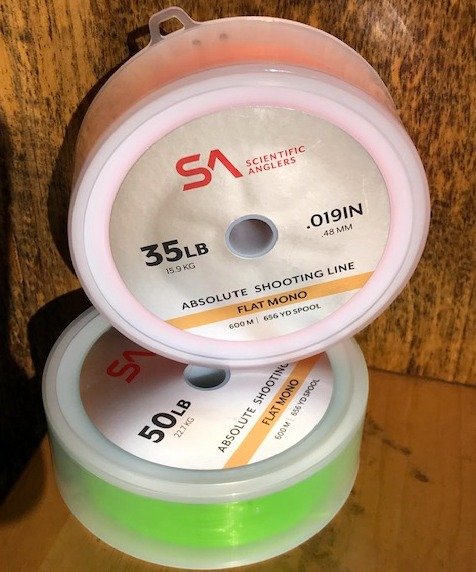
Scientific Angler’s Floating 0.021" Mono
This is the “sleeper” running line of the bunch. It’s a hollow-core monofilament running line that addresses a few of the problems that traditional monofilament has and includes a few improvements. This line is a .021” diameter with 36# break strength. Again, mono has very little water spray, so this is a great line for the winter if you can keep your hands warm. On the plus side, it’s easier to keep your hands warm when there is little to no water coming off of your running line.
While traditional monofilament line sinks, this line is hollow and floats! It has a nice diameter that is easy to handle and does not coil up as much as some monofilaments. It still requires some initial stretching when you get out on the water, especially on a cold day, but it’s nothing to worry about.
While this line does not have any pre-built loops either, a triple surgeon’s loop has a very small profile on the line as it “seats” into the hollow part of the line. Overall, this line has a lot of potential, but gets overlooked by most anglers. I have not used it myself, I've only talked to people that fish it, but the guys that use it are very pleased with it. I plan on trying it out the next time I need a new running line.
TRADITIONAL LINES
Airflo Ridge Running Line
I fished this running line for over a year with little to no complaints. It is a traditional extruded fly line style, but has microscopic ridges that run along the line that improves shooting distance due to the reduction of friction on the rod guides. Less line touching the guides equals more distance. This running line comes in 20# and 30# versions. We sell tons of them and Airflo always makes high-quality products.
This line is made with a PVC-free urethane coating, which is more resistant to UV rays, and chemicals like sunscreen and bug spray. It also fades and cracks less than PVC, which should give it a longer lifespan. Ridge Running line is a solid choice for beginners, the occasional spey caster, and anyone that enjoys a traditional feeling line that is easy to deal with, has minimal tangling and can be fished year round.
RIO Powerflex Shooting Line
The RIO Powerflex Shooting Line is a quality traditional coated running line. There are no frills or gimmicks to this line. I don’t really need to go into much detail about this line since it is by far our best selling running line. It’s just a solid American built line that is tough, shoots well, stands up to a variety of fishing conditions and has a nice feel to it. The .030” and .035” are solid choices for 7wt spey rods, while the .040” is great on 8wt rods and above. The .024” lines up well on trout-sized switch and spey rods.
It does have loops on it, floats well, shoots well and is easy to handle. Since it is the most like a single hand fly line in feel, it is the go-to line for beginners. We sell more of these than any other running line because of the quality, price tag and ease of use. While there are no fancy ridges, textures or tapers, it gets the job done and it does it very well at a good price.
There is no perfect line for everyone and every condition. I have tried most of the running lines on the market at some point and I go back and forth depending on my mood and what I am willing to deal with. Each line has advantages and drawbacks that can fit a person’s style and abilities. What works for one guy may not work for another and what works well for summer steelhead may not be the best choice for winter steelhead. All I can do is relate my experiences with these lines and let you know what I like and am using; so….
As of time of publishing the following lines are on my steelhead reels:
Scientific Anglers Dragon Tail is on my 7wt spey and is my current “go-to” setup. I have fished it more this winter than any other. The Rio ConnectCore .032” on my “other” winter rod has seen plenty of action this year, but does not get the daily use that the Dragon Tail does, but I am moving it to my go-to reel because John wanted to try the Dragon Tail for a while. These two lines are the most expensive, but they are both in another class as far as the features. The great thing is that both of them have the right features that could give you the ability to improve your experience. I consider these to be the two premier running lines on the market today.
On my 6wt, which is currently in my closet, patiently waiting for the Deschutes fish to move in, I am using Rio 50# Slickshooter and am on my third spool of it since I started at the shop here. The Deschutes has quite a few spots where distance casting is highly beneficial, and I believe that there is no better line for casting long distances on warm days in warm water with dry lines.
I have a plastic tote filled with used lines, including several spools of Slickshooter, a couple of braided lines and some Airflo Ridge line for emergencies and backups. I would not hesitate to fish any of them in a heartbeat under the right conditions.
Again, we are always happy to answer any questions you may have on gear or if you just need some encouragement to get out of the office for an afternoon. Stop on by or give us a call and tight lines!

Andrew Perrault
Gorge Fly Shop | Product Specialist
541.386.6977
"Fly Fish the World with Us"