Showing posts with label Simms G3 Guide boots. Show all posts

Feb 6, 2024

Introducing Simms G3 Guide Boot - New for 2024

Comes with 2 pairs of laces

We are so excited for the brand new Simms G3 Boot, updated and redesigned for 2024!  

Simms G3 boot has always been our go to boot for the anglers looking for a durable, yet comfortable wading boot that will provide the support, traction and comfort desired by every angler.  The brand new 2024 model encompasses all of those features but with lighter new material, increased durability, 20% better "wet slip sole", and now comes with two sets of laces.  But, the coolest feature is that these boots can now be resoled at Simms.  Soles wear out over time and a lot of time the boot is still in good condition, now you can get your wading boots re-soled!  

Here is our Fly Shop Pro Tip: If your wading boot wears out faster than you think it should, it could be your wading boot is too small.  Wading boots that are too small can fail much faster vs. a boot that is properly sized.  Wading boots should have enough room in the toe box and room to move around....unlike snowboard or ski boots that are designed to fit tightly.  Having enough room in boots allows for proper blood flow resulting in warm comfortable feet.  Pressure from the water while wading will push the material of your socks, waders, and boots and if there is not enough space it will create a cramped environment in your boots resulting in cold crampy feet, and if your feet are not happy you will not be happy.

Generally with Simms wading boots (boots designed to be worn with Stockingfoot waders) are generally sized with one full size over your street shoe.  So if you wear a US Men's street shoe size 10.5, your wading boot will more than likely be size 12.  Going up just a half size does not generally allow for  enough space.  Now each person can be different and the width of your feet and other things can make for different circumstances.  

With today's materials and construction you should not be "un comfortable" while wearing your waders and wading boots.  Do yourself a favor and make an investment in wading gear that is sized correctly.  There are many price points to suit your budget and wading needs. 

Feel free to call the shop and discuss wading gear options that would best suit your angling needs and budget.  We look forward to hearing from you!


https://www.gorgeflyshop.com/store/pc/Sale-Closeouts-c38.htm

"The Gorge"

Gorge Fly Shop Team - 541.386.6977


"Fly Fish the World with Us"

Sep 1, 2023

Big Savings on Simms G4z wader, G4 Pro jacket, G3 Guide boots


For a limited time catch a great deal on some Simms legendary products including G4z Waders, G4 Pro Jackets and G3 Guide Wading Boots. 


https://www.gorgeflyshop.com/store/pc/Sale-Closeouts-c38.htm

"The Gorge"

Gorge Fly Shop Team - 541.386.6977


"Fly Fish the World with Us"

Nov 4, 2016

Felt vs Tread - Who Gives A Boot

Wading Boot Sole Options - What Grips

Now Hold On!

Before you go off and get your waders in a wad thinking that the title of this article defines how we feel about your wading safety and/or our responsibility to the health of our streams first give me a chance to explain that it was really just a catchy phrase designed to get you to click into this article. Did it work?

Next... Let me inform you that if you're just looking for pleasurable fly fishing reading, THIS IS NOT IT! Click out now! Nothing fun about wading boots. This is purely an informational article intended to educate about wading boot traction options from one man's opinion taken from many years of experiences with both boots and various wading environments.

And lastly I apologize now to the manufacturers. I'm not writing this to endorse or criticize any one brand or product but I'm not going to hold back the truth of what I have experienced with various types of wading boot soles. The view of this article is only intended to examine how to deal with concerns of stream health and angler safety.

The idea of discussion about this topic comes from some recent opinions posted to one of our blog post. I don't think the author of said post intended to take a stand on what is best for anglers or streams but instead he chose the sole type based on the geographical area he fishes and the difficult and hazardous nature of the rivers he wades. Traction after all can be a life or death reality.

The concerns regarding wader safety and clean streams are real and many opinions exist about which sole type is the right one. I've been fortunate enough to have fished a variety of waters all across America and with that knowledge it's easy for me to understand why so many different opinions exist with this subject. In addition to so many varied types of stream beds and terrain you also have an assortment of traction options that can work across a variety of conditions.
  • Felt
  • Studded Felt
  • Tread
  • Studded Tread
  • Aluminum Pucks
  • Aluminum Bars

So what is right for you (and me)

This is were we get very deep and opinionated. I'm not going to try to tell you what you should be using. That just opens the door for arguments. It's up to each and everyone of us to decide what is best for the streams we fish and best for our wading skills and conditions. I will tell you this, there is an answer for everyone with all the available options we have today. 

Felt

I don't know who came up with the idea of felt but it was brilliant. Seemed like the perfect answer, mostly! Felt provides a good level of traction in the stream. Felt is also very boat friendly. But aside from those attributes felt also comes with some messy baggage. It carries dirt including possible hitchhikers that could pose a threat to our streams. Now before you start writing your comments that felt is just a scapegoat to the problem let's all take a hard look at reality, Felt is Dirty! Go ahead, jump in your truck right after getting out of the stream with felt boots and watch what it does to your floorboards. This is why we all have weather tech mats after all right! Why do fly shops have posted on their doors "Please Remove Wading Boots!" I welcome your comments but please do not even try to defend felt. 

Another issue I've encountered with felt is winter snow and  icy conditions. Felt can freeze and create a boot that is as safe as a pair of ice skates. Not to mention they get heavy and freeze your feet. Felt is no good for icy winter anglers.

But does that mean you should forfeit felt forever? Consider your situation, maybe you are only fishing one stream in felt boots all season. That's not really going to pose a threat of invasive species transfer. Maybe you're lucky to fish once a month. Pretty sure any possible threats will have been dried up long before you hit the stream again. Maybe you're completely anal and wash your boots in a bleach/water solution after every use. But let's talk reality, how many of you are actually going do that after every use?!
Traction with felt is good but truth is you can equal or even get greater traction today in different ways. So if you are one of those that still thinks felt offers superior traction, think again!

Studded Felt

Admittedly studded felt is hard to beat. All the same problems as above but greater traction ability. Note that many drift boat guides do not like studded traction devices in their boats. Luckily most modern studs are screw in therefor also removable for those times when they are undesirable. 

Tread

I'll go ahead and own up that tread alone is pretty much completely useless and downright dangerous for most anglers. BUT! I have waded streams that are so friendly that one would be safe in a pair of converse tennis shoes. For those situations maybe tread soles are just fine. Since recent demand for tread soles has spiked companies have put lots of r&d into getting better traction from rubber and I can tell you from my experience rubber soles have improved. 

Some kind of add-on traction is necessary for most conditions
Several positive attributes are associated with tread soles. Obvious of course is they are pretty clean. Also they do really good out of the stream such as hiking trails. They are very boat friendly except on boats that have diamond plate steel to walk on (slippery when wet). If your trip involves air travel you might appreciate a chance that tread soles will dry out the night before your flight. Never fun when you get home and open your luggage to find it full of musty clothes because your felt boots drowned everything.

Studded Tread

I doubt any tread sole users would argue that in most cases tread soles need the addition of some kind of traction device. Be it screw in studs, screw on aluminum pucks or similar devices. I've had good success with the Simms Hard Bite Studs in Simms Boots as well as using them in other boot brands. Are they the best traction you can get? No! But they work well in most average wading situations. Many anglers are content with this traction option for the water they wade. 

Aluminum Cleats

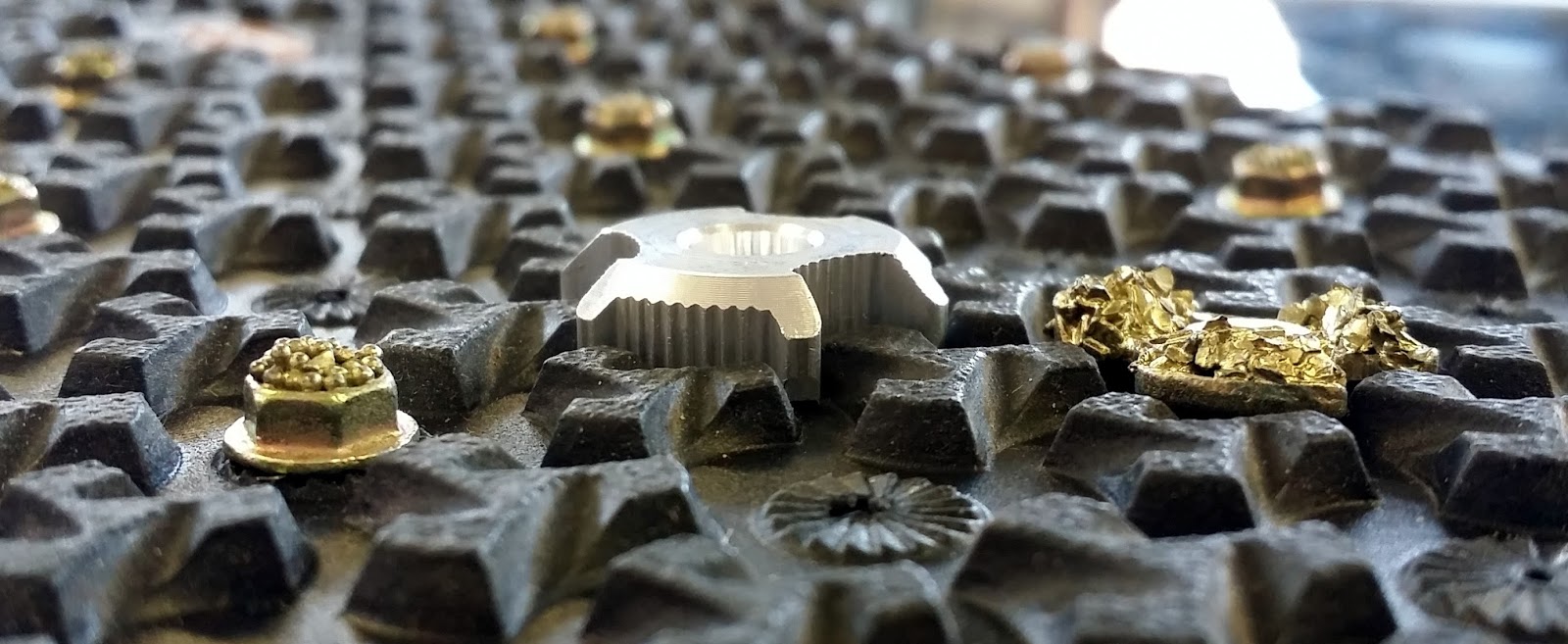
Left Simms Hardbite Star Cleats - Right Simms Alumibite Cleat

Another option from Simms for their tread soled boots are the Alumibite Cleats. I have used these with good success. Aluminum does a great job at cutting into the slime that makes rocks slick. There does seem to be one drawback, as the aluminum looses its sharp cutting edge they seem to lose efficiency. In the case of Simms Alumibite cleats you can remove and flip over to regain that sharp edge again for awhile. I found that using these in conjunction with the Simms Hardbite studs gets really good traction for Simms boots.
Note: Some anglers are reporting the loss of these screw in type of traction devices. I hear they get ripped out and even if you replace missing ones they no longer tighten into the original holes further increasing the problem of loss. I'd like to note here that all Simms boots have a hard retention plate designed to receive the screws. It's very important to be sure to drive the screws firmly into this plate for maximum retention.

Simms Traction Devices left to right - Hardbite Studs - Alumabite Cleat - Hardbite Star Cleat


Hardbite Star Cleats

Another option from Simms is the Star Cleats. Basically a star shaped piece of metal with jagged carbide chips welded to them. Initially they do a great job of cutting slime but I have seen many with the chips worn completely away leaving behind a smooth metal surface that doesn't do anything for traction. Ten Star Cleats for $29.95 to me just doesn't have as much value as the Alumibite Cleats at ten for $21.95.

Aluminum Bars

If you really want traction aluminum bars are it! Bars were the first traction device I used that I openly said "this is better than felt!" Not only do they grip in the stream but also provide good traction on the trail and to the best of my knowledge I have not heard any guides complaining about them in their boats. Like the puck style they can lose their sharp edge over time but with such a larger area of coverage they seem to hold onto it longer. If there was one downside of aluminum bars is they are not ice friendly.

Currently I am only aware of two boot brands that utilize aluminum bars. One of which is Korkers and the other is a brand Patagonia which we do not currently carry.

Boot Brands

Korkers Wading Boots

I'm not trying to do a sales pitch for Korkers here but they really do offer some great versatility. Korkers have the ability to adapt to varying environments and/or to meet specific territorial regulations. Gorge Fly Shop has sold Korkers boots for many years. We've watched them improve and perfect the interchangeable sole system. It's a system that works for most anglers and it gives you the best traction option when needed whether it be a decision made by choice or by regulation. All current Korkers wading boots are built on the Omnitrax v3.0 interchangeable sole system.

Now the bad...The standard Korkers tread sole called Kling-On in my opinion provides the least amount of traction of any tread sole I have ever used. My advice is don't use it. The Studded Kling-On version is only marginally better. If you are going to wade in Korkers boots you want to utilize Felt, Studded Felt, AlumaTrax or the original Studded Rubber Soles.
Left to Right - Alumatrax, Studded Felt, Studded KlingOn. Studded Rubber

You know felt and studded felt, no need to talk about them. Alumatrax Soles start out as the standard non-studded Kling-On sole with aluminum bars riveted to them. While the bars are non replaceable the complete sole is so renewing traction is easy...just buy new soles. The Korkers Alumatrax sole is our number one selling add on sole option for Korkers boots. They provide good clean traction in and out of the water.

The original Korkers Studded Rubber Sole is an extreme option mostly used by rock hopping jetty anglers. The rubber part of the sole has no tread to it at all and traction is completely provided by 7mm carbide tipped screw in replaceable studs. Probably not a sole you want to hike for miles in but when traction is a must these are the soles guys are reaching for. They are very popular among east coast striper anglers.

Korkers offers Vibram Idrogrip Soles in both studded and non-studded versions. I don't have much feedback for these soles as they are a bit pricey and so few anglers opt for them.

Simms Wading Boots


Simms G3 Guide Boots equipped with Alumibite Cleats

Simms builds great boots period. Durability, sizing and comfort are all positive attributes for Simms. If I could name one missing feature from Simms is the lack of a full on clean traction device similar to the aluminum bar option other manufactures provide. But even so that shouldn't deter anyone from finding great traction from Simms boots if the user is willing to outfit them properly with the available traction devices.

Simms Vapor with Combination Alumabite
Cleats and Hardbit Studs
Simms Wading Boots are currently utilizing two tread sole types developed by Vibram. Idrogrip and Megagrip. Both are designed to accept all Simms traction devices.

Vibram Idrogrip is found on the G4 BOA, G3 Guide, Rivertec 2 BOA, Headwaters and Freestone wading boots.
It claims to be ideal on wet surfaces, improved grip on slippery terrain and inspired by free climbing rubber,

Vibram Megagrip is found on Vaportread, Vaportread Salt, Intruder, Intruder Felt, Riprap Shoe and Streamtread Sandel. It claims to provide unparalleled wet and dry surface traction, superior grip with rugged longevity and optimal balance of stability and flexibility for ground adaptation

For wading environments with average difficulty many are doing just fine with the Simms screw in Hard Bite Studs. My go to for maximum traction from Simms boots is a mix of Alumibite Cleats and Hard Bite Studs. The combination of the two together is tough to beat. I know some guys have seen a problem of rip outs but I'll note again, make sure they seat in tight to the internal retention plate. Personally I myself have not had this problem.

Simms also offers several models available with felt soles. Currently they include the G3 Guide, Rivertec 2 BOA, Headwaters, Freestone, Rock Creek, Intruder, Vapor and Women's Vapor Boots. Add the Simms Hard Bite screw in studs for felt soles and you'll be in good shape to handle life threatening wading conditions such as found on our local steelhead fishery known as The Deschutes River.

Redington Wading Boots

Redington Palix Shown with Goat Head Spikes - Click Picture for a larger view

Redington Wading Boots don't get much attention but there is a sneaky feature they just don't get credit for. By utilizing a combination of soft rubber compounds and adding into the mix ground walnut shells, an old technology taken from tire manufacturing way back when, they have developed arguably the stickiest sole we know of. I still wouldn't recommend going out in tough wading environments without some degree of added traction devices but for easy wades they perform well. Redington also offers screw in studs provided by Goat Head Gear. I have used these studs in the Redington Palix River Boots and have experienced a comfortable level of traction.

Goat Head Sole Spikes offered from Redington
Redington wading boots don't score high on the durability scale but they also don't cost as much as most other wading boots. One key note when considering a pair of the Redington Wading boots is you buy them to match your foot size. DO NOT buy them one size over your foot size like all other wading boot brands. Redington manufactures these boots with the needed room built into them to allow for your stockingfoot wader to fit. I appreciate this idea but unfortunately most anglers are already accustomed to buying one size over creating for us a high degree of boot returns for improper sizing.

Summary

Let me emphasize there are two areas of concern for wading boot technology, keep our streams clean and keep our anglers safe. The goal here is to share my experiences hoping that it will help you make the best decision possible for your needs. There is no one right answer for everyone but there are many options that can solve the problems we face. The good news to come out of awareness's and all out anti-felt regulations is that is has forced our industry to evaluate and improve technologies that has not only provided cleaner options but in my opinion technologies that can exceed felt performance.

I hope you found this information helpful. Please share your sole experience in our comments that we may all benefit from others experiences...

More Boot Post...


Simms G4 Boa Boots vs Simms G3 Guide Boots

Simms Vapor Wading Boot Review

Wading Boots - Finding the Right Size

Simms Headwaters Boot Review

Killing My Simms G3 Guide Boots

Pay Less For Redington Palix

Korkers Devils Canyon Wading Boot Review

Korkers Defined - All About Sole

BassProGreg


Gorge Fly Shop Internet Sales Manager | Product Specialist


"Fly Fish the World with Us"


Read more of Greg's Post

May 3, 2016

Killing my Guide Boots

Its official: I have worn my Simms G3 Guide Boots into the ground.  

Two and a half years of solid abuse, still in great shape
I have never been able to wear a boot all the way through the felt before.  In my fifteen years or so of being a professional fishing bum I have owned a dozen or so pairs of wading boots.  Brands like Hodgman, Chota, Patagonia and Orvis have all had their chance, and most all of them have failed before I had worn them out.  In my history of abusing gear, I have found that it is usually a seam, stitch or eyelet that fails with wading boots.  I have owned a few sets of boots that have had the soles separate.  My first pair of Simms split open above the toe, and I duct-taped it right up and finished the season out.  But there is something special about these G3 Guide Boots; they have been abused beyond what any “typical” fisherman could do to them and they have come out the other end valiantly.

How do I know that my boots are finally dead?  My first clue is that there is nearly zero felt left on the soles.  The studs are worn down to nubs and they are faded, worn, scratched and beaten.  I am going to keep them around for a few years to use with my float tube, and for “emergencies” (misplacing my other boots) but it was definitely time to move on for the sake of safety... and because I really wanted to check out the new Simms Headwaters Boots.

Felt and studs worm down to almost nothing.  
Safety is seriously a top priority for me, so even if they are still comfortable and technically functional, I have to look at other options now.  Proper felt and good studs are a necessity for me to go anywhere near the Deschutes and a few of our other slick, basalt-laden rivers.  I take a swim in the Deschutes about every six hours of fishing even with studs and felt.  Without good studs and felt, I might as well just jump in when I get to the river and save myself  the trouble of worrying about whether I will stay dry or not.  Without good felts and studs, these boots are no longer river worthy for me, but they can have a nice, comfortable retirement for a few years kicking around in the local lakes.

Before!
I had bought these G3 Guide Boots in November, 2013.  I had intended to keep wearing an old pair of Orvis boots for a few more months as they seemed to have some life left in them.  Fortunately, I made the mistake of trying on the Guide Boots after a long day of fishing in my overly-tight, fairly uncomfortable Orvis boots sometime in early December of that year.  It was immediately apparent how superior the G3 Guide Boots were before I had even laced them up.  They were so comfortable I couldn't believe it.  I let out a muffled groan at the realization that I had been needlessly sporting inferior footwear.  The Guide Boots were incredibly easy to get on, comfortable and lightweight.  I threw out those Orvis boots on the spot and never looked back.

What I liked about them:

Everything about the G3 is oversized, extra strong and bulletproof, yet the boot maintains a very lightweight feel.  The high-ankle support is a solid feature that provides fragile ankles with extra stability and also provides the anglers attached to those ankles with peace of mind when wading in sketchy, slippery spots.  The rear pull-strap that is used to help get your feet into the shoes is big, beefy and easy to use.  They are very comfortable to hike in, which is a big deal for those of us that put the miles on our feet to get to the big ones.  The extra tough, oversized toe guard is a great feature that provides protection against painful encounters with big rocks underwater.  

The primary material used for the boot is just soft enough to be really comfortable on your feet, yet it stays rigid enough to keep your boots roomy and sturdy.  Solid stitching and strategically placed reinforcements do a good job at preventing the separation of materials.  The shoelace eyelets have been functioning fully with no concern about failure.  I didn’t even replace the laces in two and a half years of fishing hard. 

What I didn’t like about them:

There were no serious issues for me in over two years.  They were incredibly durable, comfortable, lightweight and easy to wear; hands down the best boot that I have ever had.  There are lighter boots on the market, but they don’t have anywhere near the ankle support that these do.  I would not hesitate to purchase the Simms G3 Guide Boot again in a heartbeat. 

Minimal toe guard separation, but nothing serious
One minor gripe is that the upper hook eyelets for the laces were not super easy to get my laces into.  I had the laces slip out a time or two while in the river, and I had to dig them in really tight to get them to seat well.  I found when my laces were wet and swollen, they were not as easy to work with in the hook eyelets.  Very minor issue in the grand scheme of things.   

Other than the felt wearing out, the only “failure” with my boots was the toe guard.  The softer boot material began to separate from the rigid toe guard.  The separation is very minimal and I honestly did not notice it until I started taking pictures for this article. 


My G3 Guide Boots have served me well over the past two and a half years.  Through thick and thin, three pairs of waders, winter steelhead, spring trout, summer steelhead, fall Chinook, bass, carp, muskie and shad, they had a great run.  These boots have set a new standard of excellence for both durability and comfort for me, but it is time for me to move on to other boots.  I now have the new Simms Headwaters Boots and am looking forward to finding out if they will hold up as well as these did.  


Andrew Perrault
Columbia Gorge Fishing Reports
Gorge Fly Shop | Product Specialist
541.386.6977


"Fly Fish the World with Us"

Apr 4, 2014

Simms G4 Boa Boots VS. Simms G3 Guide Boots

“Decisions, decisions…which wading boot should I buy?”

Products: Simms G4 Boa Boots and Simms G3 Guide Boots
So, you’re in the market for a new pair of wading boots. You walk into the Gorge Fly Shop or sit down and log onto the Gorge Fly Shops website (www.gorgeflyshop.com) and you’re either staring at the back wall with all the latest boots on display or you’re looking at multiple pages of wading boot options on your display screen. Either way, if you’re anything like me when my wife sends me to the supermarket for children’s cold medicine and I stand in the isle looking like a deer caught in the headlights, drool dripping out of one side of my mouth, right eye twitching all the while trying to figure out what it is exactly that she wanted. Maybe just maybe this review can help you make a sound decision. In my opinion sometimes we have too many choices. The beautiful thing, in my opinion, is there’s never been a better time to buy top quality wading boots with the latest and greatest in state of the art materials. I had the pleasure of testing out the New Simms G4 Boa Boot and the New Simms G3 Guide Boots…and here is my review…

The New - Award winning Simms G4 Boa Boot is Space Age…Darth Vader would have worn these if he could!

THE G4 BOA BOOT: Description

According to: Simms, in their words: Step into Simms’ G4 Boa® Boot and elevate your fishing experience thanks to an asymmetrical Boa® system that delivers an articulated, secure fit over and across the instep. Underneath the G4 chassis you’ll find an advanced RiverTread™ platform that minimizes rigid materials in exchange for maximized proprioception—your ability to feel and adapt to an ever-changing underfoot environment. In addition, Vibram® Idrogrip outsoles provide great grip across slick underwater obstacles via multi-directional lugs—compatible with all Simms’ AlumiBite™ and HardBite™ cleats and studs. Inside the boot is an environment hardwired for warmth and comfort, featuring a lined neoprene finish, cushioned where you need it most and ultra-smooth for easy on/off performance.

FEATURES

  • Simms NEW RiverTread™ Platform for guide-ready wading performance, support & traction
  • Waterproof PU-coated leather & TPU-coated textile upper for maximum abrasion-resistance & durability
  • Fully-lined with neoprene for wading warmth, cushioning & easy-on/easy-off 
  • Boa® Closure System for easy-on/easy-off & a precision, on-demand fit
  • Also see the G4 Boa® Replacement Kit 
  • MATERIAL TECH: A waterproof PU-coated leather & TPU-coated textile upper with an asymmetrical Boa® Closure System & full neoprene lining; Built on the Simms RiverTread™ Platform with a 4.0mm Vibram® Idrogrip rubber outsole
  • APPROX. PAIR WEIGHT (size 10): 57.6 oz.
  • SIZES: 07-14, whole sizes, EEE width
  • PRICE TAG: $239.95
  • PRICE TAG TO COMPLETE YOUR SYSTEM, INCLUDING BOA REPAIR KIT, AND TWO BOXES OF ALUMABITE CLEATS: $296.80

MY TAKE ON THE G4 BOA BOOT:

Of the two boots I tested, I first tried the G4 Boa Boot. I fished them pretty hard for nearly three weeks. This was the first time I had ever tried a Boa style wading boot. I’ve always liked the idea of the Boa system but I’m old school enough to be a bit stubborn and stick with shoe laces. I was excited to try something new. Everything about the G4 Boa Boot screams technology. Space age technology I would say. The Simms G4 Boa Boot has all the latest in materials and features (see features list above).

All I can say about these boots is that, in nearly every area of concern that I would have in a wading boot, it excelled, they were awesome. I had lots of toe room, which helps keep your feet warm, and the NEW RiverTread™ Platform definitely was noticeably more comfortable than any other sole on any other wading boot that I have ever used! They were light while walking and wading, which is important to a man who has had five knee surgeries. I love the little gravel guard clip near the toe which secures your gravel guard around the top of the boot. I love the sole pattern which includes spots for your Alumabite Cleats. It takes the guess work out of where you should put the studs (see photo below with studs). I love the look of the boots. You know that that’s important to the fish…

Your boots will be one of the last things they see as you let em go.


Now, I said nearly every area of concern they excelled. So, what didn’t I like about the Simms G4 Boa Boot you ask. Well, honestly it was the tightening of the Boa System. I struggled with getting the fit I wanted to get. If I started to crank on the Boa gear knob, I couldn’t get the toe area snug before the area above my ankle was too tight and it would cut my circulation off in my feet. When your circulation is impeded your feet will become very cold very quickly while wading. I tried to pull on the Boa cable near the toes and tighten the Boa crank as I pulled on the cable and I still couldn’t get the toe area snug before the area above my ankle was too tight. Trying to pull on the cable as I tightened the Boa crank began to defeat its purpose of being quick and easy and having an on demand fit, to being cumbersome and a pain in the-you- know- what.

Last thing is that you really need to carry a Boa Repair Kit. Unlike traditional shoe string systems, if you snap a string where you can just tie a square not in the shoe string and get back to fishing, with the Boa system, if they break your outta luck. Now the system does have a lifetime warranty and they do stand behind it, but if you’re in the middle of a trip and snap a cable and you’re without the repair kit, well let’s just say you’re not going to be none too happy.

BOTTOM LINE ON THE SIMMS G4 BOA BOOTS:

I don’t want to trash the boots because everything else about them was awesome. They didn’t win the 2014 New Product Showcase Award for nothing. I wish they made this boot with a shoe lace system. I’d buy it in a heartbeat! I talked to a few guys who have the G4 Boa boot and they absolutely love them. They love everything about them. My research revealed that if you’re a smaller footed person, say less than a size 12, the Simms G4 Boa Boot in all areas and cases excelled. In other words, the boot fit and performed as they said it would. If you happen to have larger feet, size 12 and above, then you might take a longer, harder look at the New Simms G3 Guide boot instead. Now, I am not a guy with thick ankles. As a matter of fact, for my size, at 6’5”, 250 pounds and a size 14 wading boot, I have pretty skinny ankles.

All in all, I would buy the boot in a New York second, if I could try them on and everything felt good. In other words if you can tighten the Boa System to the point it is comfortable to you and your foot. Be sure when you purchase the Simms G4 Boa Boot that you also buy the G4 Boa Repair Kit and two boxes of Alumabite Cleats, there’s 10 to a pack and you will need two packs to stud both boots (see photo below of my G3 Guide Boots with studs). The Alumabite Cleats are super sticky while wading and I prefer them over the other types of studs, even though they wear out quicker because they’re aluminum and aluminum is softer than the other types. Have you ever seen an aluminum drift boat stuck on a gravel bar? Have you ever tried to pull or push said drift boat from the said gravel bar? Enough said. Now on to the Simms G3 Guide Boot
The New Simms G3 Guide Boot is much lighter than the older discontinued model.

THE G3 GUIDE BOOT: 

According to: Simms, in their words: Description Central Montana is home to cowboys, roughnecks, and fly fishers, all with three defining traits—spurs, steel toes, and Simms. For those occupying the latter category, Simms’ G3 Guides™ raise the bar with a RiverTread™ platform bolstered by proprioception, which minimizes rigid underfoot materials in order to enhance feel whether on the trail or in the water. The felt G3 combines all day wading comfort with the angler-appreciated underwater traction of a 12mm felt outsole, compatible with all Simms’ AlumiBite™ and HardBite™ cleats and studs. Additional features include TPU molded heel clips that lock in fit, while the neoprene lining stacks cushioning where it counts, keeping feet warm and delivering easy on/off performance.

FEATURES

  • A 12mm felt outsole version of the Guide Boot for a lighter, yet more durable balance of wet trail & all-day wading 
  • Simms NEW RiverTread™ platform for guide-ready wading comfort, support & traction 
  • TPU molded heel clip for positive heel fit & hiking security 
  • Partially-lined with neoprene for wading warmth, cushioning & easy-on/easy-off 
  • MATERIAL TECH: Waterproof Nubuck leather & TPU-coated textile upper, RiverTread™ platform/12mm Felt outsole
  • APPROX. PAIR WEIGHT (size 10): 60.8 oz.
  • SIZES: 07-14, whole sizes, EEE width
  • PRICE TAG: $199.95
  • PRICE TAG TO COMPLETE YOUR SYSTEM, INCLUDING TWO BOXES OF ALUMABITE CLEATS: $243.85

MY TAKE ON THE SIMMS G3 GUIDE BOOT:

I didn’t start out nor did I intend this to be a Dual Boot Review, it’s just how it ended up and I hope that it helps you make the right decision when buying a premium wading boot. Having owned a pair of the old, discontinued G3 Guide Boots and using them for a number of years before retiring them, the first thing I want to say about the NEW SIMMS G3 GUIDE BOOTS is that they are incredibly lighter than the older model. I kid you not, without putting them on a scale and actually weighing them, I’d say they feel at least 25% lighter if not more. Anyone who has owned a pair of the old G3 Guide Boots knows that, although durable, it seemed like they came with ankle weights inside them. They were heavy!

After getting the New Simms G3 Guide Boots all studded up and ready for the testing, I was immediately encouraged by the fit and feel of the boot. As I said earlier, I am a fan of the shoe lace system. To me it just seems easier and dare I say quicker to lace up and go. Just like anything though, laces have their drawbacks. A few being, they get dirty, and they break to name a few. But they also have their pluses, which include a steady snug fit throughout the boot, and if they break, just tie a square knot in them and go about your business.

With the incredible Simms NEW RiverTread™ platform the Simms G3 Guide Boot as well as the G4 Boa Boot both had the most comfortable wading sole I have ever used. I seriously could tell the difference right away while wading. I could feel the sole flex and fit and form around rocks as I would wade. I thought about how an Octopus’s suction cups grab as the slither along the ocean bottom. As I said earlier, I have had five knee surgeries and because of that if I stand too long on anything that is too rigid, my knees begin to scream at me and let me know exactly how they feel.

With the New Simms G3 Guide Boot, I was able to achieve the fit and feel that I look for in a wading boot. A hint for those who may not know this… while lacing up your wading boots using a shoe lace system, cross the laces and pull them snug as you lace up. In other words you should have the left side of the lace in your right hand and your right side of the lace in your left hand. This is way easier, and more efficient in lacing up.

I love the ankle support of both the G4 Boa Boot and the G3 Guide Boot. This is especially beneficial if you have ankle problems and need the extra support. Every feature (listed above) performed as they said it would. To date, these are the most comfortable wading boots I’ve owned. The only difference when I say this between the G4 Boa Boot and the G3 Guide Boot as far as fit goes was the lacing system. The G4 Boa Boot was just as comfortable as the G3 other than the top part of the Boa system being too tight at the top and too loose in the toe area. The comfort of the New Simms G3 Guide Boot is stellar. For a guy like me, they are a perfect match.
My G3 Guide boots ready for the testing…complete with AlumiBite™ studs.

BOTTOM LINE ON COMPAREING THE NEW G4 BOA BOOTS TO THE NEW SIMMS G3 GUIDE BOOTS:

I’ll start with this, either way you choose, you can’t lose. If you want the space age New Simms G4 Boa Boot, try them on before buying them. Get your foot in there and crank down the Boa system and if they feel good, rock ‘em. If they don’t, and they fit you like they fit me, put them back on the display rack and pick up the New Simms G3 Guide Boot and rock them.

I’ll end with this, if you’re shopping online with the Gorge Fly Shop (gorgeflyshop.com) and you can’t just stroll in and try them on, let me say this and hope it helps you make the right decision on which boot you should get. If you’re a size 12 or smaller and want the G4 Boa Boot, go for it. You will probably be happy that you did. If you are a size 12 or larger, go with the New G3 Guide Boot and have peace of mind knowing that you’ve made the right choice. I’ll end with this. The only way you’ll make a bad decision is if you don’t get one or the other. Are they expensive? Yes! Are they worth it? Yes! Are you gonna hide the credit card receipt from your better half? Yes! Okay…I’m just playin now. I’ll stop…

"There will be days when the fishing is better than one's most optimistic forecast, others when it is far worse. Either is gain over just staying home." - Roderick Haig-Brown


By John Garrett – Gorge Fly Shop
March 22, 2014

"Fly Fish the World with Us"



Visit our Relaunched Steelhead Only Site

Shop Gorge Fly Shop & SteelheadBum.com

  © 'and' Steelhead.com Mike Prine 2009-2014

Back to TOP