Showing posts with label ConnectCore. Show all posts

Jul 17, 2018

RIO InTouch Grand Fly Lines

The benefits of ConnectCore, combined with best-selling fly line tapers and a unique tri-color line casting gauge (SureFire) makes for the finest performing trout lines on the market.
The RIO InTouch Grand features RIO's unique ultra-low stretch ConnectCore Technology.

The InTouch Grand is a full line size heavier than the industry standard, and features more weight distributed towards the front of the line to easily load faster action fly rods.

The ultra-low stretch ConnectCore provides groundbreaking levels of sensitivity for intuitively better cast timing, easier line lift and sharp, precise mends. Lack of stretch also means enhanced detection of subtle takes and faster reaction time when setting the hook. The RIO Grand is the best choice of line for the modern, fast action fly rod.

The line also features RIO's unique three color "SureFire" color system that improves accuracy and makes it easy to gauge exact distances at a glance. In addition, RIO's "MaxCast" Technology actively repels water for higher flotation, longer casts and greater durability, while RIO's "MaxFloat" Tip, keeps the line tip floating high on the water and puts an end to annoying sunken line tips.
Technology -
  • MaxCast - High-tech line coating that repels water while you fish increasing floatation and durability
  • MaxFloat - Proprietary tip coating for superior float, reduced drag, and quieter pickups
  • AgentX Technology - Our most advanced coating technology for enhanced performance, durability and slickness
  • ConnectCore - Get In-Touch with a non-stretch line core for improved strike detection and faster hook sets.
  • Surefire - Unique three-color system ensures deadly accurate distance control.
  • Easy ID tag - quickly identify fly line
  • Front welded loop
  • Rear welded loop
Specs - 

SKULine SizeColorFull Head Weight30' Head WeightHead LengthSink RateTotal Length
6-20671WF4FGreen/Gray/Yellow140gr175gr37ft 11.2mFloat90ft 27.4m
6-20672WF5FGreen/Gray/Yellow160gr195gr37ft 11.2mFloat90ft 27.4m
6-20673WF6FGreen/Gray/Yellow185gr230gr39ft 11.8mFloat100ft 30.5m
6-20674WF7FGreen/Gray/Yellow210gr280gr40ft 12.1mFloat100ft 30.5m
6-20675WF8FGreen/Gray/Yellow240gr310gr41ft 12.5mFloat100ft 30.5m

Find RIO Fly Lines at "The Gorge"

"The Gorge"

Gorge Fly Shop Team - 541.386.6977


"Fly Fish the World with Us"

Aug 4, 2016

RIO InTouch Big Nasty Fly Line - New for 2017

RIO Big Nasty Won Best New Freshwater Fly Line
Rabbits and chickens...no problem!
This New RIO InTouch Big Nasty had my name written all over it for the big articulated streamers I throw for bass. I got a sample and couldn't wait to get on the water with it. I spooled up the WF8F and paired it with a Sage Method 890-4. Tied on my version of Swinging D and hit the lake. Immediately I noticed the extended 15' of handling section in this line. The head length is a total of 40' including front and rear taper but the line also includes a 15" handling section behind the head. What this really helps with is increase the range that one can pickup and bring into control for another cast or re-casting to the same spot. Re-casting to same spot is something I do often in bass fishing when a fish blows up or is moved by your fly but does not initially strike it or misses it. Having the ability to re-cast to exact same spot with one backcast is crucial. The Big Nasty line really made that task easy and repeatable. In the past, short powerful headed lines cast great but were limited to a short area of line to get the power going, Another words lots of stripping line between cast. Just as I have noted in 2016 Rod Picks, "Widen your sweet spot", lines too are widening the sweet spot thus giving us a greater range in the line of casting control.


The New RIO InTouch Big Nasty features a short, powerful front taper allowing easy casting of large Streamer and Terrestrial flies. Includes great features like InTouch ultra low stretch ConnectCore, AgentX and Extreme Slickness for durability and easy shooting, and looped on front and rear for easy rigging. Heavier than industry standard to load modern powerful rods. Comes in WF6F thru WF10F sizes. Available August 2016 for $89.95.


BassProGreg


Gorge Fly Shop Internet Sales Manager | Product Specialist


"Fly Fish the World with Us"

Jul 11, 2016

RIO InTouch Trout / Steelhead Indicator - New for 2017

Designed to cast indicator rigs
The RIO InTouch Trout/Steelhead Indicator fly line has a taper profile designed to make easy casting of indicator rigs and give the angler good line control and mending. Enhanced with InTouch Ultra Low stretch ConnectCore for great feel and sensitivity.

Indicator lines have long rear tapers. This helps with mending your fly line. The large front body of an indicator line is what helps it carry the weight of indicators and multi fly rigs. An indicator line can really help with the technique whether it is fished from a boat or while wading. I should note that these lines roll cast pretty well also. With the addition of ultra low stretch InTouch ConnectCore the Trout/Steelhead Indicator line will also provide you with better hook sets.

Also equipped with AgentX and Extreme Slickness for easy casting and welded loops front and rear for easy rigging.


BassProGreg


Gorge Fly Shop Internet Sales Manager | Product Specialist


"Fly Fish the World with Us"

Apr 14, 2015

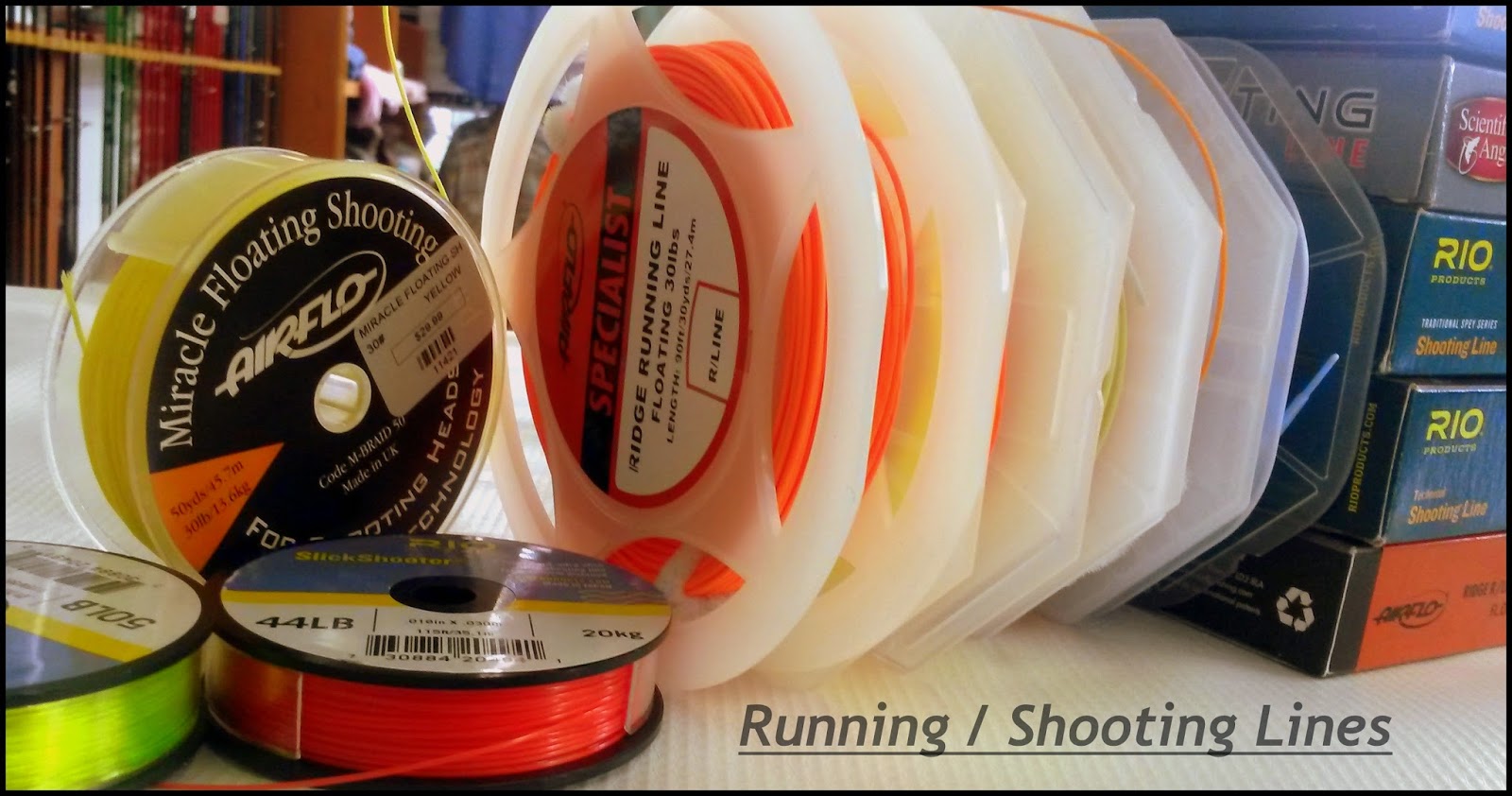
Guide to Running / Shooting Lines

Explore various types of running line options

The biggest hurdle for many people that are just starting out with two handed rods is understanding all of the terminology and gear that is so specialized with in this sport. Today, we are going to discuss running/shooting lines.

A running/shooting line is a crucial part of your spey fishing set-up. There are many, many varieties of these lines and each has advantages and drawbacks. Let’s start by learning what a running and/or shooting line is:

A standard weight-forward floating line is pretty easy to understand. Tie it on to your backing, reel it up and tie a leader on to the front end. You’re ready to fish. If you look at a “line profile” for a RIO Perception (just an example, choose any line), you will notice that there is a 36’ head and a 54’ running line. The running line is a thin diameter, level (has no “taper” and does not change diameter) floating line with minimal weight/resistance that is attached to the back end of the head.

RIO InTouch Perception
A spey set-up is not much different, except for that the head and the running line are separated, then connected by a loop to loop system. This allows spey fishermen to change out the heads for different applications without having to carry spare spools.

Running lines for spey rods come in a wide range of options. There are different materials, diameters and textures to consider. I have chosen a few of my favorites to talk about. Remember that there is no perfect line for every application and person, but every angler will have personal preferences to what works best for them and what features are a priority in choosing a line.

PREMIUM LINES

RIO ConnectCore

This is in the running (pun intended) for my favorite all-around line. I would feel comfortable using this line year round in most conditions. It floats, and shoots well, which are definite advantages; but the big draw to this line is the “connect core”. The connect core does not stretch, and most important; every little rock, leaf and fish is felt through the whole line with maximum response. The minimal stretching also means that there is no energy lost in your cast. With a typical line (standard fishing lines stretch up to 22%), when a cast hits it’s anchor point, it has to stretch out quite a bit during the change in direction, which results in a loss of energy. There is no loss of energy with the Connect Core, which means longer, easier casts. I cannot stress how much of a difference it makes to be able to feel the energy in the line.
Feel More with ConnectCore

It is available in four sizes (.026”, .032”, .037” and .042”). I prefer a .032” or .037” diameter for my 7wt spey rod, and definitely the .032” for my 6wt in the summer. The .026” is great for those little trout spey rods and the .042” is good for your 14’ and longer rods.

There is an increasing diameter (taper) on the front “handling section” which I really like as a larger diameter line is easier to handle, especially if you have numb hands or are generally clumsy. It’s not much of an increase, but every little bit helps, and the color change helps me know how far I have to go before I cast again. I can carry my loops more evenly when I see the color change coming.

Drawbacks: From my personal use I have noticed that it tends to get twisted up over time; a little more than other lines. This can be caused by a double spey cast which naturally puts a twist in the line, or a poorly tied fly that spins in the current. It can be solved with the RIO Anti-Twist Spey Swivels, which are awesome if you tend to use a double spey on a regular basis.
Eliminate Twist Problems
The twisting is definitely not enough to stop me from using it, or even consider, but I have to be conscious of how it is looking after a day or two of fishing hard. I have occasionally had to take the head off and strip the running line down to the backing while it hangs in the current. This will naturally untwist the line; then you’re good to go for quite a while.

Overall though, this is a top shelf, year-round line, perfect for anglers that prefer a traditional feeling line and anglers that like the newest technology (ConnectCore).

Scientific Anglers Dragon Tail

So this is not a new concept, but I think that S/A has nailed it for this line. The big idea for this line is that there is a 15’ tapered section on the front which increases the diameter of the line from .038” to .075”. The diameter increases to the point where the transition between the head and running line has a minimal difference in diameter. The big taper results in a smoother transfer of energy from the running line to the head with tighter loops and straighter casts.
Dragon Tail

This running line has seen a lot of action this past winter on my steelhead rod, and has become my go-to line. I like it for several reasons. The first is the ease of handling and fishing. Cold hands have a hard time gripping small thin lines. This thicker line is definitely the easiest to handle of any shooting line that I have tried (but I have not tried them all…). The thickness of this line helps to minimize tangles, and I have noticed fewer tangles than most other lines… The textured feature adds to the ease of handling and increases distance, as well as being easier to pick up off the water during your cast due to the “dimples” that create the textured effect.

I have dubbed this line the “lazy man’s running line” because it casts well with a varying amount of “hang down”. Hang down is the amount of running line that is outside of the tip of the rod at the beginning of the cast. Most people have very little excess running line “hanging down” when they begin their cast, but because of the unique taper, the Dragon Tail casts well with up to and over a foot of hang down… meaning I don’t have to be as precise when prepping for my next cast… a.k.a. the lazy man’s cast. I was experimenting the other night with it and was casting with about 4’ of hang down out of the tip of the rod. It wasn't really pretty, but it was casting as far as I needed it to go and it was far more hang down than I can do with any other running line.
S/A claims this line to be either 20# or 25# strength (depending on where you look), which, if true, is pushing it a bit. Not because I plan on catching a huge fish, but because I have snagged my head up in a tree (yes, I admit that). I do not want to test the break strength of the loops on this line if it is only 20#, but I haven’t had any problems yet…

Garry Sandstrom, our awesome Scientific Angler’s sales rep told me that there is a dedicated group of guys that are fishing this line with short sections of T-8 through T-20 just off the running line in a Czech nymphing, tight line system for fishing little slots that you would be unable to get to with a big head and spey head. It’s an outside-the-box approach that has a lot of potential around here.

BRAIDED LINES


I once saw an inspirational speaker in middle school. He let us know that “we are more alike than different”. When it comes to braided running lines; that is the truth. Outside of braided lines, there are many options to choose from in tons of features, textures, ridges, tapers, diameters and everything in between… As far as braided lines go, the biggest difference is the color.

I have used braided lines as far back as I can remember. I believe that my first running line after ditching the old Rio Windcutter line was a braided line. While there are some nice features of these lines, there are also some drawbacks that make them poor choices for beginning anglers. I honestly couldn't tell the difference between the following lines if I was blindfolded casting or if they were the same color, so it’s really just a preference of color and whether you want 105’ (Airflo) or 150’ (Scientific Anglers) of running line. I’ll try not to repeat myself too much in these two line reviews…

Airflo Miracle Braid

Airflo’s Miracle Braid has a single strand poly core and a .032” diameter. It also floats, shoots a mile and a half and doesn’t stretch. These are all great features of a running line. The tangle factor is minimal and is very durable.
Miracle Braid

It all sounds perfect, right? Well there are some things to consider before grabbing one of these lines. The first thing is texture. The braids tend to pull a lot of water through the guides, which is fine in the summer, but not in the winter. Besides ice building up in the guides very quickly, small shards of ice can form in the texture if it is very cold and can potentially cut you. The texture itself is fairly rough and not very easy on the hands.

Another factor to consider is that there are no pre-built loops on this line, but building them is not very difficult. Some people really love a simple line that goes right from the spool onto a reel with no excess work. Ten minutes to build a loop is a small price to pay for a good line.

A third thing to consider is that it is fairly loud going through the guides, but that should only bother the most discerning of anglers.

If you can deal with those little factors, this is an awesome line for a lot of anglers. Overall, the benefits of this line outweigh the negatives by quite a bit, so for the right angler, this is a quality choice. I have fished Miracle Braid for years and will definitely string it up again sometime in the future.

Scientific Anglers Braided PE

This is a braided Polyethylene mono-filament with a .032” diameter. As I stated in the intro to braided lines, they are more alike than different. I fished this line for most of the past year and do really enjoy it. There is no stretch and minimal tangling. It floats and is very, very durable. You can beat the snot out of this line and it does not crack or fade or get tacky over time. This line shoots very well and is a nice diameter to keep hold of.

Braided lines all have the same drawbacks; they pick up a lot of water spray during casting, so ice builds up quickly on guides and can form small icy shards on the line in very cold conditions. This can cause cuts on sensitive fingers (I have a scar to prove it). I took it off my reel after a couple of days of fighting icy guides and a bleeding finger this winter, but I look forward to fishing it again this summer.

This line does not have any loops built in, so the angler must do it themselves (or bring it in to the shop). Building loops is easy enough, but is a task that many anglers don’t want to deal with.

I am very pleased with this line and will continue to fish it for years to come. If you are looking for something different that a traditional coated running line, this is a solid choice for intermediate to advanced anglers. Again, beginners are best served by using a traditional coated line that mimics the feel of a standard floating single-hand line until they have enough experience to know what features are a priority for them in a new running line.
Note: We currently do not stock this line due to virtually no demand for it. If you which to purchase it please call us and we can accommodate your order

MONOFILAMENT LINES

RIO Slickshooter / Gripshooter

Now if you are looking for a line that has the most potential for distance casting, a monofilament running line must be in the arsenal. I know more guides that fish Slickshooter than any other line, so that should be a good indication of its potential.

RIO Slickshooter
The RIO Slickshooter is a colored flat (oval) monofilament. Monofilament shooting lines have been used by steelhead fly fishermen to get maximum distance since Amnesia became popular in California in the 1960s. Rio’s version comes in 25#, 35# 44# and 50# varieties and I prefer the 50# version. Why, because as I admitted earlier, I have stuck a head up in a tree… The last time I did it I was using 50# Slickshooter and I definitely needed somewhere around 40# of pressure to get it out…

A big advantage of monofilament lines is that there is very little “water spray” from this line if you are fishing it below freezing temperatures. This minimizes ice building up in your guides; however, it is harder to deal with the smaller diameter of this line if your hands are cold…

The RIO Gripshooter is an improved version of Slickshooter. Improved? Rio has built a loop on the front and coated the first 17’ of the line with a traditional style PVC coating that makes it easier to handle. For me, the original version is just fine. For someone transitioning to mono for the first time, the Gripshooter is a great choice.
RIO GripShooter

So there are a few drawbacks to consider with these lines. If you are willing to deal with them, then monofilament running lines can have some serious potential for you. The first is that it does not float. If you are in “frog water” the line will slowly sink. It is difficult to pull the line out of the water during your cast in this situation. It’s not as bad in faster moving water, but it is a concern.

Another drawback is durability. Monofilament will wear down quicker than most others. I got a full summer out of my last spool of Slickshooter, but it was far past spent by the end of the season. It needs to be replaced more frequently, but you can buy almost four spools of Slickshooter for the cost one ConnectCore or Dragon Tail, so you must think of this as more disposable than others.

A third thing to consider is that monofilament needs to be stretched out and has a tendency to coil up. When I get to the river, I take forty or fifty feet of running line off my reel and stretch it out before I start fishing. This helps negate the coiling (memory) issue that mono can have. The memory issues are almost non-existent when its 100 degrees on the Deschutes, but that’s not something that everyone tends to experience. There are also no loops on a spool of Slickshooter, but it is very easy to tie a triple surgeon’s loop on each end; you just have to make sure that the oval shape lays down flat when you do the knot and some guys like to coat it with UV knot sense to make it smooth.

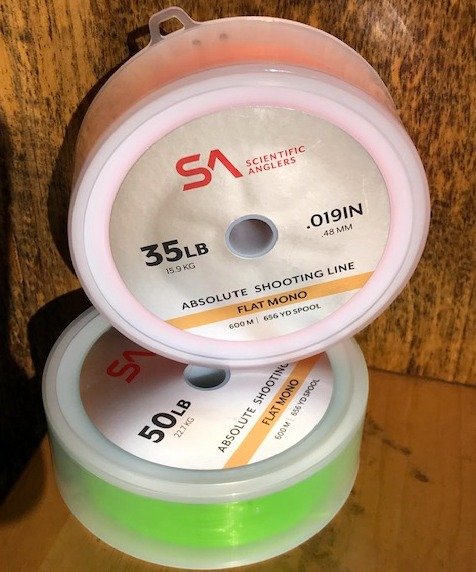
Scientific Angler’s Floating 0.021" Mono

0.021" Hollow Mono
This is the “sleeper” running line of the bunch. It’s a hollow-core monofilament running line that addresses a few of the problems that traditional monofilament has and includes a few improvements. This line is a .021” diameter with 36# break strength. Again, mono has very little water spray, so this is a great line for the winter if you can keep your hands warm. On the plus side, it’s easier to keep your hands warm when there is little to no water coming off of your running line.

While traditional monofilament line sinks, this line is hollow and floats! It has a nice diameter that is easy to handle and does not coil up as much as some monofilaments. It still requires some initial stretching when you get out on the water, especially on a cold day, but it’s nothing to worry about.

While this line does not have any pre-built loops either, a triple surgeon’s loop has a very small profile on the line as it “seats” into the hollow part of the line. Overall, this line has a lot of potential, but gets overlooked by most anglers. I have not used it myself, I've only talked to people that fish it, but the guys that use it are very pleased with it. I plan on trying it out the next time I need a new running line.

TRADITIONAL LINES

Airflo Ridge Running Line

Airflo Ridge Running Line
I fished this running line for over a year with little to no complaints. It is a traditional extruded fly line style, but has microscopic ridges that run along the line that improves shooting distance due to the reduction of friction on the rod guides. Less line touching the guides equals more distance. This running line comes in 20# and 30# versions. We sell tons of them and Airflo always makes high-quality products.

This line is made with a PVC-free urethane coating, which is more resistant to UV rays, and chemicals like sunscreen and bug spray. It also fades and cracks less than PVC, which should give it a longer lifespan. Ridge Running line is a solid choice for beginners, the occasional spey caster, and anyone that enjoys a traditional feeling line that is easy to deal with, has minimal tangling and can be fished year round.

RIO Powerflex Shooting Line

The RIO Powerflex Shooting Line is a quality traditional coated running line. There are no frills or gimmicks to this line. I don’t really need to go into much detail about this line since it is by far our best selling running line. It’s just a solid American built line that is tough, shoots well, stands up to a variety of fishing conditions and has a nice feel to it. The .030” and .035” are solid choices for 7wt spey rods, while the .040” is great on 8wt rods and above. The .024” lines up well on trout-sized switch and spey rods.
RIO PowerFlex Shooting Line

It does have loops on it, floats well, shoots well and is easy to handle. Since it is the most like a single hand fly line in feel, it is the go-to line for beginners. We sell more of these than any other running line because of the quality, price tag and ease of use. While there are no fancy ridges, textures or tapers, it gets the job done and it does it very well at a good price.

There is no perfect line for everyone and every condition. I have tried most of the running lines on the market at some point and I go back and forth depending on my mood and what I am willing to deal with. Each line has advantages and drawbacks that can fit a person’s style and abilities. What works for one guy may not work for another and what works well for summer steelhead may not be the best choice for winter steelhead. All I can do is relate my experiences with these lines and let you know what I like and am using; so….

As of time of publishing the following lines are on my steelhead reels:


Scientific Anglers Dragon Tail is on my 7wt spey and is my current “go-to” setup. I have fished it more this winter than any other. The Rio ConnectCore .032” on my “other” winter rod has seen plenty of action this year, but does not get the daily use that the Dragon Tail does, but I am moving it to my go-to reel because John wanted to try the Dragon Tail for a while. These two lines are the most expensive, but they are both in another class as far as the features. The great thing is that both of them have the right features that could give you the ability to improve your experience. I consider these to be the two premier running lines on the market today.

On my 6wt, which is currently in my closet, patiently waiting for the Deschutes fish to move in, I am using Rio 50# Slickshooter and am on my third spool of it since I started at the shop here. The Deschutes has quite a few spots where distance casting is highly beneficial, and I believe that there is no better line for casting long distances on warm days in warm water with dry lines.

I have a plastic tote filled with used lines, including several spools of Slickshooter, a couple of braided lines and some Airflo Ridge line for emergencies and backups. I would not hesitate to fish any of them in a heartbeat under the right conditions.

Again, we are always happy to answer any questions you may have on gear or if you just need some encouragement to get out of the office for an afternoon. Stop on by or give us a call and tight lines!


Andrew Perrault
Gorge Fly Shop | Product Specialist
541.386.6977


"Fly Fish the World with Us"


Jul 13, 2014

RIO's InTouch Lines - Get "In-Touch" with the other end of your fly line

It's middle July and I-CAST/IFTD mega show is just a week away. This is where all the dealers go to check out all that is new and improved for the upcoming 2015 season. We'll cast rods and handle reels and catch up on all the latest gear designed to catch more fish (or more fisherman). 


A product that I have watched steadily improve over the last few years is fly lines. I just received product information sheets of the new additions to the Rio InTouch series of lines and I think we all have something to cheer about. 


Mar 27, 2014

Get InTouch with Rio Lake Lines

Make the Connection: Get InTouch with Rio Lake Lines

Great fishing for Trout can be found in lakes all around the world. 

In the USA we think of the Western US and Western Canada (British Columbia and Alberta). In our area of the Columbia River Gorge and the Cascade Mountain range we think of lakes such as Lost Lake, Goose Lake, Mosquito Lake and Trillium Lake. Venture a little further and the reservoir of Crane Prairie on the Deschutes River comes to mind. And there are so many more lakes (too many to list) some of which don't even have names.

Our fly fishing gear has been steadily improving over the years and today's rods and reels are nothing short of amazing and the same could be said for our wading gear as well. My opinion is the one area of the sport of fly fishing we may have seen the most improvement is with fly lines. We have lines today for any possible situation that we may encounter. The lines today help us reach fish that not too long ago were just not reachable with fly fishing gear. Today's lines help us reach out further, help us cast better and most of all help us get our flies to the fish.

So many options! What do I choose?

With so many variables of lake angling it makes it tough to choose what is the appropriate line for each individual situation. I reached out to Northwest Rio fly line representative George Cook for some help in this subject and together I think we can help bring some clarity to what lines can benefit your fishing.

InTouch CamoLux and AquaLux -
These lines are quite possibly the most important to lake anglers and may be the only type of line you need. They are full intermediate meaning that the entire line is made to sink. They all have a sink rate that is 1.5-2.0 IPS, (inches per second).

InTouch CamoLux
InTouch CamoLux is the newest member of the group and it takes advantage of the new ConnectCore Technology. This technology gives you virtually no stretch which results in incredible connection for better strike detection and hook sets. I'll quote George on this technology, "When the phone rings, you answer quicker!" As the name implies the line is a clear camo color to help prevent fish spook and is equipped with a front welded loop for easy rigging. Also new on the InTouch CamoLux is a "Hang Marker". We'll talk more about the Hang Marker later.

AquaLux
AquaLux Lake has been around for awhile and is still is a very valid and useful lake line. It is extremely popular with Western Canadians. The head length ranges from 34' to 44' depending on line size making it longer than the InTouch CamoLux. The head is a clear intermediate that transitions into a very slick translucent green running line. The AquaLux also includes a front welded loop.

Hover
Lake Series Hover is a favorite of some of the most crafty lake anglers in the Northwest from B.C. to Central Oregon. "A true creeper" and an "old time favorite" for just getting under and "Hovering" above fishy weed beds and edges. Another advantage of the Hover line is better line control on windy days.


InTouch Midge Tip Long - 
InTouch Midge Tip Long
(New for 2014) is loaded with innovation and technology.
I have to share with you the full George quote "A Real “Sleeper Lake Line Here Folks”. The Midge Tip “Long” is what I call the Brian Chan Darth Vader Secret Weapon. Brian Chan along with fellow B.C. Angler Phil Rowley are the “Deans Of Western Canadian Lake Anglers”. These boys just plum get after it up north. This line features a 2 meter intermediate section that has a multitude of uses from chironamid fishing to “Edge Probing” with Damsels/Scuds and Dragons."
Besides ultra low stretch ConnectCore Technology the InTouch Midge Tip Long features a 6' clear camo intermediate tip and welded front loop for easy rigging.

Midge Tip (the original) is one of the top fish catching lines in the world and a consistent winner of numerous fishing competitions. It is perfect for fishing nymphs, emergers and chironamids just under the water surface. It has a 3' clear intermediate tip and comes equipped with loop in front for easy rigging.

Midge Tip

Depth Range for Sub-Surface lines
InTouch Deep Series (Deep 3 - Deep 7)
Deep Series sink rates
These are your full length, full sinking lines in 4 densities to meet the demands of stillwater anglers. Just like the InTouch Midge Tip Long the Deep Series is packed with technology starting with ConnectCore. The deeper you fish the more important sensitivity becomes, ConnectCore helps to detect those strikes that otherwise may go unnoticed. Deep Series lines have a powerful front loaded head for easy casting and maximum distance. Density Compensation technology is used to ensure that the tip of the line sinks faster than the body and is accomplished by adding a more dense material to the thin front tip of the line. The four densities available are Type 3, Type 5, Type 6, and Type 7. Deep series are also front end looped for easy rigging.
InTouch Deep effective depth range

Hang Marker -
Colors for different sink rates
Just like the InTouch CamoLux the Deep Series also incorporates the Hang Marker. The Hang Marker is a highly visible tag built on the fly line that indicates when the end is close. It is also color coded on the Deep series to indicate what density the line is.
George Cook gave a great explanation I would like to share.
"Modern twist on old world fishology. In the United Kingdom as well as British Columbia Canada where lake (reservoir) fishing is incredibly abundant and popular, The “Hang Tag” represents a number of things from a “Tactical Perspective” A) The Color Identifies sink rate (IPS #). B) Longtime Lake anglers in both B.C. and the UK play it as a “Soak it spot within the retrieve” in other words “Hang There” upon reaching this spot in the retrieve (In a Boat/Watercraft-Strip In) often times the Americans will reference it as an I.D. to roll cast and commence a casting sequence. I will tell you from a 30 year lake fishing and guiding perspective that it will serve you best to ALWAYS retrieve to the loop or leader nail knot based on the propensity for lake critters “To Follow Till They Bail”. Stay in the saddle till you simply have to do what I call the “Side Swing Out Move” to see if “Anybody” is trailing the fly!"
Outbound Coldwater Series

Outbound Coldwater Intermediate
While these lines are not considered "lake lines" they do have their place in a stillwater environment. They can go from lake fishing today to shore line distance casting on the beach tomorrow.
Read the Quote from George, "The Outbound Coldwater Intermediate at 37.5 (Head Length) is a devastating effective lake line for both the Lake Angler on “Foot Patrol” or fishing from a pontoon boat or float tube. Spinning rod (Cast) distances can be realized with this line providing a major “Coverage” opportunity for today’s lake fishing enthusiast!"

Leaders and Tippet - 
Flouroflex Plus Tippet
Generally with the use of sinking lines a tippet is the only needed connection to your fly. Both George and I agree that Flouroflex Plus Tippet will have you covered. If you do chose to use leaders be sure to keep them on the short side of 6' to 7.5'. Too long of leaders will affect the sink of your fly and defeat the use of a subsurface or sinking line. FlouroFlex is preferred for not only its abrasion resistance and invisibility but also for the faster sink rate over nylon due to its dense properties.

Get Connected and find out what your missing - 
As an example I will draw on my experience fishing deep water for Bass and express the importance of being connected to your fly. It wasn't until I started fishing the appropriate lines that a revelation revealed itself and that revelation was I have been missing fish for way too long.
Get Connected and feel the difference!

I'm quite sure this article only contains a limited knowledge of Lake line uses. Please feel free to comment with your experience with lake lines. Maybe it's just a rod/line match-up that's great or your home location where you fish a lake line or maybe a technique that you have found a particular lake line to be useful. We would love to hear from you.


Gorge Fly Shop Internet Sales Manager | Product Specialist

"Fly Fish the World with Us"

Nov 21, 2013

Rio Fishing Trip - Missouri River, Montana

The Guys at Rio Fly Lines invited several guys up to Craig, Montana for three days of incredible Missouri River Trout fishing.
Montana Sunrise
Sunrise in the eastern sky lights the way to a most memorable trip. A trip that would include new experiences, new friends, beautiful landscape and Trout! Lots of Trout; Big Browns, Big Rainbows slamming streamers and sipping Baetis all day until darkness pulls the shade and leads to the tribute paid for the lifelong memories in the making!
Sasquatch? No! Just me trying to keep up with Simon
We arrived at the Helena, Montana airport on Thursday around noon. Collected our gear and headed on our way to Craig, Montana. Craig is only about 30-40 minutes from Helena airport. Immediately after unloading Simon asked "who wants to go wet a line?" So we grabbed our gear and took off down the dirt road and found a pull off. A short distance trek and we were in the water wetting our lines. Fish were rising everywhere! Simon eased into position for a quality cast and laid out a presentation this rainbow couldn't resist.

The hatch is on!
Even at this angle the smile on Simon’s face is quite identifiable. Not sure if it is due to being the first hookup of the trip or the sound of a Sage Click reel screaming its way to the backing on a beautiful 20 inch Rainbow!
First of many!
Launch
Day one greeted us with blue skies and sunshine and just a touch of morning fog. Immediately after launch we started the day chuckin’ Streamers. Blue skies made fishing a bit slow but still managed to get several grabs and land a couple chunkies. Later that day the Callibaetis started hatching and we started seeing heads rising. Wasn't long and we started hooking fish on dry flies and the bite carried on the rest of the day.

Mark Raisler of Headhunters Fly Shop guided Aaron Stiny (Rio) and me on day one. The only rules I heard mentioned went like this…
…And release fish of course!
Aaron Stiny (Rio) and Mark Raisler(Headhunters Fly Shop)

The Missouri is an amazing river. It’s loaded with fish and the Montana scenery is breathtaking, wildlife of all types make their living here. I watched everything from eagles soaring to deer getting a drink at water’s edge.
Mr.Buck
Accommodations was this cool lodge called Lookout Lodge operated by www.thetroutshop.com. It has a great view overlooking the river with river access also. You can rent the top or the bottom separately or rent the whole thing for larger parties. Its situated a couple miles from town down a dirt road with very little traffic.                                                              
Day two is Streamer Time! Sage One 691-4

The Sage One really is a sweet rod and handles average size streamers with ease. The Sage Method was my rod of choice for all day Rio StreamerTip line casting of the larger breed of streamers.

Large Streamers caught some large fish as seen here…
Day Two
This Beauty came on day two brought to hand by Steve Dally of Dally’s Ozark Fly Fisher. Steve Operates on the White River, AR… big Brown Trout waters. I hope to catch up with him soon for some of that Streamer action.

Scotch and Streamers

Rio Perception Fly line 

The line of choice for all the dry fly fishing. It floats high on the water for excellent drag free drifts and the long range hook sets are positive and secure due to the ConnectCore technology. I also want to note how well this line cast on a variety of rods. It loads great, shoots great and presents flawlessly. Without any doubt this is my new “go to” favorite dry line.

Clear and chilly = Extreme Headwear
Mike Kuhnert of Evolution Fly Fishing guiding John Harder (RIO R&D Manager) and Leo Siren of Fish First out of the bay area. It was a clear blue sky chilly day and I was a bit envious of Leo’s Simms Gore-Tex Extream Hat he was sportin’.


Bobo came on a Fish Skull Skulpin Bunny with a Sage Method 691-4 equipped with a Rio Streamertip Cleartip fly line.
Secret Sauce
Mike Schultz of Schultz Outfitters in Ypsilanti, Michigan has my attention with his knowledge of Streamer fishing. We also share the Steelhead affliction and swinging flies with two hands rods. Mike guides Steelhead Alley in the Midwest, the very place I connected with my first Steelhead which changed my view of fly fishing forever.
Mike and Steve putting together a game plan for the day.
Sage One 4116 Switch test swing
Simon brought his Sage One 4116 switch rod and I had to give it a swing. Equipped with a Scandi Short VersiTip using the intermediate tip and a tandem rig of soft hackles I managed to swing up my first Brown Trout. I went on to swing up several more Rainbows that day. I think swinging for Trout is becoming a new passion for me. I felt connected to this rod and could really feel the fly. As Simon put it “The tug is the drug” and he couldn't be more right! I've since added to my arsenal my own 4116 and plan on putting it to use on my Southwest home waters of the San Juan and Rio Grande rivers as well as the Northwest waters of the Deschutes River Redsides come next spring. Call it my homework for the winter. Stay tuned for updates on what I find.
Montana Sunset
Our trip ends with a fire in the sky shot as we round the last bend before the takeout. Not a minute was wasted as darkness overtook the light. We loaded boats in the dark and headed back to Craig, Montana. We celebrated our trip with a barley toast at the corner bar and relived our favorite moments of the past three days. Back to the lodge for incredible feast presented to us by Sherri Walls of Canyon Cooking Catering. Special thank you goes out to Sherri for keeping all of us healthy and well-nourished for our stay.

I’ll finish this up with this, There is something magical about a group that comes together all sharing the same passion for the sport. I have experienced it a few times before and can’t explain what it is but I can say that it is very real and I witnessed it again on this trip. All of us came from different areas and a couple even born and raised abroad but the bond of the sport ties us all together with a sense of total unselfish passion to teach and share the sport that has hooked us for life.

Thank you,

BassProGreg


Gorge Fly Shop Internet Sales Manager | Product Specialist


"Fly Fish the World with Us"


Visit our Relaunched Steelhead Only Site

Shop Gorge Fly Shop & SteelheadBum.com

  © 'and' Steelhead.com Mike Prine 2009-2014

Back to TOP