Showing posts with label Oregon Coast. Show all posts

May 7, 2021

Columbia Gorge Fishing Reports - 5.7.2021


Trout - Deschutes River:

Big bugs are here and trout are looking up in the lower sections of the Deschutes. There are salmon flies and golden stonefly adults all the way up to Maupin but with a cooler weather pattern this weekend, these bugs will not be as active taking flights and laying their eggs. Fishing with dries should still be productive though! Next week it is really going to take off with weather in the low 80’s predicted. We have a great assortment of salmonfly and golden stonefly patterns to choose from so give us a shout to get dialed up. Don’t forget about the smaller little yellow sally stoneflies, the Deschutes trout love eating these smaller stoneflies and will become more prevalent later in May and into the month of June. Tough to beat a purple chubby this time of year. 

Cheers to the start of what should be a fantastic month of dry fly fishing our favorite river.
Shop Trout Flies

Lake Fishing:

Coming soon!

Steelhead - 

Coming soon!
Shop Steelhead Flies

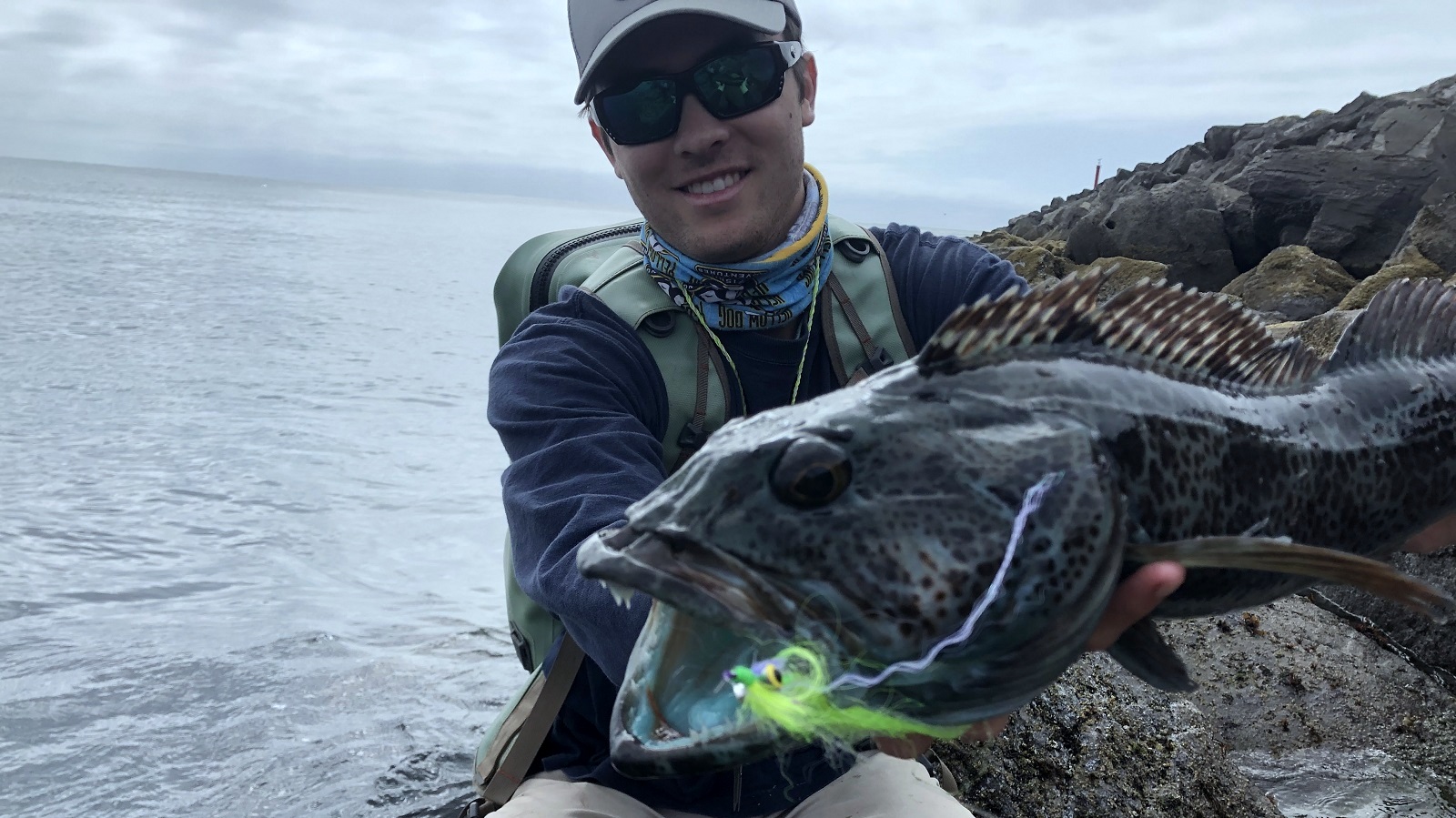
Oregon Coast Rockfish

Rockfish and lingcod fishing off the jetties has been really productive when the ocean lays down. Large clousers with dumbbell eyes and a full sinking line something in the 250-350 grain weight window is good. Go when the swell is predicted to be 3-5 feet or less. I like fishing an outgoing tide and into the low tide the best because you are able to get down lower to the water and fish the deep slots and troughs where the big lings hangout. Vary your strip speed but the technique that works best for me is a quick jerk of the rod tip then stripping in the slack slowly. Continuing that all the way back. This causes the fly to dance right off the bottom of the rocks.

Smallmouth Bass / Carp:

Smallmouth fishing has remained steady this spring. As weather and water temps continue to increase, the fish will become more responsive and less lethargic. Early spring, slow your presentation down significantly as the fish aren’t as aggressive. There are still some great smallies being caught now around the Columbia basin and should only get better. Slow stripping baitfish and small streamer patterns is an excellent strategy as is fishing a jig style fly under an indicator.


-Zach Parker

https://www.gorgeflyshop.com/store/pc/Sale-Closeouts-c38.htm

"The Gorge"

Gorge Fly Shop Team - 541.386.6977


"Fly Fish the World with Us"

Nov 20, 2020

Jetty Fishing on the Oregon Coast


Got plans to head to the coast this spring? Well, I’d bring some fly rods with you and I’ll tell you why: 

Spring can be an interesting time of year regarding fishing. Winter steelhead fisheries are closed or slowing down as fish are either spawning or returning back to the salt. Hardcore steelhead anglers might be getting ready to hang the waders up for a few months until the first summers start arriving, while other anglers, are getting ready for trout season to open. This past spring, I geared up the full sinking lines, clousers, and single hand 9 weights and headed to the coast in pursuit of a different species on the fly. 

Jetty fishing on the Oregon Coast has always had a special place in my heart. Growing up, jetty fishing was one of the first kinds of fishing that my dad introduced me to. I can remember early mornings hiking out over the large slippery rocks in pursuit black rockfish, kelp greenling, rock perch, cabezon, and the prized lingcod. 

Lingcod

Fly fishing off the rocks is a fishery that is beginning to gain some traction and a bit of press, although almost every time I go out there with my fly rods in hand, I am outnumbered by gear fisherman and usually get many confused looks from other anglers as I stand perched out on the rocks, throwing double hauls with an eight inch fly. To each their own. 

The Gear 

This type of fishing requires a stout rod. I like a saltwater 8 or 9 weight single hand fly rod but there have been some instances out there where I wished I had my 10 weight. Freshwater or all purpose 8 weights generally have too light of a butt section for these strong fish. Saltwater specific 8 weights like the Sage Maverick or Sage Payload: Sage Maverick and Sage Payload, are a bit beefier and can handle the large flies, heavy lines, and large fish you’ll hook into out on the rocks. You don’t need to get too crazy with reels. Something that matches the rod you’re throwing and can hold 100 yards of backing plus your fly line is suitable. I personally have been using a Redington Behemoth in the ⅞ size. Redington Behemoth. Most important thing is to make sure the reel has a sealed drag to prevent salt from getting into the drag and causing corrosion. 

Rockfish

The line system is probably the most important part to this kind of fishing. Your standard weight forward floating line, even if it is designed for saltwater, will not cut it (at least by itself). Most of these jetties on the Oregon Coast drop off pretty quickly and you’re fishing in water that is 15-25 feet deep and sometimes fighting tidal currents as well. You need to get down right away. I run a 250 grain line from Cortland, (it’s an old line but gets the job done) which has a 30 foot sinking head that integrates into a floating running line. Before using this line, I was running a RIO Big Nasty fly line with a 12 foot section of T-20 sink tip on the end, which was difficult to cast, but it got me to the right depth as it equates to a similar overall grain weight as the Cortland line. The RIO Leviathan line would be a great choice as well. RIO Leviathan Line., as would the Airflo depth finder. 

I then run about 2 or 3 feet of RIO saltwater tippet in the 20-30 pound range. These fish are not leader shy so you don’t need to worry about running fluorocarbon. I also tend to use a pretty short section of this tied with a perfection loop to the end of my fly line. The shorter this section is, the more it will stay down on the bottom and lingcod don’t care if your fly is relatively close to your fly line, they are going to crush the fly regardless. 

Clouser Minnows


Speaking of flies, this is where the fun starts. I tie my own clousers and the color combos that I’ve had the most success on are chartreuse and white, black and white, all white and all black. I tie them on with a Gamakatsu SL 15 3/0 hook, using the XL yellow or red dumbbell eyes, chartreuse thread, and bucktail as the main body. Throwing a little crystal flash in never hurts either. I tie them about 7-8 inches long and have found that the black rockfish like that huge size just as much as the lings do.

When to go and presentation 

Spring is by far my favorite time to climb out on the rocks and pursue these fish. March-May is the time of year that many lingcod move inshore from the deep water to spawn. Females deposit a cluster of eggs and the males fertilize and guard these eggs as if their life depended on it and will voraciously attack anything that comes near. There are some resident lings that hang around these inshore jetties year round, but in the early spring, many large females and large males move in close, making them accessible to fly anglers. 

The presentation you’re looking to achieve is simple. I generally throw about a 30 foot cast and count 10 seconds to let it sink, then just strip my fly in, varying speed from slow to fast. You’ll hook both black rockfish, lingcod and the occasional cabezon doing this. Be prepared to lose some flies. Ideally you want your fly dancing right above the rocks on the bottom of the jetty. The closer you get the more lings you’ll hook, but also the more flies you will lose. Hooking them is the easy part, keeping them up and out of the rocks is the difficult part. This is where having a stout rod comes in handy to force them out of the rocks where they instinctively will go when hooked. 
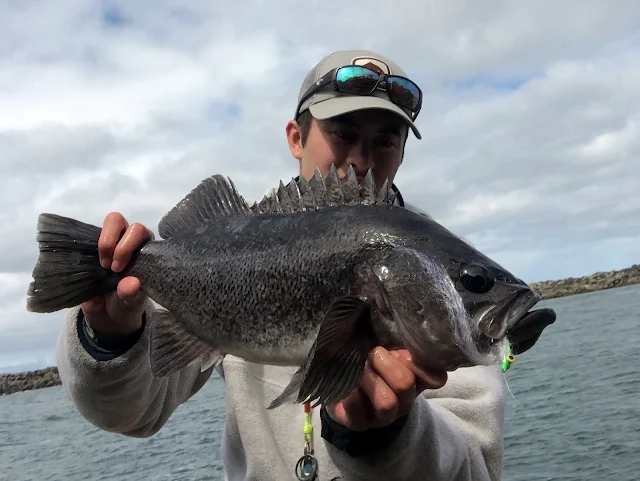
Black Rochfish

Tides and general ocean swell are another important factor to this fishery. People have their own opinions on the tide but I’ve personally done best on an outgoing tide and into the low tide. This is because I can get down closer to the water, and many of the large rocks are exposed now, making your odds of snagging on them go down. I’ve caught them in high tides though as well, so you can’t be picky, just gotta GO. In between tides can be tough as their can be heavy current making it tough to get a presentation in there. Slack tides are the best. 

Check swells before going. It can be very dangerous out there if you go on a rough day as waves can easily crash over the entire jetty. I use magic seaweed to check swell reports and usually only will go if the swell is reported to be below 5 feet. 1-2 foot is ideal. The limit is 7 black rockfish and 2 lingcod per day per angler, with a minimum length of 22 inches for the lings. 

This is an exciting fishery where quantity is the name of the game. These fish pull hard and will test you as an angler and make you a better one at that. Of course, don’t be afraid to call the shop for questions. Believe me, it is a hell of a lot of fun coming right out of winter steelhead season, where you can hook many fish in any given day and fill the freezer for months to come. 
--Zach Parker

https://www.gorgeflyshop.com/store/pc/Sale-Closeouts-c38.htm

"The Gorge"

Gorge Fly Shop Team - 541.386.6977


"Fly Fish the World with Us"



Feb 14, 2014

Lamson ARX 4+ Spey Reel

Lamson Arx 4+

A quality spey reel for your spey fishing consideration.

Waterworks/Lamson has been making high-quality reels in Idaho for over a decade. Their famous and effective conical teflon drag system has been the cornerstone of their line of reels since the beginning. When people come into the shop looking for a reel, here are a few reasons why I recommend a Lamson.

  • Made in the USA. Even better, they are made in Idaho by people that live and breathe fly-fishing. Waterworks/Lamson is a great company with great customer service.
  • One word: workhorse. I have many, many Lamson reels; most of which are 10-12 years old. Each of them has hundreds or even thousands of hours of use. Looking back, all of the big big fish I have ever caught were caught on Lamson's… and I have never had to send one reel in for repair or service. 
  • Speaking of that, their drag system is extremely reliable. I have never had to fidget with it when casting or adjust it when fighting a fish. I am sure that most of us have hooked a fish on an inferior reel and immediately panicked, tweaking the drag in a desperate attempt to get the fish under control. This is not a problem with a Lamson.
  • Lamson offers a wide range of reels at different price points without compromising quality. Besides the Konic II which is pressure cast, all of their reels are fully machined from high-quality barstock aluminum. 
The new ARX 4+ is a high quality reel that takes what Lamson does best to the next level.

Here is what Lamson has to say about it:

ARX 4+ Spey Reel

"Arx is a reel built with purpose; Spey or switch casting a variety of lines with maximum line control and reliability. The continuing evolution of Spey and Scandi lines, shooting heads, flat mono, etc. demand a reel that can help prevent line snags while retaining the high performance you’ve come to expect from Waterworks Lamson. Arx has a full cage frame that encapsulates the spool to prevent line from escaping or snagging in critical areas. Normally a configuration like this would do a good job at preventing line fouling, but would preclude palming the reel. Arx is carefully milled on the bottom third of the reel to expose a functional palming section. Even the drag knob has been designed to provide optimal grip without exposing a portion of the reel to line fouling."

Format: Large Arbor
Materials: Machined 6061 Aluminum, stainless steel
Finish: Hard Alox

This reel is truly built for the spey-fisherman in mind. I love the full frame. I have used a few reels that allow line to (especially smaller diameter mono running lines) to slip through the gap between frame and spool. This has been eliminated with a full frame and I have never been happier about it. Many other full frame reels are a little awkward when you palm the spool because the pressure from your hand has to slow the reel down; but the frame generally gets in the way on most of these reels. Because the ARX’s frame has been milled down on the bottom, it is very easy to get some leverage on the spool while keeping your hand in a comfortable position.

I took this out for a weekend on the Oregon Coast and a few mornings on the Hood River paired with a 7126 Sage Method with a 550 Skagit Max Short. While I had no love from any chrome steelhead, I was impressed with how smooth it takes line off the reel, and how the line tension remains steady. It takes minimal start-up inertia to get the reel moving. All of the features I have come to love and expect from a Lamson shine with this reel. I have a purpose for my tax refund now…


Elegance. Durability. Functionality.  The ARX 4+, a Spey Fishermen Reel

At $499 for the ARX 4+, this reel has the right combination of elegance, durability and functionality for most spey fishermen, and should be a top choice for anyone looking for a top-end reel for their spey rod without breaking the bank.


Andrew Perrault
Gorge Fly Shop

Lamson/Waterworks Spey Reels
"Fly Fish the World with Us"
What is Spey?


Feb 11, 2014

Fly Fishing Chronicles: The Oregon Coast

In Search of Chrome
We are some of the newest members of the Gorge Fly Shop crew and this is just one of the many lessons (I mean Adventures) we have learned while in search of Chrome...

As the story goes..
Since Jeff moved here last fall, I have been telling him about my favorite “secret” winter steelhead river out on the Oregon coast. Our time finally came in early January; we both scored the same two days off during the week and the conditions seemed perfect. Recent rains had brought the river levels up and they were hovering in that “perfect” zone, where the river was dropping between average and low flows, and the water temp was creeping up. All things were lining up in proper order for an epic trip of steelhead opportunities.

My fishing adventures usually start late in the evening with a long drive to a desolate river in the middle of the night. This trip was no different. We got off work in the evening; packed up Jeff’s rig, stopped by the liquor store, and then grabbed some tacos for the road. We drove until somewhere around midnight, and found a spot to set up camp off an old logging road not too far from a nice run that has been a known producer.

After we set up camp and drank some cheap bourbon, we went to bed. I was bolted awake around 4:00 am by the sounds of diesel engines. I was a bit afraid we were about to be run over by some heavy equipment or possibly arrested for trespassing.

No Contest
It turns out that there was a full-on logging operation going within sight of our camp that we hadn't noticed the night before when we were setting up. It also turns out that the logging crew starts the de-limbing machines around 4:00 am, and that they are incredibly loud and totally scary at 4:00 am.

When the first hints of morning light finally came around, we made some bad coffee in the jet-boil and tried to start the camp stove. No bueno… My new camp stove seemed to be frozen solid and non-functional; somehow it was 20 degrees at camp when we were expecting lows in the mid 30s. So no breakfast, but on the river early…

No sign of steel.
We fished hard from sun-up into mid-afternoon with no hook-ups, no bumps, and no sign of steel. Even in a spot that has produced more fish than any other run on any river for me, we struck out. When we went back to camp for some late lunch/breakfast around 3:00 pm, we noticed that our camp site was still frozen solid. Ice covered every inch of our site, even though we were in the open with no trees within 100 feet in any direction; while that the run on the river we were fishing a half mile away was in the 40’s and beautiful. Obviously we found where the “polar vortex” had creeped down into a 400 square foot section of Oregon forest. We quickly ate some protein and fished until dark, this time each getting a solid grab and I landed a couple of cutthroat.

Early to bed, slow to rise.
After polishing off our bottle of bourbon, we slept like babies that night, going to bed by 7:00 pm, and waking even earlier the following day. Again, we fished hard, hard, hard, hitting every spot that we could get to. In two days, Jeff and I each had a solid grab and a handful of cutties, Jeff landed a little jack coho, but there was no steel to be found anywhere.

Although our story is short and the grabs where few and far in between, our story still rings true... 

Photo courtesy of Sam Sickles
Every day of fishing provides an angler with learning opportunities. I learned to be more careful in selecting a camp spot, to never camp in that spot ever again; I learned to check logging schedules (my favorite run on earth was closed off due to logging). I learned that even on a river that I had conquered in years past, that no steelhead is guaranteed, even if conditions are perfect. I also learned not to tell my friends that we are going to slay steelhead; it’s just a recipe for disaster…


Andrew Perrault

"Fly Fish the World with Us"


Nov 1, 2012

Rain


Hurricane Sandy got me thinking about the last time I experienced the might of Mother Nature. I was just back from Alaska and was determined to move to the Oregon Coast for the winter. I know that to some, that doesn’t sound like the best idea; after all, it’s wet and dark for the most part but for steelhead anglers, it makes good clean sense. Not only is the Oregon Coast littered with rivers through canyons and lush forests, it is also home to some of the last remaining stocks of native steelhead in our country. Furthermore, to witness the oceanic fury bestowed upon the coast in the winter is an experience to savor.

I arrived on the North Coast in November with my dog, Dell and we started to look for a job and a place to live. But it couldn’t be just any job… I had one strict rule. No, it wasn’t about building a career or something responsible like that. I was game for any job, as long as it happened at night, so that I could spend daylight hours in the river. Washing dishes, night manager, janitor, whatever- it didn’t matter. When I opened up the classifieds on day one, it started to rain.

Jul 11, 2012

Fly Fishing for Tuna - Oregon Coast


Tuna are the hardest fighting fish period! During the summer and early fall Albacore Tuna feed within striking distance of the Oregon coast. It is a special time of year when the planets line up, the fish being close and the ocean is relatively flat. The 42’ Oppor-Tuna-ty (2005 42' Dorado Bluewater) is based out of Warrenton, Oregon. With twin inboard engines and a hull shape that is designed to plane it perfectly for this fishery. It is the only boat specifically geared up for fly fishing.


Join Captain and year-round fishing guide, Jad Donaldson, on this extraordinary trip. Day length is up to 12 hours. The time of departure varies and depends upon the tide and current bar conditions


The rate is $2000/day which includes boat, ice, bait/chum, non-alcoholic beverages, snacks and all tackle, for up to six anglers. They will try to accommodate singles and doubles etc to make a group of 5.

Anglers should expect to come home from this adventure with dinner and bruised knuckles!


Jerry Swanson

Fish Head Expeditions
http://www.fishheadexpeditions.com/
jerry@fishheadexpeditions.com
503-539-1451

Visit our Relaunched Steelhead Only Site

Shop Gorge Fly Shop & SteelheadBum.com

  © 'and' Steelhead.com Mike Prine 2009-2014

Back to TOP