Showing posts with label rio skagit max. Show all posts

Sep 1, 2022

New for 2022 - RIO Elite INTEGRATED Skagit Max Power

A powerful Skagit Max Head seamlessly INTEGRATED into an exceptionally slick Connectcore SlickCast Shooting line giving the angler enhanced detection of takes, more positive hooksets, and greater control when playing fish. 

Features

  • Powerful front end to easily cast large flies and fast sinking tips
  • Integrated running line for ease of use
  • Loops on each end for fast rigging
  • Low-stretch ConnectCore Plus for the best in performance and smoothness
  • Built with RIO's exceptionally slick, durable SlickCast coating
  • Easy ID
  • Front and Back Welded Loop
  • Overall Length: 100ft

Specs -

SKURod SizeHead WeightHead LengthColorSink Rate
6-19756#5375gr19ft / 5.8mSalmon / Blue / Light Gray
Float
6-19757#6425gr20ft / 6.1m
Salmon / Blue / Light Gray
Float
6-19758#6/7475gr20ft / 6.1m
Salmon / Blue / Light Gray
Float
6-19759#7525gr20ft / 6.1m
Salmon / Blue / Light Gray
Float


https://www.gorgeflyshop.com/store/pc/Sale-Closeouts-c38.htm

"The Gorge"

Gorge Fly Shop Team - 541.386.6977


"Fly Fish the World with Us"

Jan 28, 2015

Two Hand Troutin' - On the Yakima

Update 2.22.2015
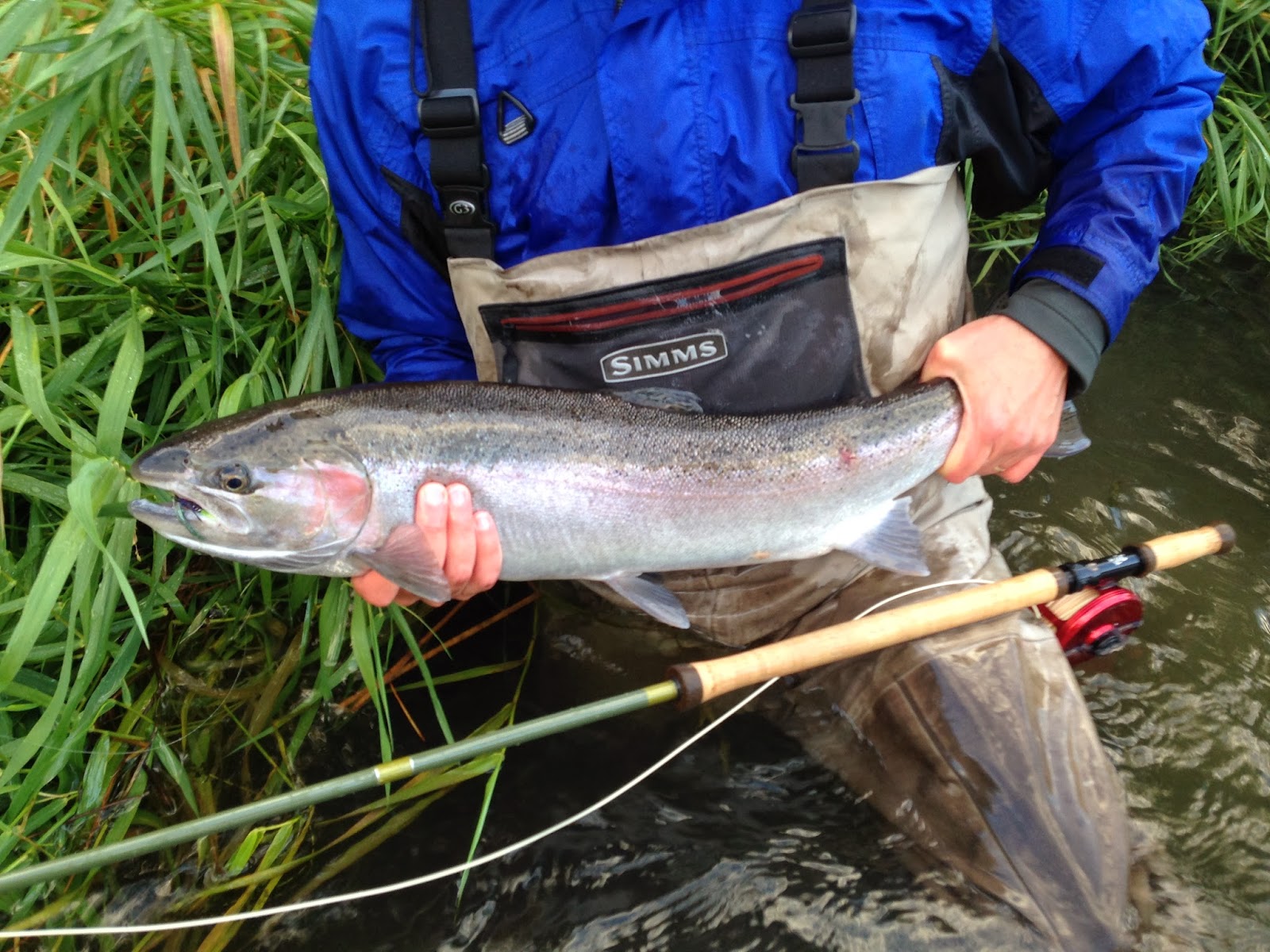
Swinging for trout on the Yakima Sunday with my 5 wt switch and hit this hen.

Photo Courtesy of Paul Huffman

Big for a mid Columbia Fish at about 28 inches. The rod is a Sage TCX 5119. I was experimenting with a intermediate tip head a little heavier than I started with, a RIO iShort 350gr, and 12 ft. of T-11. Luckily, I still had a 10 lb. tippet on because I had been experimenting with very heavy flies and didn't want to snap any more off. She grabbed a little olive rattlesnake skulpin. We only have 44 steelhead over Roza at this time and I found one! No time for a great photo. I had to get her unhooked and released quickly. The take was very unlike a steelhead. She didn't grab it on the hang down, but after a few strips in through some very quiet water.

Update 2.12.2015 - Not on the Yak but still a great trout spey catch...Thanks Paul

Photo by Paul Huffman - Methow Cutthroat

Update 2.9.2015
Paul added...

I got a chance to try the RIO iShort 350 on Jan. 31. 

 I liked the extra weight of the head. The intermediate sinking front end gets the sink tip a few inches deeper than a floater, but I'm not sure how much deeper the fly gets. I'm not sure it makes much sense from the standpoint of making it stealthy to the fish to make the front end transparent because I'm going to be attaching it to a opaque tip or leader. Maybe that's the easiest way to manufacture a intermediate end. But I had to guess where the head was pointing. I could see the bright orange proximal end, but the orientation of the distal end took some interpolation. The idea from the manufacturers and the shops that getting half the head under the surface gets it away from the shearing surface currents and helps you swing slower seems bogus to me. There are probably shearing subsurface currents as well, but you can't see what they are doing to your line. And any hydrologist will tell you the surface velocity is generally going to be slower than subsurface. In a natural stream, you generally find the highest velocity 20 to 40% down from the surface.

I had no problem clearing the iShort to the surface for the upstream snap. It wasn't to heavy to throw with my Sage TCX 5119. However, it wasn't much help in casting that big Dali Lama.

1.28.2015

We love to hear your stories and see your pictures. This article comes to us from a great customer named Paul Huffman. Paul primarily fishes for Steelhead but like us he is now looking toward the many other possibilities we can adapt two hand strategy to. Paul has found some great success on the Yakima River and has kindly shared his findings with us. Thank you Paul

Yakima River Bow

Frozen waders

I'm recovering from shoulder surgery on my non-casting side, so snowboarding is out of the question for a bit longer. I've had to settle with winter fishing on the Yakima and experimenting with my 5 wt. switch, a Sage TCX 5119-4.


I tried both my single handed 5 wt. and the switch rod and found single-handed casting is a lot harder because my left arm has to come up higher to haul line. When I'm doing standard two-hand casts, my left hand stays comfortably low.

I've been having fun swinging skulpins on a sink tip. It's like like steelheading in miniature. For years, I struggled with a single-hand 5 wt. and a sink tip. I'd do lots of tricks to find some back cast room to get a cast across the current, like casting off-handed, false casting up and down the river then changing direction, wading way out, or finding a hole in the brush behind me, hitting it with as long a back cast as I could, then hauling hard into the forward cast while releasing loops of line held in my mouth. Now with the switch rod, it's just a sweep and a flick, and care not to cast too far!

Yakima River Valley

I remember talking with Travis Duddles about streamer fishing a few years ago, and was surprised to hear that not that many trout fishermen used streamers on the Deschutes River. However, people like Greg Darling may be changing some minds. Streamer fishing has been a standard technique on the Yakima for a long time. For me, November has always been the best month. Some days I'd fish streamers until the mid-day BWO hatch started, I'd do well on tiny dry flies for an hour or an hour and a half, then go back to catching big rainbows on streamers after the hatch. It seems like the BWOs bring fish into the feeding areas, but they be willing to eat anything while they wait for the hatch.

However, I am finding there are some flies that are too heavy and bulky to cast well with a 5 wt. switch. It doesn't have the backbone of my 8 wt. steelhead rod. An example is the Dali Lama streamer, which is heavy both because of the cone head and the water absorbant twin bunny strips. I'm using a RIO Skagit Max Short 325gr. which should be better at this than some other lines, like a Scandi or a triangle taper. The heavy flies stick in the water a little too much right at a critical moment at the outbound cast, "tripping" the cast. The best way I've found to compensate is to sweep the line to the surface a little harder. For a snap-T, this would be to flip the line upstream, then sweep it downstream to get the leader tight and the fly near the surface, then quickly swing into the loop formation, make a crisp stop, wait for the loop to fully form and tighten, and have the loop, p-point, and target aligned carefully. I snapped off a couple heavy flies either struggling to roll the tip up prior to sweeping or on the outbound cast, so I had to step up to a 10 lb. tippet. It seems like that heavy tippet would decrease strikes in clear water. Still, it's probably easier than trying to cast the Dali Lama with a single handed rod.

Ice
After a little more experimenting, I found that maybe the way to go deep is to put the weight on the line, not the fly. I had been using sinking leaders and ten to twelve feet of T-7. I reached into my steelhead wallet as an experiment. First, I tried 6 ft. of T-11, reasoning that I couldn't add on a lot of extra weight. But that short tip required an adjustment to my casting rhythm. Then I tried the full 12 ft. length of T-11, and was surprised how well that cast. The casts would just rocket out there with a moderately weighted streamer. My conclusion: weight on the fly line is easier to cast than weight on the end of the leader.

When I was able to get both hands up to my tying vice, I experimented with skulpins on Protubes. They are pretty bulky with that clipped deer muddler head. The ones I tied with steel eyes, and the ones with steel eyes with a flexiweight cast well. But when I added a drop weight with the steel eyes, those were too heavy.

Swing Water
Some guys at washingtonflyfishing.com had some useful advice, some not so helpful. Some guys wanted to blame my casting ability, but I explained that everything I cast on the TCX casts like a dream, except when I reached a distinct threshold of fly weight. Others told me I should maybe try a slightly heavier Skagit Max Short 350 grain. Lots of people have been telling me to try an intermediate head. I'll have to try it. Still, it's nice to be able to just switch the tip on the floating Compact Short to a straight piece of mono and have a killer nymphing rig. I can cover a lot of water with an indicator rig, throwing it way up stream and getting a real long drift past me to the downstream swing.

I like the TCX switch for hopper fishing, for trout and steelhead nymphing, for swinging streamers for trout. I can even see myself using it for Deschutes red sides during the big stone hatch for throwing those big foam imitations. I might not ever use my single hand 5 wt. much anymore except for BWO hatches.

Contributed by Paul Huffman

Thanks Paul for your insights. I think you will get in the zone with a RIO Skagit Max Short 350gr or an Airflo Skagit Switch 360 gr although casting #2 Dali's will likely never be easy on a your TCX 5119. The rod is a champion but everything has it's limits. 


Question for our readers out there: What lines are you throwing with your TCX 5119? We'd sure like to hear about it


Thanks again Paul and Keep on Swinging!
Best,
Greg

Mar 9, 2014

G. Loomis: Pro4x Spey Rods (a legend formed?)

Josh Linn: G. Loomis Pro4x catch
One of the things I really like about G Loomis is the idea of making actions specific to fishing applications. Skagit, Scandi, long belly we make them all. For winter fishing in Oregon or sink tip fishing in general the dredger rods are hard to beat and the 13'4" 7 wt is one of my all time favorite rods. A couple of years ago we introduced the NRX Spey rod in the 13' 7/8, it's an amazing rod and perfect for the PNW. When I started Spey casting I really liked or thought I liked fast action rods as my Spey casting has evolved just like my single hand casting I've decided I like all actions and I really like the right action for the job.

SCANDI
Scandi rods are typically more of a tip action rod, so when you make a cast you are just casting right off of the tip. A really short stroke with a crisp pull from the bottom hand creates tighter more aerodynamic loops. In the states we most often think of a Scandi line as a full floater made for casting small flies on long leaders.

SKAGIT
Skagit rods are typically softer rods that flex all of the way down into the handle. They load easier and cast heavier shorter lines with ease using a constant slower motion with a little longer stroke. When we were contemplating coming out with the pro4x line of rods I wanted more of an all around rod that would be able to cast a skagit and a Scandi with ease. Something that loads easily and cast from deep down in the rod. I didn't want to make another NRX 13' 7/8 we already had that. I wanted the rod to be very easy to cast yet still be a performer.
G. Loomis Pro4x 7130-4 Spey Rod - 13' 7/8 Weight
"Cheese"
One day in February Steve Rajeff called me and said the first round of new pro4x Spey rods were ready to try. I met Steve Rajeff and Steve Choate on a river near the factory. We brought tons and tons of lines to try Scandi and Skagits,in all makes, sizes, and lengths, from airflo, rio, and SA. Mentally I had an idea of how I wanted all of the rods to cast. 14' and 15' should be more suited for a long belly line. The 13' 7 & 8 should be more of a medium action rod capable of casting skagit and Scandi lines. We tested the 14 and 15, figured out the little changes we needed to make and moved on to the two 13' rods. Both rods were amazing especially for being the first generation but they were not what we wanted. They were great Scandi rods and would probably sell amazingly well in Europe. But that's not what we wanted. We wanted more of a mid flex rod. One that would be easy to cast, that would load into the butt of the rod and that I could hit as hard as I wanted and it would just load deeper and deeper.

Steve Choate and I were on the same page. Steve Choate and Brian O'keefe really helped me to understand and develop my Spey casting. The funny thing is that Brian doesn't even Spey cast, but I did pick up some ideas and concepts from watching him distance cast. The first time I fished with Choate really made me rethink what I was doing. He is an amazing caster and showed me what was possible with a Spey rod. After being with those two guys my Spey casting really started to evolve. I started to break down concepts and redesign them. Steve and I fish mostly the same rods with very similar lines and cast in a similar manner. One thing we both do is hit it about as hard as possible and come over the top in a straight line. This allows for a good positive turn over with a lot of power. 

We explained to Steve Rajeff what we wanted, stiffen the tip so that it will flex a little deeper in the rod and smooth out the middle so it flexes a little more evenly. He totally understood what we were looking for. A few weeks later Steve called us up again. The new rods are ready. We met up on the river again there were two sets of rods, the new ones and the original ones, so we could compare and see if the changes we wanted had been made. I was most excited for the 13' 7/8 as that would be my daily fishing rod. We use high quality graphite, Fuji guides, and the best cork available, we just wrap it up in a price tag that is affordable.

We started testing the second round of rods.
Everything was good and the changes were spot on. We got to the 13' 7/8. It was great. Loaded deeper into the blank, it had a stiffer tip. Just what I wanted. I fished those prototype rods throughout the rest of the winter. Caught a fair amount of fish on them. They were easy to cast and worked well. But they were still just prototypes. Shortly after that I got the first couple to come off of the production line. Winter fishing was over and Deschutes summer steelhead was beginning. I was extremely excited to have a finished product in my hand. When we tested the rod we cast a Scandi line around 430-440. I truly like the rio Scandi lines and fish the 435 on that rod. Talk about easy, I could easily cast and cover as much water as I wanted. Nothing was off limits. I put that rod in tons of people's hands and everyone loved it. Part of that may be that the rod is a point of pride for me. I have worked with many companies casting and testing new rods but this was different. This was my rod. This was exactly what I wanted. It cast the size of lines I think a 7wt should and it does it easily. 
C.P.R:  Catch. Photo. Release
As fall progressed I had a trip scheduled to BC. I took 3 of these rods with me so that anyone in our party could use it. I was like a proud parent. Everyone should own at least two of these! We mostly fished sink tips on that trip I loaded the rods with the new rio skagit max 550. What an amazing outfit, any fly any tip, just let it rip. I still gravitate to this rod everyday I'm on the water. This is definitely my go to rod. I am still blown away that one of my favorite rods is our price point rod. But that actually says a lot about our products. When we build something inexpensive it's not just cheap crap. All of our pro4x rods are killer and I find myself using them everywhere I go.

Try one I bet you'll like it.


Josh Linn
G. Loomis - Sales Manager
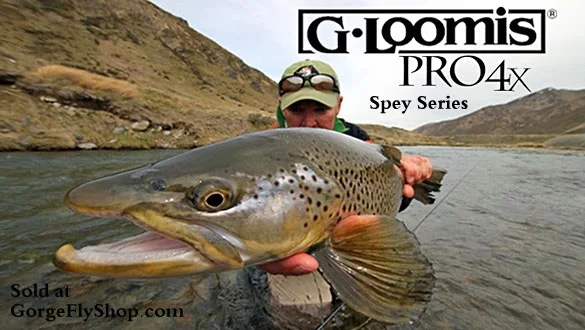


Includes FREE Spey Head of your Choice with Purchase of this Rod at GorgeFlyShop.com
"Fly Fish the World with Us"


Other G. Loomis Links and Videos:



Visit our Relaunched Steelhead Only Site

Shop Gorge Fly Shop & SteelheadBum.com

  © 'and' Steelhead.com Mike Prine 2009-2014

Back to TOP