By Certified ‘New Guy at The Shop’ Jacob Noteboom
If you’ve fished anywhere on the Deschutes in the past year or you’re a big streamer guy, you’ve probably seen guys with odd looking two-handed rods or single-hand rods with thin running lines and big fat head systems. This is the somewhat new (to our area) and a very effective tactic that involves aggressive grabs from aggressive fish. Here’s how I got into it-
I started fishing the Deschutes like many other people start out, fishing Mecca Flats with some sort of stonefly looking bug with rubber legs on it. Sure it caught a few fish here and there but after a while I started questioning myself, “why am I wasting my time roll casting and splashing a big fat bobber at fish I can’t reach?”. I expanded my tactics, used dries whenever I could and experimented with smaller mayfly and caddis nymphs. My fish numbers went up the more I explored my options and tried new flies. Fishing to moderately pressured trout definitely helped me refine my fly box a bit and get some patterns figured out... Though none of the stuff I learned over the last couple years on the Deschutes mattered when I picked up a
OPST Commando head for my 5wt and chucked a sculpin for the first time.
It was fall of 2017 and to say that the redbands were putting the feed on would be an understatement. My buddy and I were on our way home from a long day of hike-in fishing on a tributary to the middle Deschutes. We’d put quite a few miles under our boots that day but we decided we weren’t done fishing. Warm Springs just so happened to be on our way home, and there was about a half-mile of water to fish right off of the highway. By the time we got on the water, the sun was just starting to creep back behind the canyon and the fall mix of smaller caddis and their larger October cousins were starting to pop off. I let my buddy cover the bobber and pupa side of things and I decided to fish a sculpin pattern in the faster water.
My buddy set up on the backside of a large seam and instantly landed a couple 16 inch fish, this is all while I was right next to him rigging up and picking a sink tip. I waded down to some choppy quick moving water determined to swing up a big one. The only thing I knew about my Commando head setup was how to cast it, but I had never really had the chance to use it though. I had no idea how I was going to retrieve my fly or how it would feel in the current, so I did what every good fisherman does when they don’t know what they’re doing- Wing it.
I made my first cast as far as I could and my head landed flat across the river at a 90 degrees angle. The current immediately made a belly in my line and my fly began hauling ass toward my side of the bank. I can only guess it looked like my sculpin was getting ran down by another fish; and in theory, an opportunistic trout would come trucking over to steal that food for himself. Whatever my fly was doing in the water, the fish liked it and wasted no time proving that to me. I was slammed by a fish on my first good swing, and it turned out to be a hot one. I got 6 or 7 jumps out of the pissed off hen before I got her to hand. It was my first trout on the swing, and also my biggest Deschutes redband to date, taping at 19 inches. At about the 3rd jump my buddy decided to wade down to me to see what all the fuss was about.
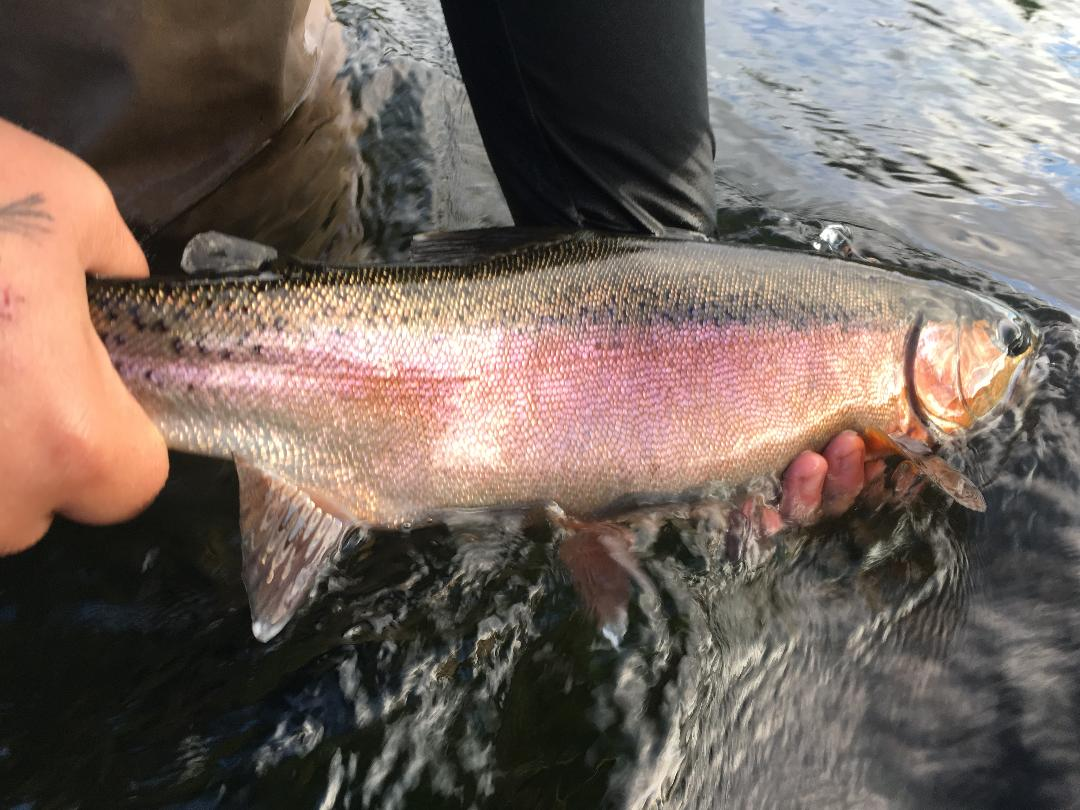
In the next 10 casts, I broke 20 inches...twice. My first night swinging for trout I had caught a 19, 20, and last but not least a 21 inch brute pushing 6 pounds. I decided I’d be okay with never using anything else for trout ever again. It’s been quite a winter since then, and I’ve acquainted myself with two handed rods. Chasing winter steelhead has given me a greater appreciation of the swing, and the spey rods that make swinging possible. I started loving spey casting so much I thought to myself, “If I’m using a spey rod to cast large flies easier than my single hander,why wouldn’t I just get a smaller sized trout spey and make my favorite tactic easier for myself?”. So I did just that.
Being that I’m a beginner spey caster with less than a year of experience, I went ahead and picked the
Redington Hydrogen Trout Spey in the 11 foot 6 inch 4wt. The longer heavier rod makes casting a little bit more user friendly. The longer length allows for the caster to set and sustain an anchor with ease. Don’t get discouraged from the lighter rods though, they are almost more fun but require a little refined timing while casting. The two-handers just make fishing so much easier, and in turn making it more fun. I don’t have to worry about getting hung up in the trees behind me or if I’ll be able to reach the fish way out in the middle of the run. Two-handed rods take all the worrying out of fishing and put you at a strange state of ease of mind. A “trance” would be a good way to put it.
If you love streamer fishing for big aggressive fish on a tight line, trout spey might just be the thing for you. We’ve got a broad selection of great quality rods for trout spey in all price points, be it
Sage,
G. Loomis,
Winston or
Redington. When buying a reel, it’s a general rule of thumb that spey rods are 2 wts heavier than their single hand cousins, think 3wt trout spey=5wt trout rod, so it’s a good idea to buy a reel 2-3 sizes up from the weight of your spey rod. When the topic of lines get brought up, think about lighter shooting head or integrated head systems to help turn over those bigger, heavier flies.
If you’re on a smaller freestone river such as one in Montana where streamer fishing from boats is king, try swinging soft hackles on standard dry lines! In summary, grab yourself a two hander, relax, and go catch some big fish. If you have any questions or want some more info, give us a buzz at the shop: 541-386-6977
Jacob Noteboom | Product Specialist
541.386.6977