Showing posts with label Jacob Noteboom. Show all posts

Aug 4, 2018

The New RIO Creek Fly Line Review


The Kid Behind The Counter Reviews 
Last week we were graced in the shop by the presence of the Great Mr. George Cook, and I was more than happy to learn that he had brought some new rods and lines for us to try. In the next couple of weeks I’ll tell you guys about some of the new product that I got to throw during ‘demo day’. The first and foremost item that I was most excited for was the RIO Creek Series Fly Line.

This line was designed for small creeks and casts at a distance of roughly 5 to 30 feet (Check out our other article on the Creek for some of the specs and science on the line.) Before I got my hands on the line, I thought that it was just going to be a newer variation of one of the lighter small water series,( i.e. the LightLine, InTouch Trout LT, InTouch Perception) but when I got my hands on the line (matched up with the new Sage Dart, which you’ll be hearing my thoughts on shortly) I realized that this line was a whole new animal.


I picture a small creek, I envision a body of water that I can cross in 5 steps or less, this is the kind of water the line is designed for. If you try to fish this as a cool new dry fly line for big water, you’re not gonna have a good time. The guys at RIO designed this line to load a rod with only a foot or 2 of fly line out of the tip. The taper is one that almost mimics a micro shooting head system, but one that is delicate enough to land a size 18 dry gently in a tight spot.

This line is a ‘4 pulls and under’ weapon, think of it as putting a full choke onto a shotgun to reduce the spread of the shots you take. No doubt about it you will be more effective and more accurate at 10 feet or closer with this line, than any other on the market.
  • Designed to load at close range
  • Ideal for nymphs, dries and small streamers
  • Supple coldwater core for tangle-free performance
  • Perfect for small creeks, streams and brooks
SKULine SizeColorHead LengthSink RateTotal Length
6-21785WF0FGreen / Yellow30ft 9.1mFloat65ft 20m
6-21786WF1FGreen / Yellow30ft 9.1mFloat65ft 20m
6-21787WF2FGreen / Yellow30ft 9.1mFloat65ft 20m
6-21788WF3FGreen / Yellow30ft 9.1mFloat65ft 20m
6-21789WF4FGreen / Yellow30ft 9.1mFloat65ft 20m

Perfect for some of the small water we have in the Mt. Hood, Mt. Adams territories. If you have any questions on the RIO Creek line, or any other item in the shop, give us a call or shoot us an email.


Jacob Noteboom | Product Specialist
541.386.6977

"Fly Fish the World with Us"

May 8, 2018

Clarks' Stone Dry

The Clark’s Stone is one of our go to stonefly patterns during the Salmonfly hatch. 90% of guys I see on the river are throwing gargantuan foam body flies that barely even break surface tension. These flies all generally look the same and it only takes a few hooks in the mouth for a fish to realize he probably doesn’t want to eat those anymore. Enter the Clark’s Stone, with a body consisting of dubbing and deer hair, this bug sits in the film and does an amazing job of being a ‘minimalist’ dry fly. Pack your floatant though, because this fly catches fish, but after being thrashed by a few angry Redbands, it will indeed become waterlogged and sink upon the following casts before being dried back out again. This fly is also an amazing subsurface carcass pattern later in the hatch when bugs that have perished are falling back into the river. The nature of the fly allows for each one to look different in the water, the deer hair wing allows for variation in the silhouette of the bug to look slightly different, making it more recognizable as food and less recognizable as a hook in the mouth to a trout. Next time you’re following behind someone during the big hatch, keep a Clark’s Stone handy, it just plain catches fish.


Jacob Noteboom | Product Specialist
541.386.6977

"Fly Fish the World with Us"

May 7, 2018

Plenty of Options - Deschutes Salmonfly Season


Well, word’s out

The big bugs are crawling around on the lower Deschutes River. That means 2 things, the river is going to be crowded with a bunch of people and a bunch of giant puffy dry flies. The average angler is going to see plenty of fish rising, but also see plenty of fish refuse their fly. In my opinion, when I think of the average guy fishing salmonflies, I picture someone who throws the same fly all darn day. Sure that will get you consistent fish, and you’ll be happy at the end of the day, (most of the time).

Now picture an angler that has 3 rods rigged up and 4 fly boxes full of every different bug in the river. This is a very dangerous man to have fishing in front of you, because he is going to be prepared to make 4 different presentations with lord knows how many different patterns in a stretch that the average man throws a few casts with the same fly in and leave. Here’s a few things that will help you pick up more fish behind the average guy on the water in these beginning weeks of the hatch.

Know your bugs

This doesn’t mean you have to know the scientific name of anything, it just means you should know the life cycle of a few bugs and what patterns to throw to replicate them in a few different stages of life.

Big Stoneflies

Lets start with the big boys, salmonflies and golden stones. It may not seem like it, but the lives of these 2 creatures are vastly different, with the exception that they hatch at nearly the same time. Larger stoneflies like salmonflies and skwalas, will take part in what we call behavioral drifts every few months or so, such as this month when they stage near the banks and shallow water preparing to hatch. During these drifts, the nymphs very easily become dislodged and end up bouncing off the rocks right into a hungry fish’s mouth. This is one of the reasons that we fish stonefly nymphs deep down on the bottom, because they have a very heavy body and will actually crawl out of the water to hatch unlike mayflies which are much lighter and can simply swim up to the surface.

Golden stones are a very different bug in their nymph stage. They are constantly moving around looking for smaller critters to munch on, which makes them a great year round pattern. Later in the hatch when the stoneflies have already emerged and mated, they begin dying off and their carcasses will end up back in the water to complete the circle of life, this is a great time of year to dead drift or swing adult stones under the surface of the water, because unlike most lighter insects that float upon being spent, dead stones are at the mercy of the current.

Mayflies

When it comes to mayflies in most rivers, there are 3 main behaviors throughout most species, clingers, swimmers and burrowers. If you flip a rock over and see a nymph crawling around, 90% of the time it’s a clinger mayfly. These nymphs are often anywhere from size 14 to all the way down to 24 with some species. Some mayflies such as blue winged olives hatch 12 months out of the year, so fishing a mayfly nymph can work 12 months out of the year, but, sometimes different species of mayflies are keyed in on more by trout than others. Say it’s mid afternoon on the Deschutes in summer, you saw some bwo’s on the water in the morning, so you tied a drab olive dry fly on and caught a few fish, but now the brunt of the bwo’s are done moving for the day. You might get on a few fish that are still keyed in on them, but a majority of fish will happen to begin to feed on different insects. You could fish to 10 different fish that are keyed in on 10 different species or stages of insects in a day on rivers like the Deschutes. This is why having so many different variations of flies and patterns is important. I’ve had instances in a 20 yard stretch of water where I’ve had to swap flies every time I hook a fish due to the vast variety of insects hatching at the time.

Emergers

Emergent mayflies are often very overlooked. We all seem to pay attention more to duns on the water that we can see more than emergers under the surface. Soft Hackles are a deadly weapon that I rarely see used. They are like streamers in the sense that you can play with and use a wide variety of retrieves and presentations. I see dry dropper rigs often used with hoppers or stoneflies with larger heavier nymphs, but a small parachute pattern with a weightless soft hackle as a trailer is one of the best combos to have on the river during smaller hatches. Soft hackles can also be used in the trout spey side of the world if you’re more particular to a swung fly presentation (see: ‘Trout spey chronicles’ for more reading on swinging soft hackles).

Caddis

Spring time caddis are the second largest forage for fish this time of year, and they are often seen throughout the day, though more prevalent in the evening hours. If you see a fish ignore a stonefly completely, and perform a splashy take moments later, chances are that fish is eating caddis. Fish are a tad more aggressive and opportunistic to caddis due to the fact that upon hatching, their wings are creating quite the commotion on the water unlike a mayfly who sits still while pumping fluid into their wings before flight. Caddis on the other hand are frantically attempting to get off the water as soon as they emerge from pupa form, which allows the beginner fly fisherman to be able to fish a little sloppy at first. Fish expect caddis to make movement on the water, so if you’re just starting out and you’re having a hard time with presenting a drag free drift, tie on a caddis. Dead caddis patterns later in the afternoon on a hot day prove very effective, these are often adult dry fly looking bugs with either beads attached or lead wrapped around the hook to break surface tension, another option would to be adding sinkant to a normal dry fly.

We have plenty of every pattern and a ton of components that you want to have if you want to be more effective than the next guy on the river. Learn about your bugs and when and where they hang out, and you’ll be meeting plenty more trout this season. For more questions or info on hatches, flies, or tactics, give us a call or an email at the shop.

Tight lines and happy hunting.


Jacob Noteboom | Product Specialist
541.386.6977

"Fly Fish the World with Us"

Apr 21, 2018

Spring Emergence


Every year I get a few opportunities to travel up to one of my favorite parts of the state, Wallowa Lake. My family decided that we would be spending a week up there for Easter. My mind instantly wandered to my fly boxes and I began running myself through different scenarios. ‘Do I have flies for this hatch?’, ‘What if they want chironomids?’ ‘Is it going to be a streamer game?’, etc. I went and bought a smorgis board of flies to replicate anything hatching, swimming, or flying in the watershed. My dad and I loaded up the boat with everything we possibly needed and set out on the 7 hour drive.

My goal for our trip was to find some larger fish, and in years past, I knew a few hotspots of where they’d be living. The upper river poured into the lake near the main campground and almost formed a sandy delta of about 5 or 6 separate creeks that gave the lake a little bit of current for about 30-50 yards each. During the hotter months later in the summer, these would be stacked shoulder to shoulder with smaller, less hardy stocked trout, and 30-50 8 inch to 14 inch fish days were not uncommon. They had not begun stocking the lake yet and I had never fished those creeks so early in the year before, and as it turned out, this was a whole different game.

We had gotten to our cabin and unloaded our gear around 4. Being too late to in the day to launch the boat, my dad elected to sit down for a beer and I elected to go throw on my waders and try to find some fish. The lake’s average depth is 161 feet and the max depth is 312, so to have a small little flat with an average of 2-3 feet is pretty special. In the earlier spring months, those shallow flats are the first areas to “warm” up. It may only be a 5 degrees difference, but that could be what makes or breaks a hatch. When I got down to the beach, I took a minute to just watch and listen the area, which to me, is the first step to catching. Within 30 seconds fish began showing themselves. They were sipping just under the surface, so all I could see were boils. The size of the fish was still a mystery, but I knew generally what they were eating, and where they were sitting. Being a streamer junkie, my first idea was to see if any of the fish would be opportunistic enough to take a big chunk of meat. After about 20 casts I had to accept the fact that it just wasn’t gonna happen with the conditions I had. I quickly swapped over to a dry line and sz. 18 soft hackle to see what would happen. I casted across the current and fed some line out in the slack water to create a belly and swing the small emerger pattern.

I carried a slip loop because in the past, any leader lighter than 5x(I was using 6x at the time) disagreed with me and I had lost many a fly to big fish on the hookset. On my first swing I was met with a grab and my loop had left my pinched fingers before I could blink. The water temperature was a crisp 35-40 degrees and the fish had plenty of lobedo to show off. I was taken on an about 30 yard run by the fish and by the time I turned his head i had maybe 6 or 7 wraps of fly line left on my reel, which is astounding for a trout to do, in my experience. When I got the fish to hand I quickly realized what I was dealing with.


Wallowa lake has a small population or naturally reproducing rainbows, but the majority of the rainbow trout in the lake are stocked fish, some of these being cutthroat/rainbow hybrids, also known as cutbows. Cutbows tend to grow faster, acclimate to natural food faster, and also tend to be a lot more aggressive. The first fish of the night happened to be one of them.

I fished on into the evening and returned to the cabin that night with high hopes and high spirits. The next morning our family had made some plans for a brunch but I wasn’t too upset about not being able to fish until the afternoon. When it comes to spring time hatches, the sun is your best friend (with some exceptions). Nymphs in cold water could be waiting for that magical temperature before hatching and you’ll usually find that happening later in the day after the sun has been on the water for a bit. Fish in colder water will of course still move to intersect food heading their way, but they may not be actively searching throughout the water column like they will later in the day after a small rise in temperature. If you’re not a morning person, this time of year is definitely for you.


When it comes to lake gear, I’m typically packing a 9’5wt for dries and smaller streamers like damsels and leeches, but when it comes to indicator rigs and larger streamers or throwing sink tips, I’m using a 4wt switch. For as many flies as I like to carry on me, I like to have at least 3 boxes with me to organize all my patterns. For smaller flies, the Umpqua UPG LT Fly Box, as well as the Midge version, are great, they hold more than enough flies and are slim enough to keep 3 or 4 in a sling pack comfortably. The lines I’m currently using are a RIO Intouch Perception for dry flies and emergers, and an RIO Intouch Outbound Short for streamers and indicators.  When it comes to rods we have plenty of makes and models for any situation you’re going into, give us a call or email for recommendations.


Jacob Noteboom | Product Specialist
541.386.6977

"Fly Fish the World with Us"

Apr 18, 2018

The Fly Tying Learning Curve


When everyone thinks fly tying, they think artsy dry flies or classic atlantic salmon patterns with crazy color schemes and exotic materials, but it doesn’t have to be as complex as it looks. This post is for the people that are intimidated to get into fly tying or have tried it and gotten too frustrated to continue, from one novice to another.

There is nothing wrong with fishing a ‘bad tie’. If you think a fly you tied might be subpar with what you would consider fishing, don’t count it out. When it comes to trout, we like to think they have a reflex when it comes to feeding. A good buddy of mine told me a great analogy for how he thinks trout feed most of the time. Say you’re walking in your home, and you look down to see something black with legs, about the size of a quarter. You immediately think “oh crap that’s a spider, I better smash it!”, but at a closer look you realize it was just a piece of lint. Now put yourself into the mind of a trout in a feeding lane, you’re posted up on a juicy seam and you look up to see something black with legs, about the size of a quarter. You immediately think “oh crap, that’s food, I better go eat it!”. Next thing you know some guy in a backwards hat and cargo shorts is taking pictures of you with his fly in your mouth for instagram. ‘Presentation over representation’ is something that I try to remind myself religiously. To put it simply, when it comes to a majority of trout, presenting your fly matters a lot more than what’s on the end of your leader(although in some situations, flies really matter). In short, you flies don’t have to be picture worthy to be fish worthy.

When I first started tying, one of my biggest problems was material organization and paying attention to following steps to certain patterns. One thing that has helped me a lot as a novice is separating my materials into categories, i.e. Maribou and chenille in their own bags, hooks and beads in the others. When I first started tying, all my stuff was piled into one bag. Whenever I went to grab something I needed it ended up with me picking everything up off of the floor due to the bag exploding. It took me a very short time to figure out a better way to store things. I evolved from one bag to multiple bags, to finally, a container system.

It used to take me forever to tie the simplest of flies, because I never prepped any of my materials.Say I want to tie a few wooly buggers, nowadays I have separate piles of hooks and beads, maribou and chenille, that way I can just grab and go, step by step and not have to fumble with materials while I knockout a tie.

Getting creative with your fly tying doesn’t mean you have to come up with something innovative or next level (props to you if you do though). Being creative can be as simple as using a different color hackle on a small dry fly, or throwing rubber legs on a plain jane wooly bugger. Thinking out of the box is what makes fly tying so awesome. There’s no set rules on how you have to tie something, no one is going to bust your door down and tell you “you can’t use that on that fly!”. Some people will go as far as to judge you on your flies.They may tell you “there’s not enough of this,” or “there’s too much of that.” instead of paying attention to negative criticism, surround yourself with friends that tell you “I’d eat it!”, more often than not these people will help teach you and push you to become a better tier, compared to those who will judge and dissect everything that leaves your vice.

In the end, the fish themselves are the ultimate judges of your creation. Pay attention to fish behavior when fishing a home tie. There’s 3 basic answers a fish will give you. 1, The preferred answer: An aggressive take. Looks like your fly worked, soak it all in. 2: The fish will ignore it completely, meaning it might not want the style of fly you’re throwing, be it nymph vs. dry vs. streamer etc… The 3rd and anything from final answer is an outright refusal. Most of the time you will only witness this when throwing a dry fly or a streamer in clear water. Refusals can be for a hundred different reasons, be it color, size of fly or other reasons such as leader size or a sloppy cast. Alast, fish can’t talk (with the exceptions of jack crevalle and drum.) so you don’t really know what they’re thinking until they eat, but that’s for another story. In short, don’t get intimidated, be it by your fly vice, other tiers, or fish. Keep your friends that like your flies close and the fish that like your flies closer.


Jacob Noteboom | Product Specialist
541.386.6977

"Fly Fish the World with Us"

Mar 23, 2018

A Newbie’s Introduction to Trout Spey

By Certified ‘New Guy at The Shop’ Jacob Noteboom


If you’ve fished anywhere on the Deschutes in the past year or you’re a big streamer guy, you’ve probably seen guys with odd looking two-handed rods or single-hand rods with thin running lines and big fat head systems. This is the somewhat new (to our area) and a very effective tactic that involves aggressive grabs from aggressive fish. Here’s how I got into it-

I started fishing the Deschutes like many other people start out, fishing Mecca Flats with some sort of stonefly looking bug with rubber legs on it. Sure it caught a few fish here and there but after a while I started questioning myself, “why am I wasting my time roll casting and splashing a big fat bobber at fish I can’t reach?”. I expanded my tactics, used dries whenever I could and experimented with smaller mayfly and caddis nymphs. My fish numbers went up the more I explored my options and tried new flies. Fishing to moderately pressured trout definitely helped me refine my fly box a bit and get some patterns figured out... Though none of the stuff I learned over the last couple years on the Deschutes mattered when I picked up a OPST Commando head for my 5wt and chucked a sculpin for the first time.

It was fall of 2017 and to say that the redbands were putting the feed on would be an understatement. My buddy and I were on our way home from a long day of hike-in fishing on a tributary to the middle Deschutes. We’d put quite a few miles under our boots that day but we decided we weren’t done fishing. Warm Springs just so happened to be on our way home, and there was about a half-mile of water to fish right off of the highway. By the time we got on the water, the sun was just starting to creep back behind the canyon and the fall mix of smaller caddis and their larger October cousins were starting to pop off. I let my buddy cover the bobber and pupa side of things and I decided to fish a sculpin pattern in the faster water.

My buddy set up on the backside of a large seam and instantly landed a couple 16 inch fish, this is all while I was right next to him rigging up and picking a sink tip. I waded down to some choppy quick moving water determined to swing up a big one. The only thing I knew about my Commando head setup was how to cast it, but I had never really had the chance to use it though. I had no idea how I was going to retrieve my fly or how it would feel in the current, so I did what every good fisherman does when they don’t know what they’re doing- Wing it.

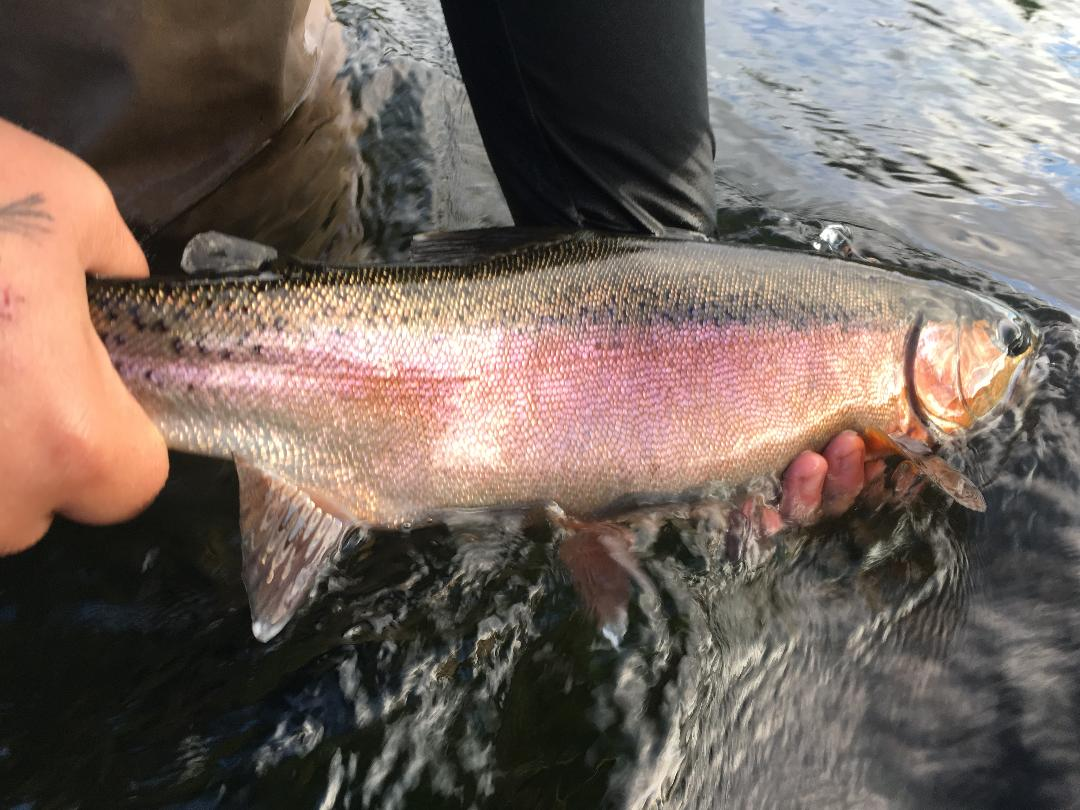
I made my first cast as far as I could and my head landed flat across the river at a 90 degrees angle. The current immediately made a belly in my line and my fly began hauling ass toward my side of the bank. I can only guess it looked like my sculpin was getting ran down by another fish; and in theory, an opportunistic trout would come trucking over to steal that food for himself. Whatever my fly was doing in the water, the fish liked it and wasted no time proving that to me. I was slammed by a fish on my first good swing, and it turned out to be a hot one. I got 6 or 7 jumps out of the pissed off hen before I got her to hand. It was my first trout on the swing, and also my biggest Deschutes redband to date, taping at 19 inches. At about the 3rd jump my buddy decided to wade down to me to see what all the fuss was about.


In the next 10 casts, I broke 20 inches...twice. My first night swinging for trout I had caught a 19, 20, and last but not least a 21 inch brute pushing 6 pounds. I decided I’d be okay with never using anything else for trout ever again. It’s been quite a winter since then, and I’ve acquainted myself with two handed rods. Chasing winter steelhead has given me a greater appreciation of the swing, and the spey rods that make swinging possible. I started loving spey casting so much I thought to myself, “If I’m using a spey rod to cast large flies easier than my single hander,why wouldn’t I just get a smaller sized trout spey and make my favorite tactic easier for myself?”. So I did just that.

Being that I’m a beginner spey caster with less than a year of experience, I went ahead and picked the Redington Hydrogen Trout Spey in the 11 foot 6 inch 4wt. The longer heavier rod makes casting a little bit more user friendly. The longer length allows for the caster to set and sustain an anchor with ease. Don’t get discouraged from the lighter rods though, they are almost more fun but require a little refined timing while casting. The two-handers just make fishing so much easier, and in turn making it more fun. I don’t have to worry about getting hung up in the trees behind me or if I’ll be able to reach the fish way out in the middle of the run. Two-handed rods take all the worrying out of fishing and put you at a strange state of ease of mind. A “trance” would be a good way to put it.


If you love streamer fishing for big aggressive fish on a tight line, trout spey might just be the thing for you. We’ve got a broad selection of great quality rods for trout spey in all price points, be it Sage, G. Loomis, Winston or Redington. When buying a reel, it’s a general rule of thumb that spey rods are 2 wts heavier than their single hand cousins, think 3wt trout spey=5wt trout rod, so it’s a good idea to buy a reel 2-3 sizes up from the weight of your spey rod. When the topic of lines get brought up, think about lighter shooting head or integrated head systems to help turn over those bigger, heavier flies.
If you’re on a smaller freestone river such as one in Montana where streamer fishing from boats is king, try swinging soft hackles on standard dry lines! In summary, grab yourself a two hander, relax, and go catch some big fish. If you have any questions or want some more info, give us a buzz at the shop: 541-386-6977


Jacob Noteboom | Product Specialist
541.386.6977

"Fly Fish the World with Us"


Visit our Relaunched Steelhead Only Site

Shop Gorge Fly Shop & SteelheadBum.com

  © 'and' Steelhead.com Mike Prine 2009-2014

Back to TOP