Showing posts with label gear. Show all posts

Jul 12, 2014

Sage SALT and ACCEL Fly Rods Plus Domain Reel. NEW FOR 2015

SALT
THE NEW SALT FLY ROD. NEW FOR 2015.
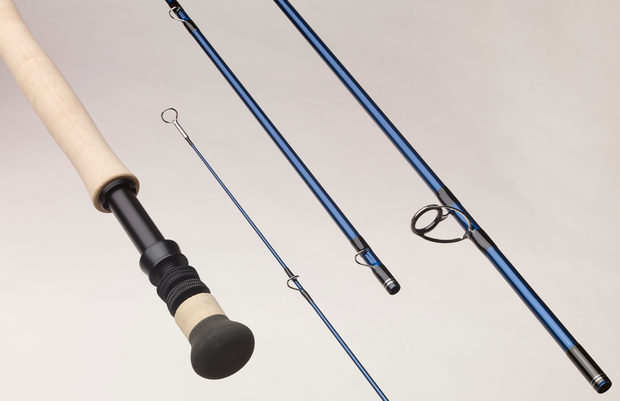
All the way from Bainbridge Island, Washington - Sage brings us two new rods, the first for 2015 is their first ever saltwater rod created with their revolutionary Konnetic Technology. With medium-fast action that some may consider "Salt Action" loads extremely quickly at varying distances that allow you to make precise first casts regardless of range all with ease. Introducing the all new SALT.

We are told the rod is tapered throughout, the stiffer tip section on it's dark sapphire rod works seamlessly with the deeper-bending middle and lower sections all to help you quickly and effortlessly lift your line off the water providing lightning-fast casts.

Sage Salt
New Sage Salt
Konnetic Technology rods have been known for tip-to-hand sensitivity and the Sage SALT is no different.
When precision casts are needed for moving targets the SALT provides instant feedback  and the torsional control and tracking qualities of the blank deliver your fly exactly where it's needed.

With added new custom components: 
  1. Deeply knurled and ergonomically cantered reel lock nuts.
  2. Black Stealth bead blasted reel seat numbered by line weight for quick selection.
  3. Plus its built in hook keeper.   

Oct 4, 2013

Rio GripShooter Review

Rio GripShooter Fly Line

Product tested: 

  • Rio GripShooter 44lb/20kg.
  • Handling Section – 17ft/-.043
  • Overall Length – 100ft / 30.5m
  • Color – Red
  • MSRP - $29.95

According to: 

Rio, in their words: Rio’s new GripShooter is based on the very popular SlickShooter, but has a thick, coated handling section that makes it very easy to grip in cold conditions. The thin nylon shooting line gives caster’s the maximum distance and is light enough to hold off the water at range and allow anglers great control of their head and fly far out in the swing. A neat 8” welded loop at the front end allows for fast and efficient head changes. GripShooter is a hard nylon shooting line with a unique handling section – the best choice for distance. GripShooter has a thick, highly visible handling section for grip, durability and visibility.

Features -

  • Thick, highly visible handling section for grip, durability and visibility
  • Front 8" Welded Loop

Specs -

SKULine SizeHandling SectionTotal LengthColor
6-1904025lb / 11.3kg15ft/.037"100ft / 30.5mBlue/Orange
6-1904135lb / 15.9kg16ft/.040"100ft / 30.5mOrange/Orange
6-1904244lb / 20kg17ft/.043"100ft / 30.5mRed/Orange
6-1904350lb / 22.7kg18ft/.045"100ft / 30.5mYellow/Orange

Intro Disclaimer:

Let me start by saying this, there is no perfect running/shooting line. They all have something that someone doesn’t like about them. This one is too limp, this one is too stiff, this one has a lot of memory, and this one slips through my fingers too easily, this one doesn’t come with a loop, on and on. Working at the Gorge Fly Shop and talking to countless customers that have fell victim to the Spey and switch craze, there are just about as many opinions when it comes to running/shooting lines as there are options for shooting heads. Today’s world of switch and Spey rods and Skagit style casting has opened the door for so many options and versatility. These options and versatility have also created mass confusion. With this being said, for this post, I would like to review the Rio’s New GripShooter Shooting line.

I can honestly say that after testing all of the shooting lines that we carry in the shop, I had settled on the Rio SlickShooter in the 44# and 50# sizes as my favorites, even in cold winter weather. I learned to live with the drawback of the SlickShooter occasionally slipping through my finger when sweeping around to create my “D” loop and casting, especially in colder weather and with wet hands. To me, the benefits of the SlickShooter seemed to drown out the disadvantage of an occasional slip. I loved the distance I got with the SlickShooter and it was easy to lift off the surface when I needed to mend. If you’re a die-hard SlickShooter fan you can also place a strip of non-adhesive tape, like used on golf clubs, where your pinching finger meets the cork of your rod. This will help eliminate slippage as well.

Let me stress something one more time. It doesn’t matter what shooting line you choose, there will be something that you won’t like about it. I tell customers all the time to find one that they like for its advantages and can live with its disadvantages. In other words the advantages of the SlickShooter, I loved, the disadvantages of SlickShooter, I can live with. Then here comes Rio’s New GripShooter! My interest spiked as soon as Georgie revealed this product to us at the shop. Already being a SlickShooter fan, I was on point! I thought…gone are the disadvantages that I live with for the SlickShooter. Disadvantage number one, is the line slipping through my fingers as stated before. I thought this is the best of both worlds. I now will have a shooting line that launches like a cannon but doesn’t slip through my fingers anymore. Sweet! So, I got my hands on a spool of the 44# GripShooter and as soon as I got home, without hesitation, I immediately put the new GripShooter on my reel, set my alarm for predawn… and I was off running to check out the latest and greatest in shooting lines. Georgie had set me up to be excited when he gave us the presentation. Georgie, as he slowly pulled the GripShooter from his bag of goodies said, and I quote “When the phone rings…answer sooner!” I love that, if you know Georgie, you know what I’m talking about. So, seeing Georgie this excited about it made me that much more excited about it.

On the River:

John Garrett
So, I’m stripping out line and making short cast and swinging the short water in front of me, and I finally get the shooting head out of the tip and I am now holding the GripShooter in my fingers. Immediately I notice that it is thicker to my touch than the classic SlickShooter is. I set my anchor, perform my sweep to set the “D” loop up and let it rip. No slippage. Ok, this is cool. I even held the line loosely to see it if would slip from my grip and it didn’t. Sweet! I strip out another 3 feet and repeat. Same results, no slippage. Strip another 3 feet and again the same results. This goes on until I have 14 strips of line out. Not once has it slipped from my grip. Bear in mind that I am used to fishing with SlickShooter and it rarely slips from my grip anymore. But, I was intentionally holding it loosely to see if it would slip, and it didn’t. This is a great thing. I’m now enjoying the best of both worlds. The grip of the PVC coated GripShooter running line that doesn’t slip from your grip and the major benefit of the hard nylon SlickShooter for distance. I like…I like a lot! Why, someone hadn’t thought of it until now, don’t ask me, I’m just benefitting from it.

Rio GripShooter 50lb
As much as I love the new GripShooter and the idea of it, there is still one thing that I would customize about it. And this is a personal preference of mine since using it now for a couple of weeks. It’s nothing major other than if I was using the GripShooter on a switch rod, I would cut some of the Grip section down to match the switch rod. In other words, if I were using a Sage TCX 7119-4, which is 11’9” long, I really don’t need to have 17’ of the GripShooter. This gives me an extra 5 plus feet of the Grip section, which feels like it slows the line down just a hair until it hits the SlickShooter section where it then launches. I understand the idea of making it the lengths they did, to accommodate the Spey rods, and it may not be a big deal to some of you who try it out.

If you use the same reel for multiple rods and switch back and forth from a switch to a Spey rod, then you might want to leave it as is, to fit the longer Spey rods you have. Again, we are back with living with something you don’t like because of the advantages you do like. See, we still can’t get away from that. If you don’t switch reels back and forth, then by all means spool up your switch reel and customize it (or not), then spool up you Spey reel with its own sweet GripShooter. On my switch rod, I would cut the Grip section down to about 12 feet and strip off about 8”-10” of the PVC coating then build myself a new loop with a whip finisher. This would give me 5 feet less of the GripShooter and get me into the SlickShooter that much faster.

GripShooter Example: 25lb - Overall Length: 100'

All in all overview: 

When it comes to considering whether or not to try the new Rio GripShooter… call sooner! I promise to answer the phone sooner when you do. It is definitely worth a shot. If you have hesitated in the past, because of the negatives you’ve heard about SlickShooter, don’t hesitate now. It is a great addition to the shooting line roster and it has found a permanent place on my reels.


By John Garrett
Rio Spey Fly Lines
"Fly Fish the World with Us"


Jul 24, 2013

Sage Method Rod Series (NEW 2013)

Sage Method - New content - 12/26/2013

As promised I vowed to work with the Sage Method in order to get a true feel of this red, high caliber stick beyond what I can get from the casting pond at a show. Believe it or not color has some deciding factor with fly rods today. Many would just be fine if all fly rods are green and that’s the way it should be...Huh?

I've never been one to follow tradition and speaking for myself if I am not exploring or discovering something new then I would have hung the sport up a long time ago. Nothing wrong with traditions and I respect most all fly fishing traditions but keep in mind all traditions started out as one man's daring ability to look outside the norm and make his own discovery, was willing to share it and over course of time became tradition.

Red is the color of the Sage Method and I like it! Sage calls is Magma Red but I think of it as Magnum Red as in High Caliber. If Method was a concert you bet it would be a rock concert and just like a fine Italian Sport car the color has to be RED! If it fits wear it!

The red color sets off the Method as bold and powerful and creates a statement for which this rod needs to live up to. My simple answer is yes! The Method lives up to its look. But we know it’s not that simple. What makes a great rod today is a question that undoubtedly can be debated for years with no clear answer ever awarded. Sounds like a congressional debate is in place. Well step aside Green rod congress as I deliver your veto! This is my article and these are my opinions and I get to choose whether the Method is worthy to be adorned in Magnum Caliber, Italian Sport Car,or Rock and Roll Red.
A great fly rod is a simple desire but a complicated quest. Give me more power, more accuracy, more distance, more feel and make it more comfortable for me to cast. Each and every new fly rod that comes along we look for more of all of this. It’s a careful balance of precision and compromise. In the past more power came with the sacrifice of less feel. Rods got so stiff that the rated line size had trouble loading the rod. So we up line sizes in order to get the rods to load which in turn slowed down the rod. Sure these extra fast rods were very capable of great line speeds but the average caster really struggled to time the load mostly due to lack of feel. In the recent years I believe great strides have been made to create really fast fly rods that load with the appropriate line size and provide much greater feel than their predecessors.

If you like fast action rods than you will love a Sage Method but hold on a minute...Lets say you don’t like fast action rods….I want you fellow fly fishers to go down to your local fly shop and cast a Method. I know on my first cast I was truly surprised how well the rod loaded and how little effort it took to send my line shooting on the forward cast.

I expected POWER but had no idea how GRACEFUL it could be!

All aforementioned attributes of the Method truly puts this rod into High Caliber class but there is one more characteristic I need to bring forth. The Sage Method, (I also have recognized this in the Sage One) possess a very comfortable swing rate. I not going to even pretend I understand how this works instead I purely go by the feel of the cast. What I noticed with these new Sage fly rods is they feel very comfortable in hand and while in a casting stroke.

The best way I can define the new Sage is Power with Grace!


7/24/2013
Sage Method
Earlier this year you heard me talk about the Sage One in my article NRX vs. One. The ONE is an awesome casting rod with a very intuitive feel of stability with Sage’s Proprietary Konnetic Technology. But I said it in the article that The One is not a fast rod and I suspect we’ll see Konnetic Technology in the future refinements of faster action rod categories such as the TCX.
Welcome in the NEW Sage Method.
Sage Method - Magma Red

The Sage Method reaches deep into the fast action rod category and delivers high line speed and tight loops coupled with the greater feel and accuracy found with the Konnetic Technology; A truly welcome edition for experienced casters and demanding salt anglers.

I got my hands on the New Method at this year’s I-Cast/IFTD Show. I like the Magma Red color of this rod and the reel seat expresses quality and strength. It’s light in hand and like The One you won’t believe how thin the shafts are on these rods.

What I couldn’t wait to find out is would this fast action Method live up to the Konnetic technology accuracy that the Sage One excels in! For me the highlight of the Sage One has always been in its ability to track straight thus improving my level of accuracy. The question I have is can this faster version still retain this impressive ability to stabilize your fly line for easier casting and greater distance accuracy?

Greg Darling | Gorge Fly Shop - IFTD Casting Pond

After some time on the pond I am happy to report that Konnetic technology is alive in the Method. The Method feels considerably faster than The One but yet has a much improved feel over the predecessor TCX. It is fast and not for everyone but for those who wish their One to have more, then here is your answer. I look forward to spending more time with these rods and really tune into the feel and timing to see what it is capable of achieving. I was casting the Rio Grand Fly line and you would want this line or the salt equivalent like a Rio Bonefish Quickshooter. The Method should also be happy with a Rio Outbound Fly Line.


Impressions

I like this rod for many reasons. The bold red color, great fit and finish, Konnetic Technology and its fast action but what’s with the name “Method”?! Does it come with an instruction manual? We understood the meaning of Sage One and Circa is a good fit for the traditional feeling rod it belongs to but what is the meaning behind “Method”? Kind of feels like I have to learn something to cast this rod. It’s not for the novice but with that said I did not find it difficult to cast!

The Method is due to arrive around the first of August 2013 and they are available on our website for a pre-order purchase for those who can’t wait…be the first to get one! If you’re in the area stop by and give one a test spin.


Product Specialist


Order yours today!
"Fly Fish the World with Us"

Sep 5, 2012

Outcast OSG Commander Inflatable Fishing Boat


While talking with the Outcast crew (exceptionally nice guys I might add) at the IFTD show recently, the boat that everyone was most excited about was the OSG Commander. It’s just plain convenient. And it’s comfortable and it’s durable. There is little doubt about the quality of Outcast pontoon boats, rafts and float tubes. They are tried and trusted, have been around a while and people like them. But now the word is getting out about the Commander and from what I understand, they are selling a bunch of them.

Aug 15, 2012

Wading Boots - Finding the Right Size

Simms Rivershed

 Buying the wrong boot can cause turmoil. Try not to do this. Fishing is supposed to be enjoyable, so while looking over your options, keep these general rules in mind.

May 16, 2012

New Sage Fly Fishing T-Shirts

Nothing like having that go-to Tee shirt in the closet. You know, the comfortable one that has a message, possibly representing some internal connection. We all have them. My favorite T is blue and wearing thin across the shoulders and armpits which likely aids to the seasoned comfort factor. It has a picture of a rainbow trout on the left breast. That’s it, just a fish; no words…

I’ll pick it out of the drawer or off the floor and slip it on no matter the day as long as it’s not wicked soiled. The T can be worn by itself or as an undershirt. I wear it to bed a lot. Often this T’s ripeness is the reason I get to doing laundry on a given day.

The T is not one of those items that usually sparks your shopping quest. Rarely do you head out to the store because you need to buy one. Rather, it’s one of those items you pick up as some residual goodness that caught your eye while searching for some other, more glorified need. But this isn’t really fair. I mean you got to put something on when you leave the house. T, is always there for you, it’s always an option. Right? The need for T is great.

So in the spirit of respecting the T, check out these new, really interesting, fine looking Sage T Shirts. And look closely! These are the go-to kind.

Apr 30, 2012

Lines for Switch Rods - A Buyer's Guide


Switch rods and lines to use with them are quickly evolving. Since the time that this article was written many new lines have been developed that could be of great importance to switch rod users. One comes to mind is the New Rio Switch Chucker. The Switch Chucker is a full length line with the idea that it can do it all or most of it anyway..Its essentially a skagit line and you just add the tip to suite your current needs. Newly updated is the Skagit Short now called Skagit Max Short and a to compliment the new short skagit is the i-Short Skagit, a short intregrated intermediate sinking skagit head.

Like I said lots of new stuff for the switch rod angler. We are working with all the new offering and look forward to reporting back soon with our findings. Look for a new post about switch lines coming soon. This current post has been updated with all the current links and information contained within it is still very valid and useful. 

Finding the right line for switch rods (rods between the lengths of 10.5 – 11.5 feet) can be confusing. Let us try to clear a few things up by talking about the different types of applications that switch rods are used for.

Spey Fishing. These short rods provide a light, agile alternative when fishing small to medium sized rivers. Finally, lines now exist to give anglers a sound spey experience with rods of this size. Traditionally, spey rods have been used to cast lines to anadromous fish like Salmon and Steelhead. Anglers preferring to swing flies for these fish with switch rods should consider casting short spey heads, but there are a few choices here. If you want the capability of casting heavy sink-tips and weighted flies then you want a short Skagit line. Rio's version: Rio Skagit Max Short. Airflo's version: Airflo Skagit Switch. Both of these lines are very similar and like the regular Skagit lines, they perform best with some type of sink-tip attached to the front of the head. Their extreme weight forward nature allows them to turn over tips and heavy flies quite easily. People who wish to swing flies on the surface or mere inches below the surface can replace the sink tip and affix a dry tip to the head. Although this will work for dry line fishing, this combination is somewhat “clunky” when looking for a soft fly lay down on the water. Also, people using this setup will appreciate using a polyleader in place of a purely mono leader. So it is recommended that you attach a 10 foot polyleader to the end of the dry tip which will aid in rod-loading and line shooting.

Learn more about tips and polyleaders - Sink Tips, Polyleaders, Versileaders - A Buyer's Guide

Swing fishing with a sink-tip:

Head + Sink Tip + 4-5ft of mono leader. For example: (Airflo Skagit Switch + 10 Ft T-14 + 4-5ft of Maxima 12 lb)

Swing fishing with a dry tip:

Head + Dry Tip + 10ft poly leader+ 3-5 ft of mono leader. For example: (Rio Skagit Short + 10 ft medium Mow Float Tip + Airflo 10ft poly leader floating +3-5 ft of Maxima 12 lb.

Apr 16, 2012

Fly Fishing Float Tubes - A Buyer's Guide


If you like to fish stillwater you should seriously consider a float tube. No, they don’t go fast and you can’t tote your family along, but as far as single-person fly-fishing vessels are concerned, they are tough to beat. They are easy to carry, easy to inflate, comfortable, extremely functional from a fly fisher’s point of view and they help to open up all that water that you just couldn't reach before. Most tubes will carry you, your gear bag, your valuables and a small cooler. Not bad for fitting into a back pack!

Choosing the Right Float Tube

Like pontoon boats, the most important determinant of quality and performance depends on the materials used and the overall size of the float tube. Most tubes have internal bladders constructed of either Vinyl or Urethane. The outer shell that holds these bladders is a fabric material that will vary in durability from the top of the tubes to the bottoms. Typically the material on top is lighter gauge fabric than that of the shell material on the bottom of the tube. The durability is given a weight rating, typically between 200 – 600. Most tubes have an outer shell rating that is durable enough for average use. The main concern is what type of bladder is used.

Urethane bladders are far superior to Vinyl bladders. They are more likely to hold up and remain leak-free over time. Price is very indicative of what type of bladder is used. There are some tubes that do not use bladders. Tubes like the Outcast Trinity use a UCN (Urethane Coated Vinyl) shell to hold the air. They are not as durable, but they have drastic weight reduction as this particular tube weighs only 7 lbs! The type of valves is also a concern. Most valves are user friendly but some are more durable than others. Summit II valves are more durable than Boston valves. Leaks can occur at the valve but those tubes using Summit II valves are far less likely to do so.

The larger the tube diameter, the easier they are to maneuver. A longer, wider tube will be more stable and track better through the water. Carrying capacity also increases with overall tube size. But, those folks wishing to hike long distances with their tubes should seriously consider a tube’s packability and weight.

Outcast Float Tubes are all very comfortable. They utilize a U-shaped design that helps anglers cut through the water more efficiently. The seats are all positioned above the water’s surface which keeps people dry above the knee. Seats are either foam material or they are inflated. Tubes that have inflatable seats are easier to pack and they certainly bolster the comfort level.


All Outcast tubes come with adapters that coincide with their particular valve type. There are many pumps available on the market. Outcast has pumps, but we really love the line of K-Pumps that are built here in Oregon. Their streamlined design and functionality make them tops in our opinion.

If a leak does occur while you are out on the water Outcast has patch kits that are strong and user-friendly. Although, if no kit is on hand, a little duct tape can go a long way.

It should be mentioned that all Outcast Tubes have a 5 year warranty. Customers should contact Outcast for repairs and to see if it falls under warranty. Nylon bladders can typically be shipped out to consumers under warranty, however, Urethane bladders needing repair should be sent to Outcast for review before a full bladder replacement can be considered.

There are also numerous Float Tube Accessories available like rod holders and boat bags, backpack straps etc… Fins are also a necessity as your legs are the engine on these vessels.

Float Tubes 
Model Size Bladder Shell Weight Capacity Valve(s) Seat Warranty
Fish Cat 4 LCS
Olive
44”x54” 12” Vinyl 420pc/500pvc
Sewn
14 lbs 250 lbs (2)Boston Foam 5 year
Fish Cat 4 DLX
Olive, Burnt Orange
44”x54 12” Vinyl 420pc/500pvc Sewn 14 lbs 250 lbs (2)Boston
(2) Summit Tube
Inflatable 5 year
Fat Cat LCS
Gray/Orange
45”x64” 13” Urethane 420pc/500pvc
Sewn
12 lbs 300 lbs (1) Summit II Foam 5 year
Trinity
Navy
41”x54” 13” No Bladder 420 UCN Welded 7 lbs 300 lbs (4) Tube Summit Inflatable 5 year
Super Fat Cat LCS
Gray/Orange, Olive/Tan
45”x64” 13” Urethane 420pc/500pvc
Sewn
12 lbs 300 lbs (1) Summit II
(2) Summit Tube
Inflatable 5 year
Prowler
Navy
50”x64” 13 ½ " Urethane 600pc/500pvc Sewn 16 lbs 325 lbs (3) Summit II Inflatable 5 year
*PC – Pac Cloth **PVC – Poly Vinyl Chloride *** UCN – Urethane Coated Nylon


Click Outcast Float Tubes to see our full line of options in further detail


Gorge Fly Shop Team
541.386.6977


"Fly Fish the World with Us"

Apr 9, 2012

Fly Fishing Pontoon Boats - A Buyer's Guide

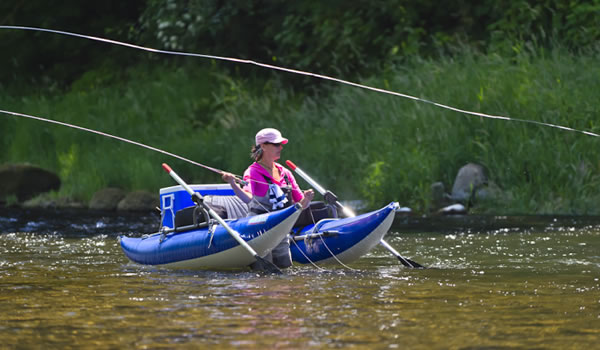
Floating atop the surface of a lake or a river is a beautiful thing. Not only is it an enjoyable way to travel, but you may also experience places that would otherwise be impossible to reach. For anglers around the globe, the benefits of pontoon boats have become quite clear. They help to bring you where the fish are -or through those special landscapes that your own two feet, cannot.

Dan Gordon - Gorge Fly Shop
New color for 2017 Stealth Pro


For those of you interested in purchasing a pontoon boat, the three most important things to consider are: Durability, Function and Your Budget.

Durability


As is the case with most products, price does depend on the quality of materials. For pontoon boats the greatest concern is the type of bladders used. Most pontoons have an outer shell that is made of a pliable, PVC material. This stuff is fairly durable and ranges from a 500 – 1800 rating (which is determined by the weight of the material). Inside these shells are the actual bladders that hold the air. There are three different types of bladders found on the market today.

The first is vinyl. Vinyl is the least expensive material and it is also more liable to leak over time. Basically, vinyl does not have a high degree of elasticity so that as the material expands, it has a tendency to keep stretching without contracting back to its original form. As time goes on, this material loses its integrity putting it at a greater danger for pin holes and leaks due to trauma.

The best, but most expensive, bladders are Urethane. If you are willing to drop the dough, boats that utilize Urethane are the most dependable and the most likely to hold up over long periods of time. This is why companies like Outcast can afford to put a 10 year warranty on their Urethane – bladder boats. This material is highly elastic and if a leak does occur, it is the easiest material to patch while on the water. Simply put, Urethane bladders are far more durable than Vinyl.

The third type of bladder is a Vinyl/Urethane blend. This is the middle price point, although there are not many pontoons out there that have this combination. The brunt of the bladder is Vinyl with a Urethane coating. As is the case with vinyl, it works but this blended material offers far less durability than a purely Urethane bladder.
It is nice to have a stout PVC shell for these bladders, but truth be told, even the low rated shells are fairly durable. Typically, boats that have Urethane bladders will also have more durable covers. Also of concern is how these outer shells are put together. Welded seams are stronger than sewn seams, however, there are cases where low-cost boats do utilize welded seams. If it is a low priced boat, our recommendation is to go with sewn seams because there are some poorly crafted, welded seams out there on low-priced models.

Frames for pontoon boats are built from both steel and aluminum. Steel is stronger, but definitely adds more weight. Many high quality boats utilize rust-proof aluminum frames as a fine balance for durability and functionality.

The added components like seats, oars etc… are fairly constant across many stock models of boats. A word of caution however: when looking at the overall quality of the boat, do not be swayed by the type of components that are added on as opposed to the quality of the pontoons. Components are a pretty cost-effective way for companies to dress up their vessels and shouldn't be the overwhelming determinant of value.

Steve Turner Photography

Functionality

This is where you must first ask yourself a few questions:
  • In what type of water will you be using the boat?
  • How many people do you wish it to hold?
  • How portable do you need the boat to be?
  • Storage capacity


Multi-day floats

Water types

Lakes-

For most lake anglers, a basic 8-9 foot boat should do the job. Although quality tubes definitely add to the life of the boat, one may get away with vinyl pontoons here. Tube diameters of 16” are pretty typical on the lakes. Higher tube diameters bolster a boat’s weight capacity as well as improve the boat’s agility. However, operating tall-tubed boats on a lake can be difficult when the wind is blowing. Light boats in the 8 – 9 foot range can be controlled with fins, as opposed to oars. We call this “kicking” and this can be very effective when you want to maneuver and fish at the same time. Trolling along a shoreline is a fine example “kicking”. But, once you get above the 10 foot length, kicking is not really a viable option. There are a series of boats out there that use four total pontoons. The Outcast Pac 9000 has two pontoons per side which allows it to keep pontoon height to a minimal, right around 10 inches. These low-profile boats perform very well in the wind and when running over shallow gravel bars. They are not as agile, however, so they take a little more strength to maneuver.

Gentle Streams-

8-9 foot boats are also useful tools for floating small or gentle streams. Many boats in this size class have “rocker” shaped pontoons, which means that the tubes curve up in a rounded-fashion in both the front and back of the boat. This essentially leaves less surface area on the water making them more agile. Floaters using these rocker boats can spin the boat very quickly. The downside here is that this style is less stable and far less able to track on a straight line when running rivers or rowing across a lake. You will be “rocking” back and forth with each oar stroke. Keep in mind that companies save money with these rocker styles because there is essentially less material involved. One might still “kick” a boat this size on only slow moving rivers. But we do not recommend this, as it can be very dangerous in moving water.

Whitewater-

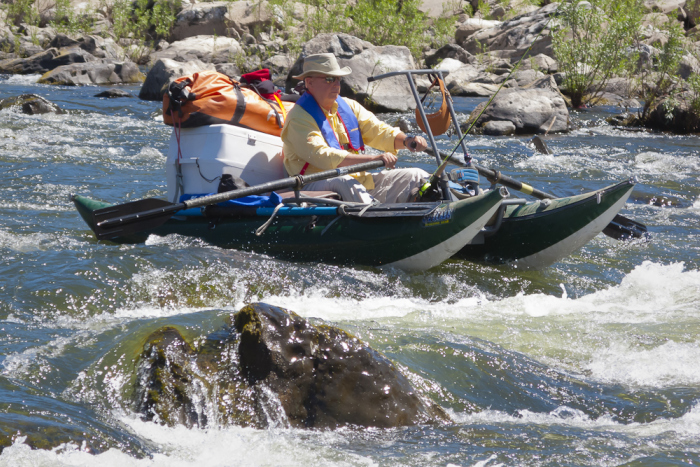
People needing whitewater capabilities should think about pontoons no shorter than 10 feet in length. Generally speaking-for running rapids, the longer the pontoon, the better they track through rapids. More length allows the boat to span across holes and wave trains. Also, thicker tube diameters are needed here to keep you and your gear afloat and more maneuverable. We would recommend 18 inch – diameter tubes and above for floating rivers with any amount of serious whitewater. Also, the total width of the boat says a lot about a boat’s over all stability. It should be mentioned here that personal skill level is the most important aspect for running whitewater. Beginner oarsmen really have no business attempting dangerous water in any size boat. When I mention 10 feet and 18 inch tubes this is really meant for advanced river runners. The less your own personal skill level, then the longer your boat should be. Even for single occupants, a 12 foot pontoon is a more viable rig to use when running serious white water. Pontoon boats are made in lengths up to 20 feet long. Rowing these multi-person vessels are tougher to move around, but they are far safer when plowing through serious rapids. Experience allows people to drop down in over all boat size.

How many people?


People wishing to bring another occupant, should have their eyes on at least a 12 foot boat with 18 inch and above diameter pontoons. Boats of this size will give you adequate space and weight capacity for you and your gear. Standing and fishing from a boat this size is also an option if there is a stout, upright frame and it is properly balanced. For three total people, pontoons or rafts of at least 14 feet in length should be the shortest boat considered.

Steve Turner Photography

Portability-


Pontoon boats, for the most part, are very portable. But to fairly address this, one must look at the overall size and weight of the boat as well as the type of frame. If you are traveling to a body of water with the boat in pieces, most vessels should break down and fit into a compact car. To get a solid feel for size, look at the number of pieces involved in making up the frame. Frames that click together with holes and pins will go together quickly. Frames that are bolted together will take more time. It is much easier to leave these pontoon boats whole and most will fit nicely on top of one’s car or in the bed of a pickup. Most boats up to 10 feet in length are very manageable for one person to throw up on the car roof. 11 and 12 footers are doable, if you’re exceptionally rugged. 12 foot pontoons can be pulled up onto a trailer at an honest boat ramp by one person, however you certainly lose options when you get into these longer lengths. The beauty of small pontoons is you can drop them in and pull them out in some fairly obscure places. If you need to hike with your pontoon, you will need a small boat and a light, packable frame. Aluminum frames are key to keeping your load light.

Storage Capacity and Anchor System-

Okay, it is pretty easy to read the specs and see how much weight a boat can handle. But an often overlooked aspect is how user-friendly a particular storage system actually is. One thing to look for is what type of anchor system the boat has. Although this seems off-topic, this aspect is crucial to how the storage racks are laid out. Boats that have an anchor system that runs through the frame (Not Over The Top!) have far superior storage systems. When this is the case, storage racks are placed above the pontoons. Some boats that have anchor lines that run over the top of the frame, have their storage racks resting down closer to the water, between the pontoons. When this is true, there is less storage space and it is more difficult to reach your gear. Essentially, the anchor rope gets in the way of your packing scheme - also hindering smooth anchor operation.

You get what you pay for-

Here at the Gorge Fly Shop, we have dealt with Outcast Boats for years and we are very happy with their quality, service and range of options. However, we do recommend two basic strategies when it comes to pontoon boat shopping. If you are a fair weather angler needing very little whitewater capabilities then spend the least amount of money possible. A solid choice here would be the Fish Cat Streamer XL – IR. If you need a higher quality boat that has a broader range of options, then go all the way to the top. Do not spend your money on a middle of the road option. Go low or go high. Remember, the real quality of a boat is in the bladders, what type of seams hold the shell together, and the type of frame and storage layout. When you make the jump from the Fish Cat series to the Pac Series there is a considerable jump in price, but it is well represented by it’s inherent quality. As far as a one-man, do-it-all, high quality boat is concerned, you should really be looking at the Pac1000FS. But of course, you may want bigger, or you may want smaller depending on your style.

Frameless Boats-

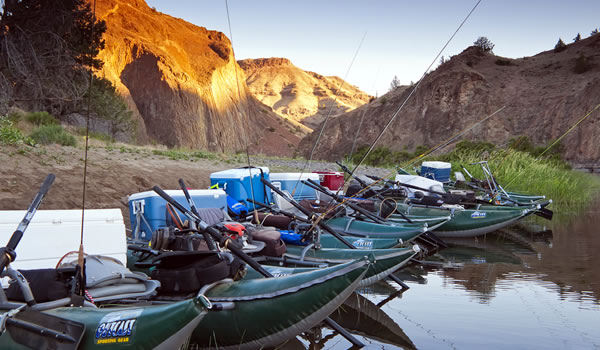
While Officially not a pontoon, boats like the new Outcast OSG Commander, Outcast Stealth Pro and the Fishcat Scout do not have a frame and are extremely light and pack-able making them the most recent trend in inflatables. A great advantage to these boats is the pack-ability. These can be stowed in a large duffel, checked as baggage, stored in a cars trunk and just as easily be carried in to where they will be used. Once inflated they become a true river boat with outstanding capabilities. All three designs use two piece oars that quickly connect to the boat and row just like a pontoon. This gives a considerable advantage over other craft such as kayaks and canoes. Also with the open design all three allow for use with kick fins making them a viable option for lakes and still water as well.

Outcast Stealth Pro


Below is table of the Outcast pontoon boats and some of the important characteristics of each:

Model
Size
Airecell
Shell
Frame
Weight
capacity
warranty
54”x 8’
16” vinyl
1000 PVC sewn
6 pc - Steel
63 lbs
300 lbs
5 year
54”x 9’
16” vinyl
1000 PVC sewn
6 pc- Steel
65 lbs
375 lbs
5 year
60”x 9’
10 vinyl
1000 PVC weld
6 pc Alum
67 lbs
400 lbs
5 year
56”x 10’
17” vinyl
1000 PVC sewn
12 pc Steel
91 lbs
450 lbs
5 year
54”x8’
16” urethane
1100 PVC Welded
4 pc Alum
52 lbs
300 lbs
10 year
54”x 9’
16” urethane
1100 PVC Welded
4 pc Alum
57 lbs
400 lbs
10 year
54”x 10’
18” urethane
1100 PVC Welded
4 pc Alum
62 lbs
500 lbs
10 year


65”x 13’
20” urethane
1670 PVC Welded
11 pc Alum
144 lbs
750 lbs
10 year
68”x 13’
19” urethane
1670 PVC Welded
NRS Frame
225 lbs
1050 lbs
10 year
72”x 14’
19.25 urethane
1670 PVC Welded
NRS Frame
236 lbs
1150 lbs
10 year
65”x 13’
20” vinyl
1000 PVC sewn
11 pc Alum
170 lbs
750 lbs
5 year
46”x 10’
11” urethane
1000 PVC Welded
Frame-Less
35 lbs
450 lbs
5 year
57”x 8’
16.25” Urethane
1000 PVC Welded
Frame-Less
35 lbs
450 lbs
5 year
55”x 7’
16.25” Vinyl
1000 PVC Welded
Frame-Less
35 lbs
400 lbs
5 year

For a more complete look, click Pontoon Boats

More Pontoon Articles:

Outcast Stealth Pro Frame-Less Pontoon Boat Review

Outcast Stealth Pro Vs. the Competition

Outcast Commander vs. Outcast Pac 800

K-Pumps - Best for Float Tubes, Pontoons and Rafts


Gorge Fly Shop Team


"Fly Fish the World with Us"



Visit our Relaunched Steelhead Only Site

Shop Gorge Fly Shop & SteelheadBum.com

  © 'and' Steelhead.com Mike Prine 2009-2014

Back to TOP