Floating atop the surface of a lake or a river is a beautiful thing. Not only is it an enjoyable way to travel, but you may also experience places that would otherwise be impossible to reach. For anglers around the globe, the benefits of pontoon boats have become quite clear. They help to bring you where the fish are -or through those special landscapes that your own two feet, cannot.
 |
| Dan Gordon - Gorge Fly Shop |
New color for 2017 Stealth Pro
For those of you interested in purchasing a pontoon boat, the three most important things to consider are: Durability, Function and Your Budget.
Durability
As is the case with most products, price does depend on the quality of materials. For pontoon boats the greatest concern is the type of bladders used. Most pontoons have an outer shell that is made of a pliable, PVC material. This stuff is fairly durable and ranges from a 500 – 1800 rating (which is determined by the weight of the material). Inside these shells are the actual bladders that hold the air. There are three different types of bladders found on the market today.
The first is vinyl. Vinyl is the least expensive material and it is also more liable to leak over time. Basically, vinyl does not have a high degree of elasticity so that as the material expands, it has a tendency to keep stretching without contracting back to its original form. As time goes on, this material loses its integrity putting it at a greater danger for pin holes and leaks due to trauma.
The best, but most expensive, bladders are Urethane. If you are willing to drop the dough, boats that utilize Urethane are the most dependable and the most likely to hold up over long periods of time. This is why companies like Outcast can afford to put a 10 year warranty on their Urethane – bladder boats. This material is highly elastic and if a leak does occur, it is the easiest material to patch while on the water. Simply put, Urethane bladders are far more durable than Vinyl.
The third type of bladder is a Vinyl/Urethane blend. This is the middle price point, although there are not many pontoons out there that have this combination. The brunt of the bladder is Vinyl with a Urethane coating. As is the case with vinyl, it works but this blended material offers far less durability than a purely Urethane bladder.
It is nice to have a stout PVC shell for these bladders, but truth be told, even the low rated shells are fairly durable. Typically, boats that have Urethane bladders will also have more durable covers. Also of concern is how these outer shells are put together. Welded seams are stronger than sewn seams, however, there are cases where low-cost boats do utilize welded seams. If it is a low priced boat, our recommendation is to go with sewn seams because there are some poorly crafted, welded seams out there on low-priced models.
Frames for pontoon boats are built from both steel and aluminum. Steel is stronger, but definitely adds more weight. Many high quality boats utilize rust-proof aluminum frames as a fine balance for durability and functionality.
The added components like seats, oars etc… are fairly constant across many stock models of boats. A word of caution however: when looking at the overall quality of the boat, do not be swayed by the type of components that are added on as opposed to the quality of the pontoons. Components are a pretty cost-effective way for companies to dress up their vessels and shouldn't be the overwhelming determinant of value.
 |
| Steve Turner Photography |
Functionality
This is where you must first ask yourself a few questions:
- In what type of water will you be using the boat?
- How many people do you wish it to hold?
- How portable do you need the boat to be?
- Storage capacity
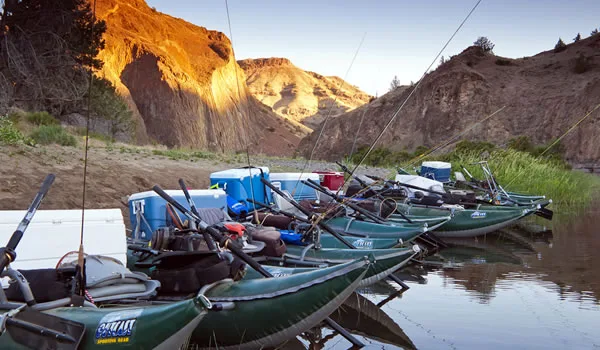 |
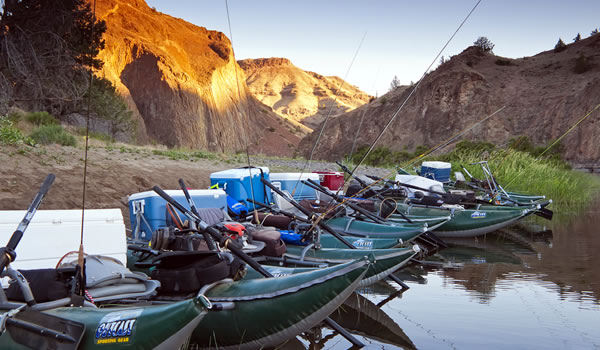
| Multi-day floats |
Water types
Lakes-
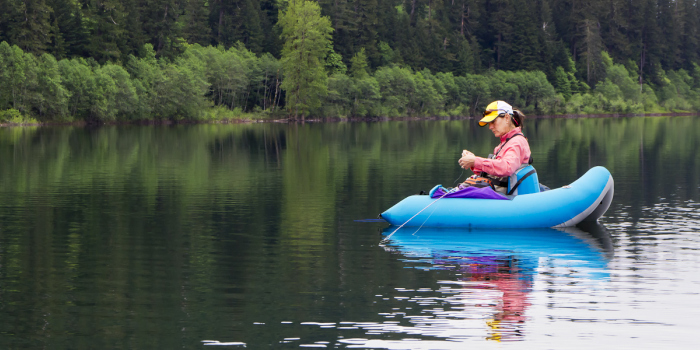
For most lake anglers, a basic 8-9 foot boat should do the job. Although quality tubes definitely add to the life of the boat, one may get away with vinyl pontoons here. Tube diameters of 16” are pretty typical on the lakes. Higher tube diameters bolster a boat’s weight capacity as well as improve the boat’s agility. However, operating tall-tubed boats on a lake can be difficult when the wind is blowing. Light boats in the 8 – 9 foot range can be controlled with fins, as opposed to oars. We call this “kicking” and this can be very effective when you want to maneuver and fish at the same time. Trolling along a shoreline is a fine example “kicking”. But, once you get above the 10 foot length, kicking is not really a viable option. There are a series of boats out there that use four total pontoons. The
Outcast Pac 9000 has two pontoons per side which allows it to keep pontoon height to a minimal, right around 10 inches. These low-profile boats perform very well in the wind and when running over shallow gravel bars. They are not as agile, however, so they take a little more strength to maneuver.
Gentle Streams-
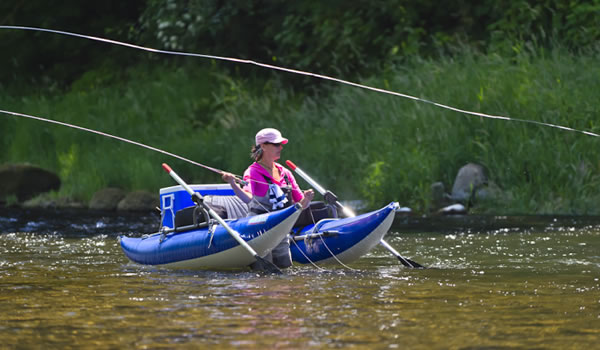
8-9 foot boats are also useful tools for floating small or gentle streams. Many boats in this size class have “rocker” shaped pontoons, which means that the tubes curve up in a rounded-fashion in both the front and back of the boat. This essentially leaves less surface area on the water making them more agile. Floaters using these rocker boats can spin the boat very quickly. The downside here is that this style is less stable and far less able to track on a straight line when running rivers or rowing across a lake. You will be “rocking” back and forth with each oar stroke. Keep in mind that companies save money with these rocker styles because there is essentially less material involved. One might still “kick” a boat this size on only slow moving rivers. But we do not recommend this, as it can be very dangerous in moving water.
Whitewater-
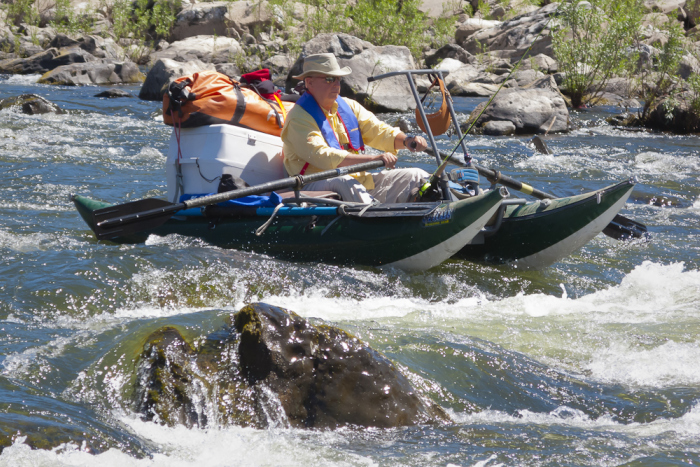
People needing whitewater capabilities should think about pontoons no shorter than 10 feet in length. Generally speaking-for running rapids, the longer the pontoon, the better they track through rapids. More length allows the boat to span across holes and wave trains. Also, thicker tube diameters are needed here to keep you and your gear afloat and more maneuverable. We would recommend 18 inch – diameter tubes and above for floating rivers with any amount of serious whitewater. Also, the total width of the boat says a lot about a boat’s over all stability. It should be mentioned here that personal skill level is the most important aspect for running whitewater. Beginner oarsmen really have no business attempting dangerous water in any size boat. When I mention 10 feet and 18 inch tubes this is really meant for advanced river runners. The less your own personal skill level, then the longer your boat should be. Even for single occupants, a 12 foot pontoon is a more viable rig to use when running serious white water. Pontoon boats are made in lengths up to 20 feet long. Rowing these multi-person vessels are tougher to move around, but they are far safer when plowing through serious rapids. Experience allows people to drop down in over all boat size.
How many people?
People wishing to bring another occupant, should have their eyes on at least a 12 foot boat with 18 inch and above diameter pontoons. Boats of this size will give you adequate space and weight capacity for you and your gear. Standing and fishing from a boat this size is also an option if there is a stout, upright frame and it is properly balanced. For three total people, pontoons or rafts of at least 14 feet in length should be the shortest boat considered.
 |
| Steve Turner Photography |
Portability-
Pontoon boats, for the most part, are very portable. But to fairly address this, one must look at the overall size and weight of the boat as well as the type of frame. If you are traveling to a body of water with the boat in pieces, most vessels should break down and fit into a compact car. To get a solid feel for size, look at the number of pieces involved in making up the frame. Frames that click together with holes and pins will go together quickly. Frames that are bolted together will take more time. It is much easier to leave these pontoon boats whole and most will fit nicely on top of one’s car or in the bed of a pickup. Most boats up to 10 feet in length are very manageable for one person to throw up on the car roof. 11 and 12 footers are doable, if you’re exceptionally rugged. 12 foot pontoons can be pulled up onto a trailer at an honest boat ramp by one person, however you certainly lose options when you get into these longer lengths. The beauty of small pontoons is you can drop them in and pull them out in some fairly obscure places. If you need to hike with your pontoon, you will need a small boat and a light, packable frame. Aluminum frames are key to keeping your load light.
Storage Capacity and Anchor System-
Okay, it is pretty easy to read the specs and see how much weight a boat can handle. But an often overlooked aspect is how user-friendly a particular storage system actually is. One thing to look for is what type of anchor system the boat has. Although this seems off-topic, this aspect is crucial to how the storage racks are laid out. Boats that have an anchor system that runs through the frame (Not Over The Top!) have far superior storage systems. When this is the case, storage racks are placed above the pontoons. Some boats that have anchor lines that run over the top of the frame, have their storage racks resting down closer to the water, between the pontoons. When this is true, there is less storage space and it is more difficult to reach your gear. Essentially, the anchor rope gets in the way of your packing scheme - also hindering smooth anchor operation.
You get what you pay for-
Here at the Gorge Fly Shop, we have dealt with Outcast Boats for years and we are very happy with their quality, service and range of options. However, we do recommend two basic strategies when it comes to pontoon boat shopping. If you are a fair weather angler needing very little whitewater capabilities then spend the least amount of money possible. A solid choice here would be the
Fish Cat Streamer XL – IR. If you need a higher quality boat that has a broader range of options, then go all the way to the top. Do not spend your money on a middle of the road option. Go low or go high. Remember, the real quality of a boat is in the bladders, what type of seams hold the shell together, and the type of frame and storage layout. When you make the jump from the Fish Cat series to the Pac Series there is a considerable jump in price, but it is well represented by it’s inherent quality. As far as a one-man, do-it-all, high quality boat is concerned, you should really be looking at the
Pac1000FS. But of course, you may want bigger, or you may want smaller depending on your style.
Frameless Boats-
While Officially not a pontoon, boats like the new
Outcast OSG Commander, Outcast Stealth Pro and the
Fishcat Scout do not have a frame and are extremely light and pack-able making them the most recent trend in inflatables. A great advantage to these boats is the pack-ability. These can be stowed in a large duffel, checked as baggage, stored in a cars trunk and just as easily be carried in to where they will be used. Once inflated they become a true river boat with outstanding capabilities. All three designs use two piece oars that quickly connect to the boat and row just like a pontoon. This gives a considerable advantage over other craft such as kayaks and canoes. Also with the open design all three allow for use with kick fins making them a viable option for lakes and still water as well.
 |
| Outcast Stealth Pro |
Below is table of the Outcast pontoon boats and some of the important characteristics of each:
Model
|
Size
|
Airecell
|
Shell
|
Frame
|
Weight
|
capacity
|
warranty
|
|
|
54”x 8’
|
16” vinyl
|
1000 PVC sewn
|
6 pc - Steel
|
63 lbs
|
300 lbs
|
5 year
|
|
|
54”x 9’
|
16” vinyl
|
1000 PVC sewn
|
6 pc- Steel
|
65 lbs
|
375 lbs
|
5 year
|
|
|
60”x 9’
|
10 vinyl
|
1000 PVC weld
|
6 pc Alum
|
67 lbs
|
400 lbs
|
5 year
|
|
|
56”x 10’
|
17” vinyl
|
1000 PVC sewn
|
12 pc Steel
|
91 lbs
|
450 lbs
|
5 year
|
|
|
54”x8’
|
16” urethane
|
1100 PVC Welded
|
4 pc Alum
|
52 lbs
|
300 lbs
|
10 year
|
|
|
54”x 9’
|
16” urethane
|
1100 PVC Welded
|
4 pc Alum
|
57 lbs
|
400 lbs
|
10 year
|
|
|
54”x 10’
|
18” urethane
|
1100 PVC Welded
|
4 pc Alum
|
62 lbs
|
500 lbs
|
10 year
|
|
|
|
|
|
|
|
|
|
|
65”x 13’
|
20” urethane
|
1670 PVC Welded
|
11 pc Alum
|
144 lbs
|
750 lbs
|
10 year
|
|
|
68”x 13’
|
19” urethane
|
1670 PVC Welded
|
NRS Frame
|
225 lbs
|
1050 lbs
|
10 year
|
|
|
72”x 14’
|
19.25 urethane
|
1670 PVC Welded
|
NRS Frame
|
236 lbs
|
1150 lbs
|
10 year
|
|
|
65”x 13’
|
20” vinyl
|
1000 PVC sewn
|
11 pc Alum
|
170 lbs
|
750 lbs
|
5 year
|
|
|
46”x 10’
|
11” urethane
|
1000 PVC Welded
|
Frame-Less
|
35 lbs
|
450 lbs
|
5 year
|
|
|
57”x 8’
|
16.25” Urethane
|
1000 PVC Welded
|
Frame-Less
|
35 lbs
|
450 lbs
|
5 year
|
|
|
55”x 7’
|
16.25” Vinyl
|
1000 PVC Welded
|
Frame-Less
|
35 lbs
|
400 lbs
|
5 year
|
For a more complete look, click Pontoon Boats
More Pontoon Articles:
Outcast Stealth Pro Frame-Less Pontoon Boat Review
Outcast Stealth Pro Vs. the Competition
Outcast Commander vs. Outcast Pac 800
K-Pumps - Best for Float Tubes, Pontoons and Rafts
Gorge Fly Shop Team
"Fly Fish the World with Us"






 Spey Fishing. These short rods provide a light, agile alternative when fishing small to medium sized rivers. Finally, lines now exist to give anglers a sound spey experience with rods of this size. Traditionally, spey rods have been used to cast lines to anadromous fish like Salmon and Steelhead. Anglers preferring to swing flies for these fish with switch rods should consider casting short spey heads, but there are a few choices here. If you want the capability of casting heavy sink-tips and weighted flies then you want a short Skagit line. Rio's version: Rio Skagit Max Short. Airflo's version: Airflo Skagit Switch. Both of these lines are very similar and like the regular Skagit lines, they perform best with some type of sink-tip attached to the front of the head. Their extreme weight forward nature allows them to turn over tips and heavy flies quite easily. People who wish to swing flies on the surface or mere inches below the surface can replace the sink tip and affix a dry tip to the head. Although this will work for dry line fishing, this combination is somewhat “clunky” when looking for a soft fly lay down on the water. Also, people using this setup will appreciate using a polyleader in place of a purely mono leader. So it is recommended that you attach a 10 foot polyleader to the end of the dry tip which will aid in rod-loading and line shooting.
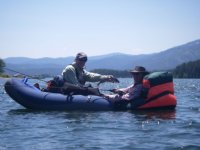 Like pontoon boats, the most important determinant of quality and performance depends on the materials used and the overall size of the float tube. Most tubes have internal bladders constructed of either Vinyl or Urethane. The outer shell that holds these bladders is a fabric material that will vary in durability from the top of the tubes to the bottoms. Typically the material on top is lighter gauge fabric than that of the shell material on the bottom of the tube. The durability is given a weight rating, typically between 200 – 600. Most tubes have an outer shell rating that is durable enough for average use. The main concern is what type of bladder is used.