Showing posts with label Sam Sickles. Show all posts

May 7, 2026

The Deschutes River Salmonfly Hatch

There are few events in Western fly fishing that generate as much anticipation as the Salmonfly hatch on the Deschutes River. Big bugs, aggressive wild Redside trout, explosive dry fly eats, and some of the most scenic water in Oregon all come together during a short but unforgettable window each spring.

If you’ve never experienced the hatch, it deserves a spot on your bucket list.

The hatch typically begins in mid-May and progresses into early June, starting downriver and gradually moving upstream as water temperatures rise. Alongside the famous Salmonflies, anglers can also expect Golden Stones, with the occasional Green Drake and PMD mixed in depending on conditions.

Stoneflies spend the majority of their life underwater as nymphs, often for multiple years. When they finally migrate to shore to emerge into adults, the river changes quickly. These bugs are famously clumsy once they hatch, often falling or getting blown back onto the water from shoreline grasses and bushes. The trout know it, too.

During the hatch, Deschutes Redsides slide tight to the banks, under alders, against grasses, and along rocky edges waiting for an easy meal. The takes can be violent and unforgettable. Even when you don’t see obvious rising fish, trout are still looking for stoneflies if bugs are active along the banks.

One of the biggest mistakes anglers make during the hatch is fishing too far from shore. Focus on likely holding water close to the bank and be prepared for fish to eat in very shallow water.

Timing & River Sections

The most consistent Salmonfly action is generally found from Pelton Dam downstream to Sherars Falls, though productive fishing can be found throughout much of the lower river during the hatch progression.

Popular access points include:

  • Warm Springs

  • Mecca Flats

  • Trout Creek

  • South Junction

  • Maupin area access points

The Warm Springs to Trout Creek stretch — commonly referred to as the “Day Stretch” — sees the heaviest fishing pressure during the hatch, but it also holds some outstanding fish and incredible dry fly water.

Below Trout Creek, angling pressure often lightens somewhat, though the hatch still attracts anglers and outfitters from across the Northwest. The float from Trout Creek to Harpham Flat is one of the iconic multi-day floats in the West, winding through the heart of the wild and scenic Deschutes Canyon.

This lower section is remote, rugged, and beautiful, but it should not be underestimated. Whitehorse Rapids is a serious Class III+ rapid and demands experienced boat handling skills.

Gear Recommendations

For many of us, Salmonfly season means putting away the indicator rods for a while and committing fully to dry flies.

A 9’ 5-weight is the standard setup for most anglers, though a 6-weight can be a great choice when afternoon canyon winds start blowing. Pair it with a quality weight-forward floating line and don’t be afraid to fish heavier leaders than usual.

Large foam stonefly patterns turn over much better on 1X–3X tippet, especially during windy afternoons. Leave the light tippet at home until later summer hatches arrive.

Fly Selection

No single fly pattern dominates every day of the hatch. Conditions, pressure, and fish mood all play a role.

That said, reliable staples include:

Bring a range of sizes and colors. Sometimes downsizing your fly slightly can make a major difference, especially on pressured fish.

And when a trout eats your fly — give it a moment. One of the hardest parts of Salmonfly fishing is resisting the urge to trout-set too quickly after an explosive take.

Why It Matters

The Deschutes Salmonfly hatch is more than just great fishing. It’s one of those seasonal moments that defines fly fishing in the Northwest.

Big dries.
Wild trout.
Canyon winds.
Cold mornings and warm afternoons.
Long floats through desert scenery.

It’s the kind of fishing experience that keeps anglers coming back year after year.


Guided Deschutes River Trip Options

If you’re looking to experience the Salmonfly hatch with experienced local knowledge, guided trips can make a huge difference — especially during a hatch that moves quickly and changes daily.

Day Stretch Float Trips

Guided day trips typically cover the famous “Day Stretch” from Warm Springs to Trout Creek. This roughly 10-mile float features some of the most productive dry fly water on the river along with the chance at larger-than-average Deschutes Redsides.

It’s also one of the busiest stretches during the hatch. Fish move constantly with pressure and changing bug activity, which makes local knowledge incredibly valuable when trying to stay on active fish throughout the day.

Multi-Day Camp Trips

For anglers wanting the full Deschutes experience, multi-day camp trips from Trout Creek to Harpham Flat are hard to beat.

These 3–4 day floats travel deep through the wild and scenic canyon with mobile camps moving downriver each day. Camp setups are handled for you, allowing anglers to focus entirely on fishing, relaxing, and enjoying the canyon atmosphere.

Expect comfortable tents with cots and pads, quality meals, riverside camps, and long days spent fishing classic Deschutes water during one of the most exciting hatches of the year.

The lower river canyon offers incredible scenery, lighter pressure, and some of the most memorable dry fly fishing in the West.

Trip Information

For guided Deschutes River Salmonfly trips:

Sam Sickles
Steelhead Outfitters
541-400-0855

Availability during Salmonfly season is limited and dates typically fill quickly during May and early June.

https://www.gorgeflyshop.com/store/pc/Sale-Closeouts-c38.htm

"The Gorge"

Gorge Fly Shop Team - 541.386.6977


"Fly Fish the World with Us"

Mar 31, 2026

Limited Deschutes Trips with Sam Sickles

Spring Spots Available with Sam Sickles: Lower Deschutes Dry Fly Trips at an Early Booking Rate

Spring in the Gorge means one thing for a lot of us—Deschutes trout season is calling. If you have been thinking about getting out on the Lower Deschutes with a seasoned guide, now is a great time to lock in a trip with Sam Sickles of Steelhead Outfitters. Sam is offering limited spots for Gorge Fly Shop customers for early bird bookings.


A word from Sam...

The birds are chirping, the grass is growing and giant stonefly nymphs are making their way to the bank.  Spring in the Gorge means trout fishing on the Deschutes.  I’m offering an early booking rate for Gorge Fly Shop customers, 10% off ($585) if you book by April 15th. Along with a killer boat ride and a fabulous lunch I will show you the five most important tips for dry fly fishing on the Lower Deschutes!  


Sam Sickles 
PO Box 115 
Hood River, OR 97031 
samsickles@gmail.com 
(541) 400-0855


https://www.gorgeflyshop.com/store/pc/Sale-Closeouts-c38.htm

"The Gorge"

Gorge Fly Shop Team - 541.386.6977


"Fly Fish the World with Us"

Sep 5, 2025

Fly Fishing the Klickitat River


Discover fly fishing on Washington’s Klickitat River. Learn about steelhead and salmon seasons, river access, boat launches, guides, and the best places to stay and eat near the Columbia River Gorge.


The Klickitat River, known locally as “the Klick”, is a 95-mile, glacier-fed river that offers anglers incredible opportunities for Summer Steelhead, Chinook Salmon, and Rainbow Trout. Even Mountain Whitefish have their place here, though they’re less pursued.

With plenty of bank access, multiple boat launches, and campsites scattered along its course, the Klick is one of the Columbia River Gorge’s most versatile fisheries. Whether you’re hiking in, floating by drift boat, or camping riverside, this river delivers. Along the way, keep an eye out for wildlife—turkey, deer, otters, and even elk in the upper stretches.

Fishing Seasons:

  • Steelhead: Typically June through November (check yearly regulations).

  • Salmon: Year-round below Lyle Falls; above the falls reopens Aug. 1, 2025.

  • Whitefish: Open all year, with winter being the prime season.

Access:

  • Road: Hwy 142 parallels 18 miles of the lower Klick, offering excellent bank fishing.

  • Boat: Popular floats include Slide to Ice House and Ice House to Town. Longer floats like Stinson to Ice House are also a favorite.

Where to Stay & Eat:

Guides:

For fishing licenses, visit Bridge Mart (Bingen), Lyle Merc, or Canyon Market (Klickitat).

Whether you’re after steelhead, chasing salmon, or just soaking up the Gorge scenery, the Klickitat offers one of the Northwest’s most rewarding river experiences.


Thanks for reading, get out there, be safe on the water and have fun!

GFS Team
John

Want to dive deeper into fishing the Klickitat? Visit SteelheadBum for more.

https://www.gorgeflyshop.com/store/pc/Sale-Closeouts-c38.htm

"The Gorge"

Gorge Fly Shop Team - 541.386.6977


"Fly Fish the World with Us"

Mar 7, 2024

WHEN ALL LINES UP...AND YOU COME TIGHT!

Admiring a beautiful summer run steelhead before watching her swim away.

Recently, I was lucky enough to fish with my good friend and guide buddy, Sam Sickles chasing our favorite fish, utilizing our favorite method...swinging for somewhat aggressive winter steelhead that are willing to chase a swung fly.  We've caught our fair share of steelhead using other methods, but swinging flies is definitly our favorite way.

We met early morning for the considerable drive to our launch destination.  We wanted to be on the water just before daylight to take full advantage of the day.  Drive time chats consisted of almost everything steelhead and how the river was in near perfect condition.  He had already had some success in prior days and needless to say, I was pretty stoked for the day.  I've ALWAY'S had a great time fishing with Sam, regardless of whether or not fish are caught.  Never any pressure to perform on his end or mine.  Just two buds out for a day of fishing.

I get a kick out of Sam because in every run I've ever fished with him, before we even step in the water he's bringing the confidence level up by saying..."this is my favorite run on the whole river. we oughtta get one here."  I like that.  I mean, might as well be confident in what you're doing and where your fishing.  Confidence is part of the game, a big part.  What I think is funny about it is that he literally says it in every run, no joke.  When he says that, In my mind I think..."what's my favorite run?" and the responce to myself is the one I am currently fishing in.

My intention for this post is to talk about the "Come Tight" part of it all.  Undoubtably you've heard the saying..."the TUG is the Drug" and even though this saying has been around for a long time, It's still the pinnacle of the process. It's that moment we dream of and can't wait for.  We endure hours, sometimes days waiting for the eat and sometimes we question our own sanity, especially in the winter.  At times, it can take extreme patience between grabs.  Getting caught up in the rhythm of it all, we make a sweet cast, set the fly up for the swing and then start talking to ourselves..."man I should just get crushed right now!"

I've tried to explain it to my wife, my kids, anyone who will listen many times, that catching a steelhead is always nice, but when I step into a juicy run, my adrenalin is already in full swing.  The anticipation.  My heart is pounding, the excitement of the possiblity of hooking and landing a steelhead is so strong in me, that I've told friends that I need to catch a fish to calm down.  In comparison to some fisheries where the adrenaline rush comes after the hook set...with swinging flies for steelhead, the rush starts the second I look at a run and step in.  

I'm sure we can agree, when it comes to hunting steelhead, it can consume you if not careful.  Everything becomes all about steelhead, your thoughts, your conversations and you life style reflect a die hard steelheader.  This applies to fly fisherman and gear fisherman alike.  At this point in my life there are only two fish that I've pursued so far that have kept me awake at night in anticpation, and those are Steelhead and Tarpon.  If you're like me, you go over your equipment like a surgeon, you make list to make sure you don't forget anything and the days leading up to your trip are filled with prepartion for the day.  You are checking the weather forcast, the river level forcast on and on...

This!...this is the reason you endure the elements of time, weather and patience!
Look at that thing!  I mean, stunning! Sam did everything right after the eat!

Let's talk about the "come tight" for a bit.  When I guided, most folks would ask what do I do after they eat the fly?  That was one of the major questions often asked and rightfully so.  It's an important issue, and inquiring minds wanted to know.  Especially those first time customers or those that just didn't do it very often and hadn't become seasoned by experience.  Funny thing about answering the question is that no matter how articulated and consice I was in explaining the answer, almost everyone would absolutely forget everything we talked about when the eat actually happend.  I've seen folks freeze on the eat, dazed and confused to what just happened, to folks that set the hook so hard that if they did stick the fish it most likely would have broken it's neck or died of shock.

There's a fair amount of debate out there on whether or not to carry a loop, to set the hook or not to set the hook.  I personally don't carry a loop and I personally set the hook.  I personally LOVE to set the hook!  When I say "set the hook" it's really not what you think.  My setting the hook is more like a steady long sweep with my rod tip low and towards the bank.  It's not a break neck type of hook set, but again it's a firm side sweep with steady pressure once the fish has turned and taking out line.  I think of it as something like tug of war.  When the fish has turned and taking line, I simply sweep to the bank side and pull on the tight line to help "seat the hook" in the corner of the jaw (see photo below).  This has proven to be very, very effective for me over the years.  That doesn't mean its 100% foolproof and I never miss or lose a fish, because I do.  But I'll tell you that, for me, it's pretty rare that I miss or lose very many fish in a season.

Others swear by carrying a loop, that it improves their odds drastically, and it may.  I just haven't personally experienced that it does.  Folks that carry loops, lose or miss fish too.  If you haven't made a choice try both and see which you prefer.  I truly love using a click & pawl type reel, such as the Hardy Marquis Salmon series reels or the Hardy Widespool Perfects.  This allows the fish to easily turn and take line from the reel before I set the hook. 
Which is why some carry a loop, in that when the fish turns and takes the loop out, you can then come tight on the fish and the odds of successfully landing the fish are increased.  Even when I'm using a non-click & pawl type reel, such as a Tibor Signature Series, Galvan Torque or Sage Spey reel, I'll set the drag loose enough, that when a fish eats and turns with the fly, it can take line without causing a backlash. When he takes enough line out that I can't stand it any longer, I'll set the brakes on him by putting my hand on the reel before coming tight on em.  Hope that all makes sence.

Summer Steelhead with a 'come back" fly, the Kalamath Intruder!

Side Note: In the photo above, this steelhead had originally tried to eat a Jerry French Black and Blue "Dirty Hoh" (photo below on the left) during the swing, he grabbed it 3 times but just wouldn't commit.  Thought I'd try another cast and he wouldn't touch it. So, I tied on the much smaller "Kalamath Intruder" in the same Black and Blue color (because that's what it originally went after) and the very first swing, nearly got the rod ripped from my hands with an explosive, amazing eat!  Look closely and you'll notice that the hook on the Kalamath Intruder is ever so slightly bent out.  Not always will they comeback to a fly, but boy I sure love it when they do!

Going smaller with similar color is never a bad idea for a come back fly!


Parting Shot:

Next time, you're lucky and come tight and bring that fish to hand, take a moment to look at it, really look at it, admire it, look at the beauty of her markings and the journey you both took to have this moment together bankside.  Then let her go, and look forward to the next.

So, where am I going with all this?  I don't really know. Maybe it's self encouragement to help endure the elements until I come tight again.  Maybe it's in hopes of encouraging others to do the same.  Maybe it's me reminising all the hours and sometimes days between fish that I slow down a bit more and discover something new on the river that I hadn't seen before.  Maybe I'm realizing that it's not all about the numbers of fish I catch but the expeirence of each one that I do.  There's something about a fish that makes you loose sleep over it, that brings your heart rate up like a work out, when you finally get that eat, something about them that makes you spend major time, money and effort in pursuing them.

I guess my point might be..."that it ALL matters."  Everything done from start, to the point of releasing the prize matters.  It keeps you connected to the sport and what you love doing.  So, the next time you're lucky enough to come tight, try your best to be calm, cool and collected.  Understand that it's a game.  You win some, you lose some, but it's fun to play.  You'll find what works best for you and you'll become efficient at it and when you do, the "odds will forever be in your favor."

Book a Trip w/Sam:
Sam Sickles | Steelhead Outfitters
Ph:  541-400-0855


Thank you for spending your time reading this, I hope you enjoyed it.

GFS Team
John G.

https://www.gorgeflyshop.com/store/pc/Sale-Closeouts-c38.htm

"The Gorge"

Gorge Fly Shop Team - 541.386.6977


"Fly Fish the World with Us"

Mar 13, 2021

Deschutes River Fishing Playbook

Salmonfly Hatch - Bucket list worthy

The Deschutes River Fishing Playbook: part one

The crown jewel of Oregon is arguably the Deschutes River. Earning Federal Wild and Scenic designation in 1988 the Deschutes is managed for recreation and continues to gain in popularity. The tailwater fishery is 100 miles long and runs north through an arid desert canyon until it meets the mighty Columbia River east of the Dalles Oregon. Along with beautiful scenery and all sorts of wildlife viewing opportunities are the fish. Wild populations of “redsides” or rainbow trout, mountain whitefish, bull trout, summer steelhead, spring Chinook and fall Chinook make the Deschutes a top fishing destination in the spring and fall.


The Deschutes is unique in a lot of ways, for one there is no fishing from a boat.  I get asked a lot where this came from and I have lots of answers but one thing's for sure, the Deschutes is a varsity level field for bank anglers.  Without a boat anglers will test their skill daily against a very sly opponent.  River level, clarity and temperature are very complimentary to a strong trout fishery.  Very few things will put the Deschutes out of shape and unfishable so it’s a fairly safe place to plan your next fishing get away.  The insect activity is heavy but the big hatches are very reliable (more on this later).  The Deschutes is truly an awesome river to fly fish with runs riffles and eddies all around.  River access is impressive as well and there is something for every type of angler and adventurer.


History

The first non-native visitors to the Deschutes occurred in 1805 when Lewis and Clark crossed at the mouth.  The name Deschutes means river of the falls for Celilo Falls located just downstream from the mouth.  Celilo Falls was a major hub for native peoples until 1952 when the Dalles Dam submerged it.  There are three dams on the Deschutes itself built from 1958 to 1964 and they are not without controversy today.  From it’s confluence with the Columbia River, a railroad runs most of the way up the Deschutes, on the west bank until it crosses the river at North Junction just short of river mile 75.  On the east bank there is an old railroad grade running parallel much of this distance.  Today it is a road, a dilapitated trail, then a road again.  There is a great book on the Deschutes Railroad Wars covering this period of time and is a great bring along book if you are floating the river.

Humans have had interaction with the Deschutes for a long time.  Even though it’s a “wild and scenic river”, there is good public access.  Prime time trout fishing starts in May and runs into the summer with the best month being May and the Stonefly hatch.  After the Stonefly hatch there are caddis and mayfly hatches well into summer.  The stonefly hatch is often referred to as the “salmonfly” hatch, but really they’re not alone as both golden stone and the smaller yellow stones are going off at the same time.  During this hatch it’s not uncommon to see blue winged olives, pale morning duns pale evening duns, caddis flies and once in a while the green drake hatch.   If you’ve got these bugs in your quiver then you are ready to come over and fish the Deschutes this spring.

Sam Sickles - Steelhead Outfitters - Deschutes River Guide
Bug hunter!
Salmonfly Hatch
The Salmonfly hatch is easily the most explosive dry fly fishing of the year.  These giant bugs live several years on the bottom of the river and then they make their way to the rocky shore, clumsily climbing out and molt from their nymph stage to adult.  The adults will congregate in the grass, bushes and trees until which time they breed then take flight.  The big slow flying bugs drop their eggs into the river then the cycle begins again.  In the middle of all this we have two or three weeks of great fishing, this is a bucket list trip.

Steelhead Outfitters - Deschutes River Guide
Know before you go.

If you point at a hundred miles of river and all the access point on the BLM guide (buy one), you might not start in the right place.  The “salmonfly hatch” moves up river with the water temperatures.  Ground zero is Maupin Oregon at river mile 52, one of three places the road crosses the river.  From Maupin the road goes south for a few miles until it reaches Locked Gate and north where it crosses the river and eventually leads to the Lower Deschutes access road.  Going north or south on this road gets the average guy plenty of spots to fish.  Maupin is well appointed with fly shops, a store, some restaurants and a hotel.
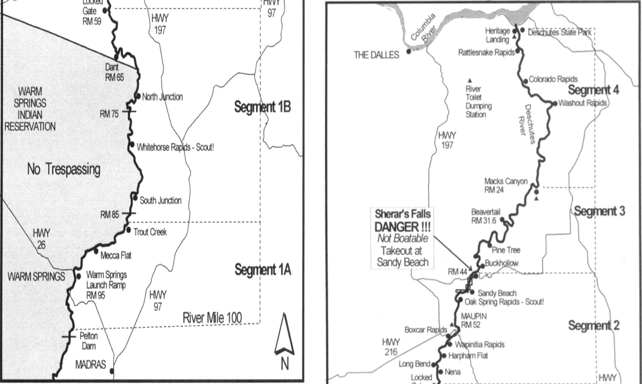
The first time the road crosses the river is at the Warm Springs Indian Reservation boundary, river mile 95.  There is river access on the east bank only.  The west side is tribal lands and a tribal guide is needed to access it.  There is a small exception from Dry Creek to Trout Creek and a tribal pass is required to access and fish this small section on the West bank.  Back to the east bank, the first public boat ramp is located on highway 26 on the east side just prior to the reservation boundary, it’s well marked and heavily used.  The next access point is Mecca Flats, a popular improved campground with a lightly used boat ramp.  A good trail runs north along the river to Trout Creek which also has an improved campground with a boat ramp.  The float from Warm Springs to Trout Creek is referred to as the day stretch although camping is allowed in designated sights only.  Camping from a boat on the lower Deschutes is regulated and requires a boater’s pass from The Bureau of Land Management.  The BLM is the primary manager of the river along with Oregon State Parks and the Confederated Tribes of Warm Springs.

Once you get to Trout Creek, RM 85, the next public access is Maupin, RM52 give or take.  Don’t miss this takeout when floating from Warm Springs to Trout Creek as the next boat ramp is just upriver from Maupin.  The section from Trout Creek to Maupin is the multi-day section, this trip can be done as an overnight but is best done in two night.  Multi-day float trips down the Deschutes are what the Deschutes is all about.  The reservation side of the river remains off limits until the boundary is reached, usually on day two below North Junction around RM65, there’s a great big sign you can’t miss it.  Look for wild horses near the reservation boundary.  I would be remiss in my duties if I didn’t point out a few hazards on this section, Trout creek Rapids, Four Chutes and Buckskin Mary are all legitimate rapids where experienced boatmen should be on the oars.  Whitehorse rapids should be attempted by only very experienced boatmen.  Whitehorse canyon is the most beautiful stretch on the Deschutes River but it claims several boats every year and people have lost their lives there.  Most people camp two nights, maybe an extra night on the same spot and take out near Maupin at Harpham Flats.

Sam Sickles - Steelhead Outfitters
Guide tested, client approved!

The Deschutes has a lot to offer every level of angler but if you are coming from afar or want to maximize your effort, hiring a local guide or outfitter is well worth the money.  Trips range from $500 for single day to $400-$500 per day per angler on multi day trips.  That said if you are just getting started and have the time for trial and error or you are a total do it "yourselfer", the Deschutes has your name written all over it.


Equipment needs:

Rods: 5 or 6 weight rods with weight forward tapers, the more aggressive the better.

Reels: Deschutes fish are big and strong and they can take all your line if you let them. I like a nice disc drag and a large arbor.

Leaders: Tapered 2x, 3x, 4x, and 5x. Same thing for the tippet. I fish as heavy as possible on the big bugs; I also like a 7.5 foot leader but carry 9 footers as well. Some times accuracy in the wind and into the bushes is aided by a short leader.

Gortex waders with felt and studded boots.

 
If you are over 16 years of age, bring a wading staff the Deschutes is tough wading. 

Come prepared for sunshine and for rain.

BLM guide to lower Deschutes, you can get this from the Gorge Fly Shop


Flies:
Bring lots of Salmonfly and Stonefly patterns, some Green Drakes, BWO’s, PMD’s, and PED’s. It’s not a bad idea to bring some nymphs of the same bugs just in case.


Shuttle Services:
Fishes (541) 475-3129

Fly Shops:
Gorge Fly Shop (541) 386-6976

Steelhead Outfitters (541) 400-0855
Silvey’s Fly-fishing (971) 219-2615
Bischoff's Fly-fishing (541) 977-2796

Mar 3, 2021

Salmon Fly Hatch on the Deschutes River, Oregon

THE SALMON FLY HATCH IS THE MOST EXPLOSIVE SURFACE ACTION OF THE YEAR!

Worth the Wait
Few things in the Northwest get trout fisherman more excited than the Salmonfly hatch on the Deschutes River. Anyone who hasn’t experienced this event is missing out on some of the best dry fly fishing around. The draw is the size of the bugs and the willingness of even the wiliest of fish to crush them on the surface. If you like fishing with big, easy-to-see dry flies while casting to aggressive wild trout than this is the hatch for you!

Hatch timing is pretty consistent, with the hatch beginning in mid-May and continuing into the first week of June. Both Salmonflies and Goldenstones hatch during this time of year along with the occasional Green Drake and PMD mayfly. The warming water temperatures start the hatch which begins down river and works its way up river over the course of a couple of weeks.

Stoneflies spend most of their life underwater in the nymph stage, upwards towards two years. Once they reach maturity the annual migration towards shore begins. Once reaching the safety of shore they begin to molt into their adult form - this is where it gets interesting for angler. Being notoriously clumsy, the bugs fall or are blown into the water from their perches in the grass and bush. The trout have followed the bugs towards the shore, and lie and wait for this windfall. The takes are often explosive, as the Redsides gorge themselves on the short opportunity of the hatch. The hatch is of vital importance to the trout as the protein rich bugs provide them with the necessary calories to recover from the spawning that just occurred in the river. Typically, when you fish the hatch, you work the bank lines, under the alder trees and anywhere you can anticipate Redsides lying in wait. Note, you may not see a lot of rising fish, but as long as there are Stoneflies in the grass the fish know they are around. Fish likely looking water and you will find opportunistic risers.

The best action is found from Pelton Dam to Sherars Falls but there is also good access on the lower access road. For most anglers the Warm Springs Boat ramp off HWY 26 is the first access point. There is also good foot access at Mecca Flats, Trout Creek, South Junction, and up and down the road from Maupin.

The stretches from Warm Springs to Trout Creek (the upper day float section of the river) and down lower near Maupin are easily the most crowded sections of the river during this time. Below Trout Creek the river experiences less pressure and the fishing is better (though it can still get busy as outfitters come from all over the state to fish the hatch!) The float from Trout Creek to Harpham Flat is thirty five miles through the wild and scenic Deschutes River Canyon. There's only one way in and it's downhill in a drift boat or a raft. This section of river is best left to the experienced boater, as the notorious Whitehorse rapids is class III+ and plays gatekeeper, letting only the most experienced boaters through, taking down a boat or two a season! The scenery in this section is breathtaking, and the camping is second to none. If you like expansive, high desert scenery and a little adventure to your fishing this is the place to be and is considered by many as a bucket list trip and on the must do list for many anglers.

Recommended equipment:

I don’t do much indicator fishing this time of year. Basically the bubble rods go away until after the hatch no matter how slow it gets. This is dry fly time. I like a nine foot five weight with a weight forward floating line, six weights have their place as well. My set up is a Winston BIIIX 590/690, Sage Click reels (may require cutting some running line off to fit), Airflow exceed fly lines. It can get windy and we are making dry fly presentations so a heavy leader is going to be needed to turn over the uber large stonefly patterns, I like 1x-3x depending on how windy, so put the 4 and 5x stuff away until the caddis hatch.

Fly Selection:

No one pattern works better than any other but my favorites are the Chubby Chernoble and the Norm Woods Special. Whatever you do bring a wide variety of Salmon fly and golden stone patterns. Make sure your variety includes smaller and bigger. Often a smaller size will get the rise. Speaking of the rise, let them have it for a full count before lifting your rod.

Deschutes River Guided Float Trip Options

Day Trips:

We offer guided trips in the “Day Stretch” from Warm Springs to Trout Creek. This is an all day, 10 mile float that has lots of great water and some of the biggest fish in the river. The pressure is highest in the section but the fishing can be outstanding. A good guide can be invaluable during the hatch on this section, as his or her intimate knowledge will keep you on the fish as the hatch progresses and fish get moved around by the pressure.


Camp Trips

Camp trips are generally 3-4 days from Trout Creek to Harpham Flats. These are mobile camps that move down the river; a camp host or "Bagger" is used to secure, set up and break down the camps. No work is involved for the clients, except for the task of fishing and eating all the food we bring down for you! The accommodations include roomy tents with cots and pads, and a luxurious dining tent where you can enjoy your hors d'oeuvres, meals and after dinner cocktails away from the elements!

We have limited remaining openings this year in May and early June. Call for available dates.


Sam Sickles
Steelheadoutfitters.com

541.400-0855


"Fly Fish the World with Us"


Feb 26, 2021

European Style Nymphing (ESN), Why Do It


Why nymph fish at all?


The truth is the overwhelming majority of trout feeding behavior happens below the water’s surface. In fact most feeding activity happens around twelve inches off the river bottom. The answer is to catch fish when they are not feeding on the surface, i.e., most of the time. Let’s be honest, if you fish western rivers for trout you nymph fish a lot. Now I know nymph fishing isn’t for everyone, this article is for everyone else. Recently the European style of nymphing has gained in popularity and here’s why.

The Old Standard


Before we step into the whole “euro” nymph deal, let’s just back-up a bit and talk about standard nymph rigs. This is the standard western nymph rig; it’s worked for a long time. This system is out of date, and if you are still using it, you are losing too many flies, spending too much time re-rigging, and most importantly, not making good drift and not seeing most strikes. I know this is offensive, I though the same thing…at first.

The first problem with this set up is the strike indicator, often large and cumbersome, designed to float heavy flies and split shots. Here’s the problem; this thing is a mess from the get-go. The bobber is big – it creates drag because water on the surface is faster than water near the bottom (where we want our flies). So, even though we are now fishing heavy rods and heavy lines so we can chuck massive payloads in order to get our flies down on bottom, the strike indicator is pulling our flies off the bottom.

How do we fix this? For starters we cast faster upstream, stack mend the bobber above the flies and and continue mending. The weight sinks fast and creates a hinge point and hopefully the flies follow the flies to the bottom, but mostly we create slack.

There is no doubt our flies get eaten and we catch some fish doing this but it’s inefficient. The flies are rarely in the strike zone and on a tight line, that is why this is the least effective style of nymph fishing. This style of fishing is best suited to boat fishing and it sucks at that as well.
This system has worked for many years and a lot of fish have been caught doing this. this system still has it’s place but it should be modified and replaced with “drop” shot nymphing.

Drop shot nymphing


Simply put, drop shot nymphing is just that. See the diagram below, “standard”. Typically the spilt shot are placed above the flies in a standard nymph rig. In a drop shot rig the weight is dropped below the flies. Often times anglers will high stick drift a drop shot rig with out a bobber type strike indicator.

This is very similar to European nymphing but not quite. This is a very effective style of nymph fishing for trout. The current on the surface even when using a strike indicator is negated by the lead dragging and bouncing off the bottom, creating the angle needed to put the flies in the strike zone.

Frankly speaking, short line high sticking with this method is effective but I like it best for fishing indicators at distance and for extended drifts. Anglers lose very few flies fishing this technique due to the drop shot being on the bottom and the flies above.


Euro Nymphing


European Nymphing is a catch all term for Czech Nymphing, every European country has basically adapted their own style to the Czech style, it’s easier to just call it all “euro nymphing”. Euro nymphing is done with a longer lighter rod and a very long leader, a sighter, and up to three weighted flies and no split shot. For people familiar with “drift fishing” terminal tackle, this technique is similar.


The Euro Rig is extremely simple and effective for catching trout. Typically the fly line is very thin. The leaders are long and thin in diameter. Flies are weighted in accordance to the water the angler is fishing. Fly patterns are simple, very simple, presentation always trumps the pattern. The ideas is that the flies tumble along the bottom on a thigh line where the trout live. Strike detection is via a “sighter”, usually chartreuse and fluorescent orange in color with a blood knot at the junction and the knot tags in tact. Straight 5x for the length of the leader is typical so 10 to 10.5′ 3 weights is the norm. The only weakness to this technique is at distance. The farther away this rig is from the rod tip the more “sag” is created between the leader and the rod tip, thereby dragging the flies. Sag can be defeated with lighter lines and tippets two things which make casting harder and harder.

So lets talk about casting. Traditional nymphing rods lend themselves the best to overhead casting as well as roll casting. Typically 5-7 weight rods, way weight forward nymphing lines and flies in line heavier ones up top make this the go to set up for casting at distance. Drop shot its are built to fish not to cast but the way weight forward fly lines and the heavier rods can still be you friend and if you’re careful you can still cast this rig. Heavy emphasis on mending this without moving the strike indicator it needs to drag the flies. The “Euro Nymph” rig does not cast, it’s not built to cast it’s built to cut the resistance of the upper current speed. Fishing the Euro Rig is best done from 20-30′ max, the closer the better. The flies are extremely heavy and the tippet is extremely thin so tension casting is best. The flies can be cast further by shooting some line, the weight of the flies can carry the cast a long ways but remember with the rod tip up at distance you create sag, reducing your effectiveness dramatically.

Tackle

There are several European Style Nymphing rods available today, typically 10-11′, 2-4 weight rods. A soft tip is required to protect light tippets and to cast light rigs. Fly lines are very thin with very small to no loops at the end. The ends go through the guides while fighting fish and remember we are typically fishing 5x. Very small 3 or 4 turn nail knots are recommended. 20,15,12# Maxima Chameleon, a sighter material too tone, or amnesia if you have it or can find it, tippet rings or micro swivels. The reel needs to be heavy. Holding a rod tip up all day is hard on the shoulder muscles, the easier to keep that rod tip up the better. The flies make this style of fishing so you will need to tie your own or go to a shop than carries them.

Flies

The bottom fly is the “point” fly or the anchor fly. The point fly is normally the heaviest fly. The dropper fly is 16-20″above the point fly (see diagram). I like a variety of sizes of tungsten beachhead flies wrapped with lead for this style of fishing. Like I said before, presentation trumps pattern. Anglers need a variety of weighted flies to fish a variety of water speeds ad depths.

Dirty Euro Nymphing

In some instances, say you’ve lost all you’re heavy flies on the bottom but fishing is good and you wanna keep going. Don’t be afraid to rig your euro nymph rod with a drop shot rig. That’s right, try a drop shot rig on your ESN rod.

I started nymph fishing in 1992, and have been fishing a long time since. Playing with straight leaders, heavier flies, better strike indicators, etc. can’t fix the real problem, fighting two speeds of current and keeping a tight line. Euro nymphing, or modern nymphing techniques are becoming mainstream and for good reason, they minimize current speeds and keep the flies in the bite zone on a tight line making strikes not only easy to detect…you can actually feel them most of the time. If you enjoy catching fish and you enjoy nymphing, it’s time to modernize.

If you would like to learn more we offer on the water modern nymphing instruction as well as guided trips for trout on the lower Deschutes year round.

To book a trip or schedule instruction please contact me;

Sam Sickles | Steelhead Outfitters
samsickles@gmail.com
541-400-0855

Feb 25, 2021

Deschutes Trout Season 2021 - Steelhead outfitters


Trout season will be here before you know it. 

  • April- Blue Wing Olives/March Browns 
  • May- Salmonflies, Golden Stones, Little Sallies 
  • June- Little Sallies, Caddis, and a mess of may flies 

Deschutes River Trout (Jetboat) 

We launch at Heritage Landing in a jet boat. Heritage Landing is a straight shot from Portland down I84. You meet me at the boat ramp and we get into the sled. There's no shuttle and no long gravel roads. 

We start fishing in mid April during the pre-stonefly, March Brown timeframe, which offers some of the best fishing of the year. There will be adult stoneflies and salmon flies the first week of May and we'll fish dry flies well into June. We do trout spey and euro nymphing as well as traditional fly fishing. 

Fishing the “lower lower” is a chance to experience dynamic dry fly fishing in solitude unimaginable around Warm Springs. Many days we see no other boaters and lots of hungry trout! 

Get ahold of me soon for open dates! Please text or email me for availability. 

Sam Sickles 
Steelhead Outfitters 
(541) 400-0855 
samsickles@gmail.com

Thanks again to everyone who supported us in 2020, we look forward to seeing you soon! 

https://www.gorgeflyshop.com/store/pc/Sale-Closeouts-c38.htm

"The Gorge"

Gorge Fly Shop Team - 541.386.6977


"Fly Fish the World with Us"

May 31, 2020

Deschutes Guide Report - Sam Sickles


Fishing has been incredible since we got back to work May 21st. The Salmon Flies and Golden Stones are pretty much done but it was fun while it lasted. In certain spots fish will still eat the big bugs but it’s pretty much over. If you need one more fish on the Salmon flies head to Mecca flats, that will be the last place to have bugs.

What is happening is everything else!
By everything I mean Sallies, Caddis, PMD’s, and Green Drakes. The dry fly fishing has been really good in the right spots and the nymph fishing is well… well it’s stupid easy.

I see conditions remaining the same until July. I spent a few hours swinging soft hackles last week. It was a rainy day and many fish were caught but the big ones eluded me. With all the caddis swarming right now soft hackles will work best early and late in the day.

I haven’t swung the big bugs much lately but same deal, early and late. Look for big time feeding activity in the evenings and morning as it gets hotter out.

If nymphing is your game, the big weighted rubber legs are still being inhaled in most spots, dropper fly gets eaten infrequently. Late in the afternoon fish prefer the dropper fly.

Don’t be afraid to fish some large green drake nymphs, they’re around and fish are keyed up for them.

When you are fishing keep an eye on the birds. When the gulls show up and look like they are feeding on bugs; picking them off the water, look for the green drakes. If the green drakes come off switch immediately, the fish will be on them.

If you are floating on the river, pull over immediately. Enjoy the month of June because we’re off to steelhead in July!

Tight lines,

Sam Sickles of Steelhead Outfitters:


Jun 26, 2019

Deschutes Fishing Report 06/26/19: Guide Edition

Sam Sickles
Get Hooked
I thought it was over, trout season that is. We had a bout of warm weather mid- June that brought water temps near 70 degrees, that’s the doom and gloom number. Along comes the wind, the clouds, and some freakishly cool weather, kabam! The river temps are 59 degrees in the morning and low 60’s in the afternoon, this is the trout happy place on the lower lower. Unfortunately or fortunately depending on how you look at it, the wind has gone nuclear! Starting almost two weeks ago the normally windy Columbia River Gorge (the CGR) went too windy, too windy for the people who live here, too windy for the people who are visiting.
Low and behold, the trout know something’s amis. If I’ve ever seen better trout fishing on the lower Deschutes, I don’t know when. It’s almost too easy. It’s like they know the end of heavy feeding is near, and it is.
That’s pretty dramatic, I know but here’s the real deal. It’s been windy, real windy. The weather has been cooler so with the wind maybe a little cold. Obviously with the high wind dry fly fishing is next to impossible. The nymph fishing for giant Deschutes resides has been on and is off the charts. Oddly enough the trout are looking for really big flies to eat, we’ve had our best luck on stone fly nymphs and variations. Despite the only live insects around, caddis flies, the fish are turning their nose up at it and everything else small.
The fishing will remain strong until the water temps come back up, my guess, this weekend, maybe early next week. Take a chance and get out there for the last week of really good trout fishing. My friends at Gorge Fly Shop can get you what I been getting them on. I’m going to the John Day for some camping/fishing.
I’ll be back after the 4th……..STEELHEAD SEASON BEGINS!
 
Sam Sickles
(541) 400-0855
www.steelheadoutfitters.com

Visit our Relaunched Steelhead Only Site

Shop Gorge Fly Shop & SteelheadBum.com

  © 'and' Steelhead.com Mike Prine 2009-2014

Back to TOP