Showing posts with label dryline. Show all posts

Oct 27, 2018

Do you let the loop hang?


To hold a loop, or not to hold a loop: That is the question: Whether 'tis nobler in the mind to suffer The slings and arrows of outrageous fortune, Or to take arms against a sea of troubles, And by opposing end them?

I bet if Shakespeare were a steelheader, he'd probably swing flies for them...

I've been asked this a few times before and my answer is never exactly clear-cut, but I do have a couple ground rules. For example, when I fish sink tips I never hold a loop, and when I dryline fish I do so about half the time. Why? Well for starters if I'm fishing a tip for winter-runs, I'm already swinging my fly down in the water column and the fish tend to move laterally rather than vertically in the water column. Therefore, when I fish a dryline the fish always have to move up in the water column to take the fly that's at or near the surface. A line from Dec Hogan that always stuck with me was, "what goes up, must come down."

So why don't I carry a loop every time if fishing a floating line? Well, it's purely situational for me. Say I'm fishing river right and trying to reach a specific distant spot- Instead of casting switch (with my non-dominating hand on top) I'll do whatever cast puts my fly where it needs to be, but as my line is shooting out the guides I'll pass the rod off to my left hand and only hang onto the bottom grip. The reason I do this is because I can control the fly much better with a little extra reach. I'm also able to slow my fly down or keep more line off the water if there is a funky surface current. When I fish this way my rod tip is almost always up high and if a fish takes the fly I simply bow the rod to the fish in respect for the steelhead taking my offering. Though it's really more because I want to give my fly to the fish and not pull it away. Similarly, if I'm twitching/skating/chugging dry flies for steelhead my rod tip is always high as I work a fly across a run. I'd much rather drop my rod tip to the fish, and if I'm fishing with my tip up I'll be less inclined to "trout set" by pulling my fly away from a fish out of excitement. Remember that, "what goes up must come down."

So when else do I fish a dryline without a loop? Sometimes in slow, froggy water or when there is a good chance for the fish to take the fly on the hang down. When these situations present themselves I believe I've got better feel with my two fingers holding the line, rather than pinching the line down on the cork by holding a loop. Sometimes I'll even pulse my finger on the running line to give the fly a little more movement in that soft/hang down water to entice the take, similarly if I'm fishing sink tips.

Is holding a loop an exact science? Not really, but it seams to be working for me and if it's not broke I ain't gonna fix it! So what do you do? Hold a loop? Sometimes? Never? Always? Situational? I think its good to be diverse in your tactics for how you approach steelhead. Either way, it's always a learning experience!


Cody Booth
Gorge Fly Shop | Product Specialist
541.386.6977
  

Jun 26, 2018

Rod Review: CF Burkheimer 7127-4

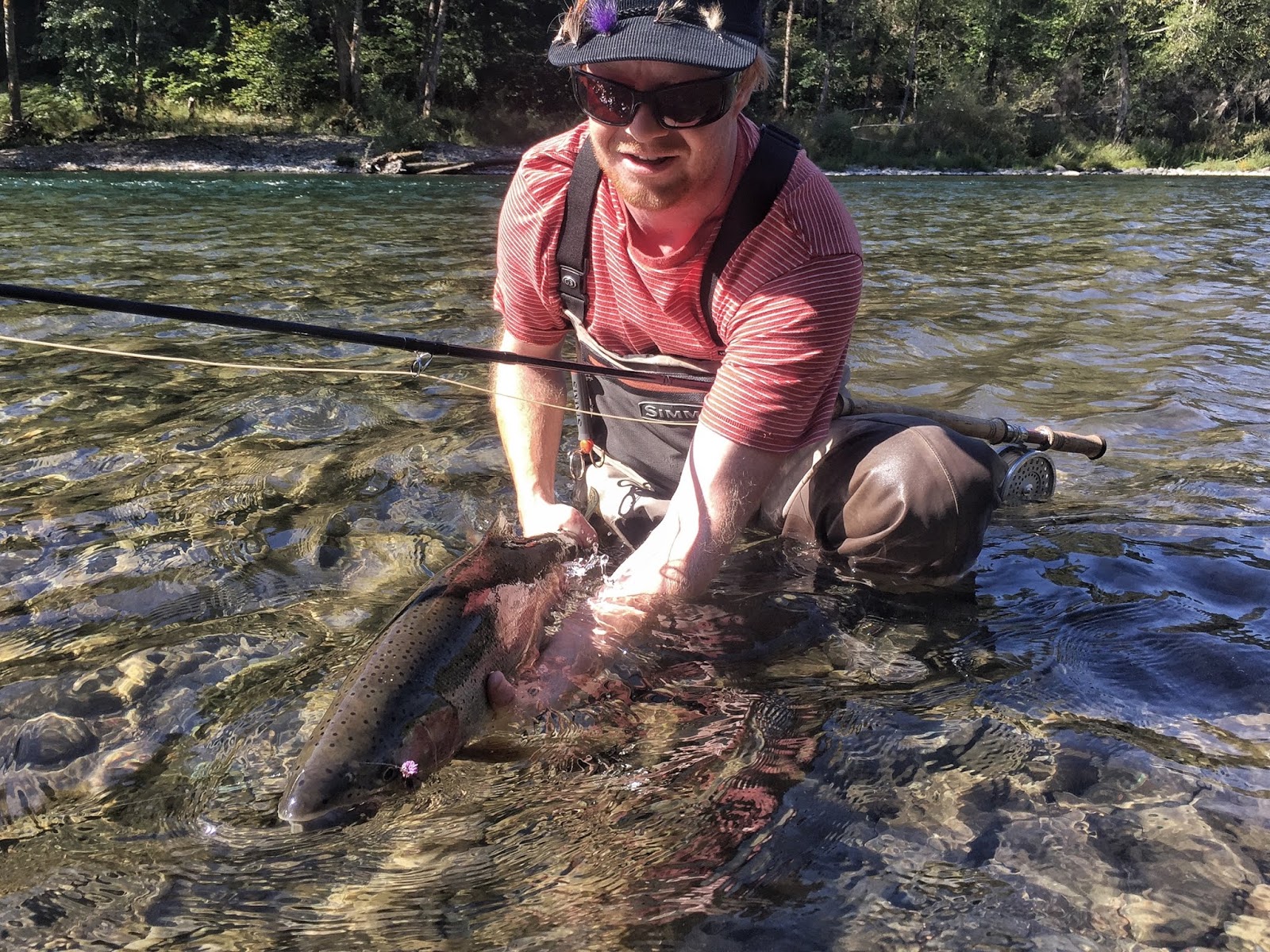
 Purple muddler and direct sunlight to break in the 7127's first fish.

There are a lot of options out there when it comes to choosing spey rods and many anglers will select their rods based on specific criteria. For the most part I believe the criteria to be- graphite technology, price, and fit/finish/aesthetics. Now when judging a book by its cover, Burkheimer rods tend to be the most coveted rods on the shelf as far as aesthetics go. They're simply beautiful. Burkheimer doesn't seem to pursue the graphite race as much as other companies such as Sage or G. Loomis, but that's okay with me as these rods have soul that you can truly feel. They tend to be in the upper price spectrum mostly due to the superior craftsmanship and attention to detail incorporated with each hand rolled rod.

Desert Steel taken on a 450gr. Scandi and 15' tapered leader. 

I've always wanted a Burkie, however never saw myself able to afford one as I was always the angler with leaky waders and hand-me-down gear. However, a couple years back I injured my foot fairly bad and now it's more metal than bone. During the long rehab process, I was unable to fish so I started saving up money that was typically spent on fishing trips. Locked away at home I kept dreaming of a rod/reel combo to replace my old wonky set-ups I'd cut my teeth on. Soon enough I was able to get out of the house able to wiggle a few Burkies (though we all know how much that tells us about a rod), but the bottom line was that it was one of the most beautiful rods I'd ever held. The first thing I notice about any rod is the grip- I can't stand big club-like corks, and I loved how Burkheimer incorporates contrasting inlays into their cork. The blank material itself was also slim and sleek unlike some other spey rods I've held. The rod felt super light in hand and I was already day dreaming of what the first fish caught on it would be like.
 When you riffle hitch a purple muddler be sure to hang on!

So I did what any steelhead junky would do so that I could sleep better at night and I bought the sucker. I've never looked back or regretted my decision since. I opted for the "presentation" model as I figured go big or go home, right? This model came with gorgeous cobalt blue graphite that's complemented by chrome guides, and high grade cork. Furthermore, the beautiful wood and bright nickle on the reel seat round out this particular rod's build, though you can certainly customize yours to fit any personal style. While I didn't have a proper reel for it yet, I was able to borrow a vintage Hardy that seemed to suite it just fine. I took it for a test run on a favorite river once I was able to cram a wading boot back on and immediately took notice of how pleasurable it was to cast. Single speys and snake rolls shined on this rod and it was a pure joy to fish all day long. I was also happily surprised at how much line I was able to cast- maybe it was the fresh running line, but I was comfortably getting a handful of extra strips while still feeling like I could push it more- astonishing, as this rod isn't considered a fast-action rod that are generally known for generating more line speed. In general, I find these moderate-fast actions of the Burkheimers much more comfortable to cast day in day out than other faster rods I've used. I even got to break it in on a nice summer-run steelie and a dry fly on its inaugural trip out!

 "Winter's Hope"- Potentially a fruitless endeavor. Dryline and winter-runs...

Over the years I've cast many different two-handers and this rod is still by far my favorite for fishing dry line.  In general, I find the moderate-fast actions of the Burkheimers more comfortable to cast day in day out than other faster rods. While I do tend to like faster action rods if I'm fishing for winter-runs with skagit heads and sink tips, but I've got a dedicated winter stick for those cold months when fish are sluggish and tips are necessary. However, I have fished it for winter-runs and it's handled big fish just fine. The grain window is rather large on Burkheimers as they tend to fit a wide variety of casting strokes. I've dialed in my scandi line preference to a 34' 450 grain with 15' tapered leaders for presentation casting, and if any wind comes up or I've got a big bushy dry fly on I'll opt for a 450 grain Rage looped to a 10' Polyleader and a few feet of Maxima. If I decide to fish skagit heads with this rod, I've found I liked a 480 grain Skagit Switch or 480 grain Skagit F.I.S.T. on it. I also like a 510 grain skagit compact head too that loads it nicely. 10 feet of T-11 is generally my bread-n-butter sink tip and it doesn't seem to have any problems with them. But again, this is my summer rod and it begs for dryline and riffle hitched flies! Since picking up this rod I've added another Burkheimer 7117-4 to the mix, which I thoroughly love for both skagit and scandi casting on smaller water and I am hoping to add the 8134-4 to the quiver for some water and fish up North. There's a reason folks are brand loyal with Burkheimer two-handers, and as soon as you cast one you'll quickly know why. 

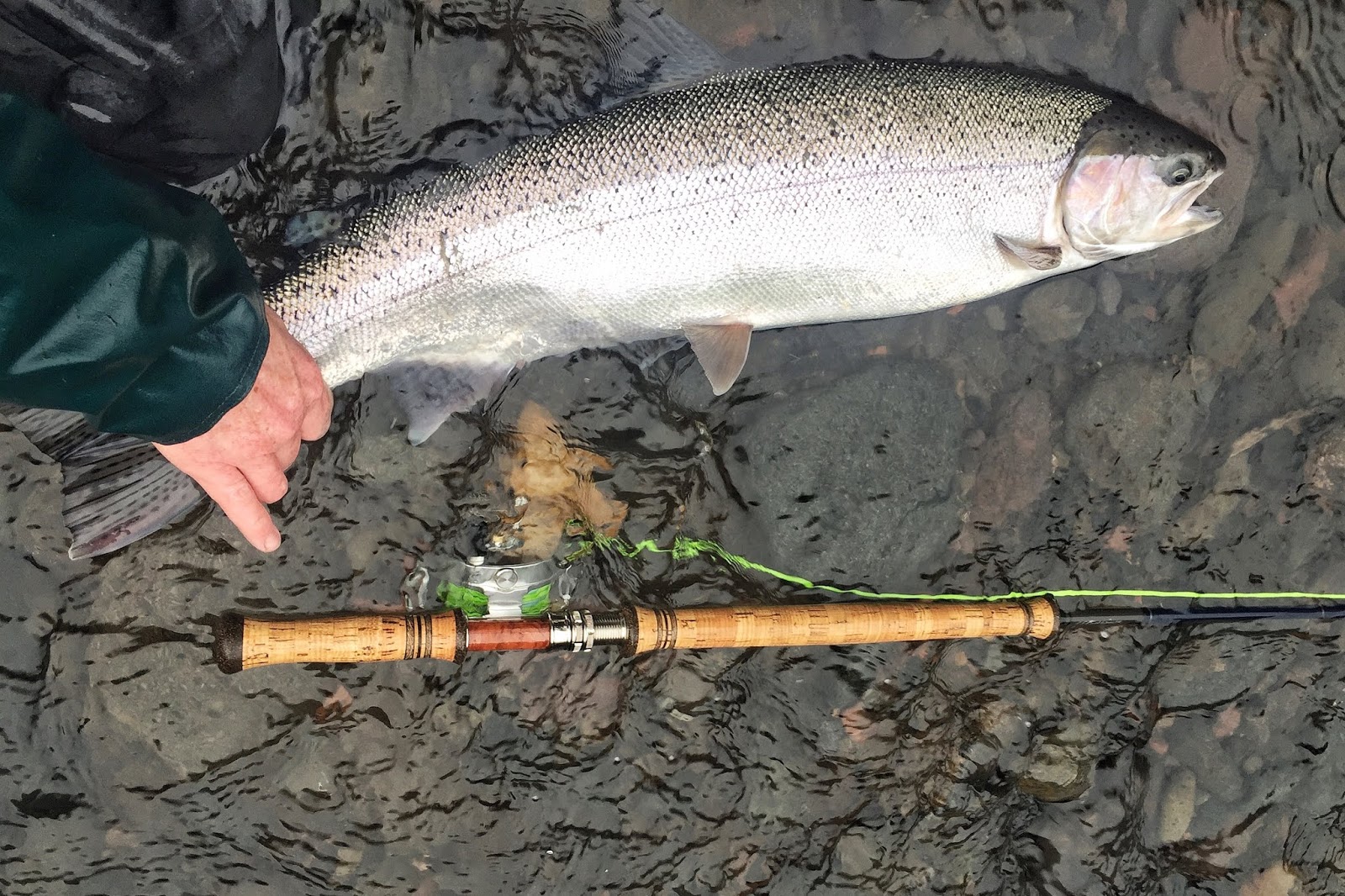
A winter hen found on the Oregon Coast with the 7127-4


Cody Booth
Gorge Fly Shop | Product Specialist
541.386.6977


"Fly Fish the World with Us"


Visit our Relaunched Steelhead Only Site

Shop Gorge Fly Shop & SteelheadBum.com

  © 'and' Steelhead.com Mike Prine 2009-2014

Back to TOP